


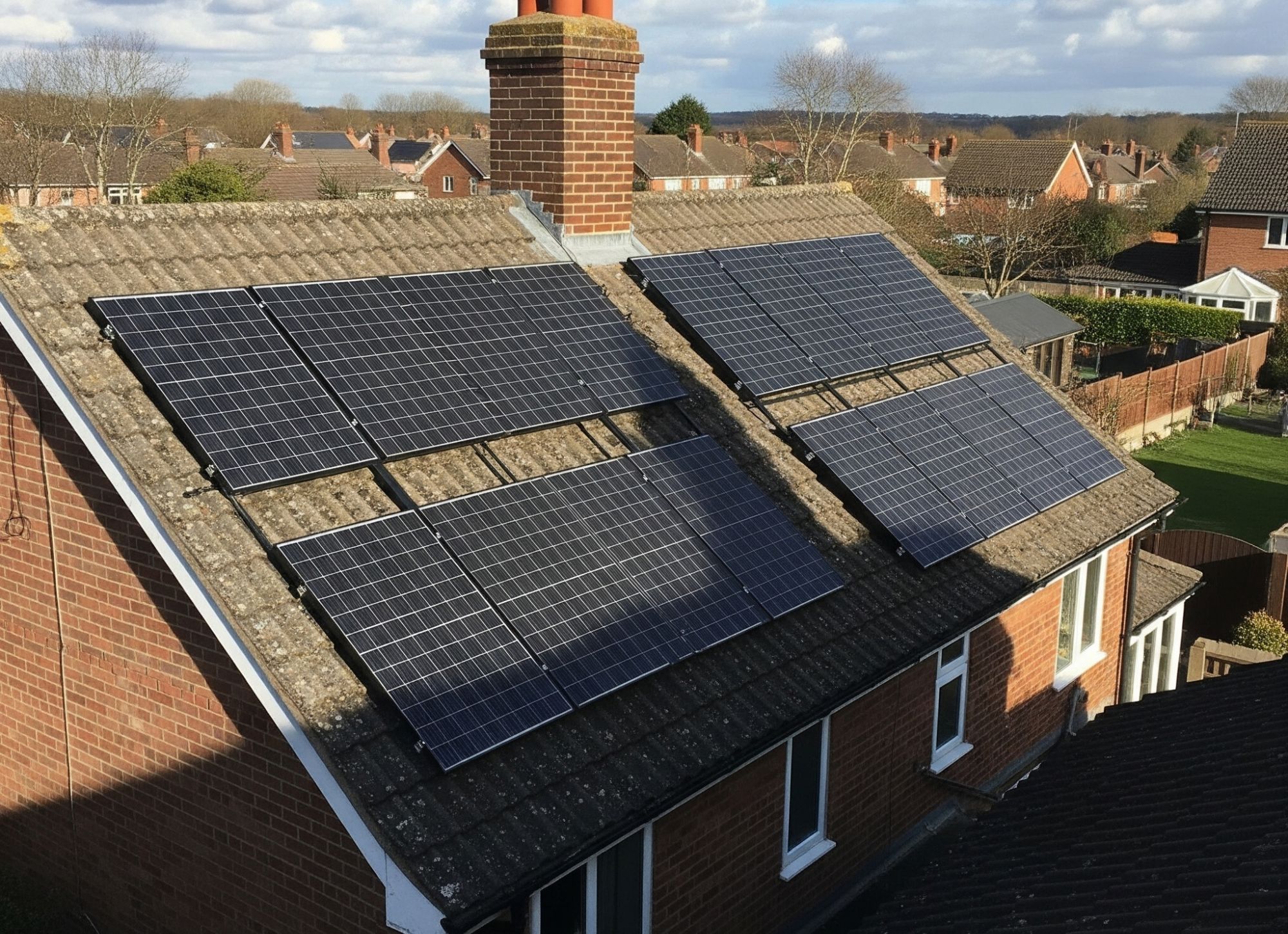
How Many Solar Panels Do I Need To Power a Refrigerator?
Knowing exactly how many solar panels you need to power a refrigerator is essential for designing a system that’s efficient, reliable, and cost-effective.
Whether you’re a homeowner or landlord, understanding your fridge’s energy requirements and how they translate into solar panel capacity will help you make an informed investment in renewable energy.
In this article, we’ll cover everything you need to know, including how to calculate the exact number of panels required, the costs, available installation options, and how to maximise your energy generation using battery storage.
How Many Solar Panels Are Needed To Power a Refrigerator?
You will need between 2 and 4 average-size solar panels (roughly 300 W each) to run a modern, energy-efficient fridge full time under typical UK sunlight conditions.
Key Considerations:
- Fridge energy consumption: A modern, energy-efficient fridge typically uses between 100 and 250 kWh per year, depending on size and model. This translates to approximately 0.27 to 0.68 kWh per day, according to the Energy Saving Trust.
For a 250-litre fridge, a realistic average daily consumption is around 0.45 kWh per day (450 Wh). - UK solar output: Depending on your location and orientation, a 300 W solar panel in the UK typically produces 0.9–1.2 kWh per day on average.
Different solar panel wattages produce varying daily outputs. Higher-wattage panels require fewer units to power the same appliance.
| Panel Wattage | Avg. Daily Output (UK) | Fridge Daily Demand (0.5 kWh) | Panels Needed |
|---|---|---|---|
| 200 W | 0.6–0.8 kWh | 0.5 kWh | 1 (ideal) → 2 for reliability |
| 300 W | 0.9–1.2 kWh | 0.5 kWh | 1 (ideal) → 2 for reliability |
| 400 W | 1.2–1.5 kWh | 0.5 kWh | 1 (ideal) → 1–2 for reliability |
Note: Always factor in system losses (10–20% due to inverter inefficiency, wiring, and shading) and seasonal variations. Oversizing your system ensures continuous fridge operation in winter months when solar output is lower.
For example:
- If you have a modern A+++ fridge, one 300 W panel might cover your needs in summer, but two will ensure consistent year-round performance.
- For an older or high-consumption fridge, you may need three or more panels to maintain continuous operation.
How to Calculate How Many Panels You Will Need to Power a Refrigerator?
You can use this simple, repeatable formula for any fridge and any panel size.
Daily Fridge Energy Use (kWh) ÷ [Panel Power (kW) × Peak Sun Hours (hours/day) × System Efficiency]
Daily fridge energy use (kWh) = how many kilowatt-hours your fridge consumes in a day (check the energy label, meter, or manufacturer spec, or measure it with a plug-in energy monitor).
Panel power (kW) = panel wattage ÷ 1000 (so a 300 W panel = 0.300 kW).
Peak sun hours = average equivalent full-sun hours per day for your location (UK typical range ≈ 2.5–3.5; use a local solar map or PV tool for accuracy).
System efficiency (derate factor) = accounts for inverter losses, wiring, shading, soiling etc. Use 0.75–0.85 (I use 0.80 as a conservative default).
Step-by-step (300 W panel example)
- Panel size = 300 W → panel power = 300 ÷ 1000 = 0.300 kW.
- Peak sun hours (UK average, conservative) = 3.0 hours/day.
- System efficiency (derate) = 0.80 (i.e. 20% losses).
- Calculate daily energy each 300 W panel generates (before losses):
Panel energy (kWh/day) = panel power (kW) × peak sun hours
0.300 × 3.0 = 0.900 kWh/day - Apply system efficiency (to allow for inverter & other losses):
Effective energy per panel = panel energy × system efficiency
0.900 × 0.80 = 0.720 kWh/day (usable). - Divide fridge daily use by usable panel output to get panels required:
Panels required = fridge daily kWh ÷ 0.720
Example: if fridge uses 0.60 kWh/day:
0.60 ÷ 0.720 = 0.8333 panels, round up to 1 panel.
Accounting for batteries (optional)
If you plan to store energy in a battery, include battery round-trip losses. Typical battery round-trip efficiency is ~90% (0.90). Multiply system efficiency by battery efficiency:
- New effective efficiency = 0.80 × 0.90 = 0.72.
So with a battery, effective energy per 300 W panel = 0.900 × 0.72 = 0.648 kWh/day. That increases the number of panels needed.
Example: fridge 0.60 kWh/day with battery:
- Panels = 0.60 ÷ 0.648 = 0.9259, round up to 1 panel, but you’ll probably want extra margin for winter/backups.
Recommended safety margins
- Always round up to the next whole panel.
- Add a winter/poor weather margin of 25–50% (multiply fridge daily kWh by 1.25–1.5) if you need guaranteed year-round off-grid performance or want to cover extended cloudy periods.
- For mission-critical loads (fridge in holiday lets, medical refrigeration) consider larger margins or dedicated battery backup.
What Factors Affect the Number of Solar Panels Needed to Power a Refrigerator?
Several important factors influence how many solar panels are required to reliably power a refrigerator. Understanding these variables helps homeowners, landlords, and commercial property owners design systems that are both efficient and cost-effective.
1. Energy Consumption of the Refrigerator
The fridge’s energy use is the primary determinant of panel requirements. Modern, energy-efficient models (such as A+++ rated fridges) consume significantly less power, around 0.4 to 0.6 kWh per day compared to older or larger fridges, which can use over 1 kWh daily.
Features such as frost-free technology, ice dispensers, and larger capacities increase consumption, thereby increasing the number of panels needed.
2. Solar Panel Wattage and Efficiency
Solar panels come in different wattages, typically ranging from 200W to 400W for domestic use. Higher wattage panels generate more electricity per unit, reducing the number of panels needed but often at a higher upfront cost.
Panel efficiency, which measures how well a panel converts sunlight into electricity, also affects output.
3. Geographical Location and Solar Irradiance
The UK’s solar irradiance varies significantly by region. Southern England and South Wales enjoy higher average peak sun hours compared to northern parts of the UK.
More sunlight means each panel produces more electricity daily, potentially reducing the number of panels needed. Location-specific solar data should be considered when sizing your system.
4. Roof Orientation and Shading
South-facing roofs capture the most sunlight, improving panel output. East or west-facing roofs receive less direct sunlight, which can increase the number of panels required to compensate for lower daily generation.
Additionally, shading from nearby trees, buildings, or chimneys can reduce panel efficiency, requiring extra panels to meet energy needs.
5. System Losses and Efficiency Factors
Real-world solar systems face energy losses through inverter inefficiency, wiring resistance, dust, and panel degradation over time. Typically, a derate factor of 10–20% is applied to account for these losses. This means you need to install more panels than a simple energy calculation might suggest to ensure reliable power delivery.
6. Use of Battery Storage
Incorporating a battery allows excess energy generated during the day to be stored and used when sunlight is insufficient (e.g., at night or during overcast weather).
While batteries improve system reliability, they introduce round-trip efficiency losses (usually around 10%), which can increase the number of panels required to maintain continuous refrigerator operation.
7. Future Energy Needs and Expansion
If you plan to add more solar-powered appliances or increase your energy consumption in the future, it makes sense to oversize your system slightly at the outset. This forward planning avoids costly upgrades later and ensures your solar array can handle evolving household or business demands.
How Much Do Solar Panels Cost to Run a Refrigerator?
On average, a 300-watt solar panel costs between £150 and £200, while a 400-watt panel typically ranges from £200 to £250 before installation.
Including installation, the total cost usually rises to about £250–£330 for a 300W panel and £320–£400 for a 400W panel.
While these costs provide a baseline, the upfront investment can vary significantly depending on panel wattage, brand, and the complexity of the installation.
Running a refrigerator on solar power remains one of the most cost-effective ways to reduce electricity bills and lower your carbon footprint.
Approximate Cost of Solar Panels Suitable to Power a Refrigerator
| Panel Wattage | Approximate Cost per Panel (£) | Typical Installation Cost per Panel (£) | Total Cost per Panel Installed (£) |
|---|---|---|---|
| 200 W | £100 – £140 | £80 – £110 | £180 – £250 |
| 250 W | £130 – £170 | £90 – £120 | £220 – £290 |
| 300 W | £150 – £200 | £100 – £130 | £250 – £330 |
| 350 W | £180 – £220 | £110 – £140 | £290 – £360 |
| 400 W | £200 – £250 | £120 – £150 | £320 – £400 |
Note: These costs are estimates based on recent UK market pricing and typical installation fees. Prices may vary depending on supplier, brand, and installation complexity.
Factors Affecting Cost
- Panel Wattage: Higher wattage panels cost more but may reduce the total number of panels needed.
- Installation Complexity: Labour, mounting hardware, electrical work, and permits influence overall expenses.
- System Size: Although powering a fridge alone requires a small system, most households install solar panels to cover wider energy needs.
- Geographic Location: Prices can fluctuate across Southern England, Greater London, South West England, and South Wales due to regional market differences.
How Much Can You Save Using Solar Panels to Run a Refrigerator?
You can typically save around £5 per month and over £60 per year on electricity costs by powering your refrigerator with solar panels, depending on your system size and local energy prices.
A typical UK household fridge uses about 0.5 kWh per day, which translates to roughly 15 kWh per month. With the average UK electricity price around 34p per kWh (according to Ofgem), the monthly and annual savings can add up:
| Energy Consumption | Monthly kWh | Monthly Cost (£) | Annual Cost (£) |
|---|---|---|---|
| Fridge (0.5 kWh/day) | 15 | £5.10 | £61.20 |
The exact amount saved depends on:
- The number and wattage of your solar panels.
- How much energy your system generates and uses on-site.
- The system’s performance through the year, including seasonal variations.
| Number of Panels | Est. Monthly Savings (£) | Est. Annual Savings (£) |
|---|---|---|
| 1 (300 W panel) | £5.00 | £60.00 |
| 2 (300 W panels) | £10.00 | £120.00 |
| 2 (400 W panels) | £13.50 | £162.00 |
| 3 (300 W panels) | £15.00 | £180.00 |
These figures assume that the energy produced by the panels is used directly to power the fridge, maximising self-consumption and savings.
Return on Investment (ROI)
The ROI on solar panels depends on your initial investment and the energy savings. For example, if a 300 W solar panel including installation costs around £300, and it saves you about £60 per year running a fridge:
- ROI period = £300 ÷ £60 = 5 years
Since solar panels typically have a lifespan of 25+ years, this means you can enjoy around 20 years of largely free electricity after recovering your initial costs.
How Much Space Will You Need for Solar Panels to Power a Refrigerator?
When designing a solar panel system to power a refrigerator, understanding the physical space requirements is just as important as calculating the number of panels.
The available roof space, type of installation, and alternative mounting options all affect how easily you can fit the right solar array on your property.
Roof Space Needed for Different Wattage Solar Panels
Solar panels typically measure around 1.7 m by 1 m (1.7 square metres), but the exact size can vary slightly depending on wattage and manufacturer.
| Panel Wattage | Approximate Size per Panel (m²) | Est. Roof Space for 2 Panels (m²) | Est. Roof Space for 4 Panels (m²) |
|---|---|---|---|
| 200 W | 1.6 | 3.2 | 6.4 |
| 250 W | 1.65 | 3.3 | 6.6 |
| 300 W | 1.7 | 3.4 | 6.8 |
| 350 W | 1.75 | 3.5 | 7.0 |
| 400 W | 1.8 | 3.6 | 7.2 |
For powering a typical refrigerator, 2 to 4 panels are usually sufficient, meaning you will require roughly 3.2 to 7.2 square metres of usable roof space, depending on panel wattage.
Roof Installation Types: In-Roof vs On-Roof
- In-Roof Installation: Panels are integrated flush with the roof covering, creating a sleek, low-profile appearance. This method is aesthetically pleasing but can be more expensive and complex to install.
- On-Roof Installation: Panels are mounted above the existing roof on racks or rails. This is the most common and cost-effective method, allowing for easier maintenance and flexibility in panel positioning.
Insights: Read our guide on in-roof vs on-roof solar installation to understand the differences between these two systems and which option to choose.
Horizontal and Vertical Installation
Solar panels can be installed either horizontally or vertically, depending on your roof’s dimensions and orientation. Horizontal installations are common on wide, low-pitched roofs and can simplify wiring, while vertical setups suit tall, narrow roofs. Both orientations perform similarly in terms of energy generation if correctly angled toward the sun.
Alternatives When Roof Space is Limited
If your roof space is insufficient or unsuitable due to shading or orientation, there are alternative mounting options to consider:
- Ground-Mounted Solar Panels: Provided you have enough land space, ground-mounted systems allow for flexible panel orientation and easier access for maintenance. They are ideal for larger properties and commercial sites.
- Wall-Mounted Solar Panels: For properties with limited roof area but exposed walls facing south or west, solar panels can be installed vertically on walls. Though less common, wall-mounted panels can supplement roof systems and increase total energy generation.
By evaluating your available space and choosing the right installation method, you can optimise your solar panel system to power your refrigerator efficiently.
For tailored advice and professional residential and commercial solar installation services in Southern England, request a free quote from EE Renewables today.
Are There Solar Panel Grants Available?
Yes, there are several government-backed schemes and grants designed to help reduce the cost of installing solar panels, particularly for eligible homeowners, landlords, and social housing providers in the UK.
ECO4 Scheme
The ECO4 scheme (Energy Company Obligation) offers free or subsidised energy efficiency improvements, including solar panel installations, for low-income households and vulnerable groups. The scheme runs until March 2026 and targets homes with lower Energy Performance Certificate (EPC) ratings, helping to reduce fuel poverty and carbon emissions.
Home Upgrade Grant (HUG)
The Home Upgrade Grant targets low-income, off-gas-grid homes in England, helping them install energy efficiency measures such as solar panels, insulation, and low-carbon heating systems. The HUG aims to reduce heating costs and improve home comfort while cutting carbon emissions.
Additional Financial Incentives
- Zero Percent VAT: Solar panel installations benefit from a 0% VAT rate, reducing the upfront cost compared to many other home improvements.
- Smart Export Guarantee (SEG): This scheme pays solar panel owners for excess electricity exported back to the grid, providing ongoing financial returns.
- Local Authority Flexibility: Some local councils offer tailored grants or interest-free loans to supplement national schemes, particularly in regions like Southern England, Greater London, South West England, and South Wales.
FAQs
How does seasonal variation affect the number of solar panels needed to power a refrigerator?
Seasonal changes in sunlight hours and weather impact solar panel output. During winter months, shorter days and cloud cover reduce energy generation, meaning you may need to oversize your system by 25-50% or include battery storage to maintain continuous refrigerator operation year-round.
Can solar panels power multiple appliances along with a refrigerator?
Yes, solar panel systems can be sized to cover multiple household appliances. When doing so, you need to calculate the total daily energy consumption of all devices and adjust the number of panels accordingly to meet the combined demand reliably.
What maintenance is required to keep solar panels running optimally for powering appliances?
Solar panels require minimal maintenance. Keeping panels clean and free from debris or shading helps maintain peak efficiency. Regular checks (annually or bi-annually) by a professional can ensure the system continues to operate efficiently over its lifespan.
Our Verdict
For a modern, energy-efficient model, 2–4 × 300 W panels generally ensure reliable, year-round operation. Factors like fridge model, usage, system design and location all influence the final number. For precise sizing, tailored installation, and reliable performance across Southern England, EE Renewables is ready to help. Request your free, location-specific quote, and start harnessing solar energy.
