


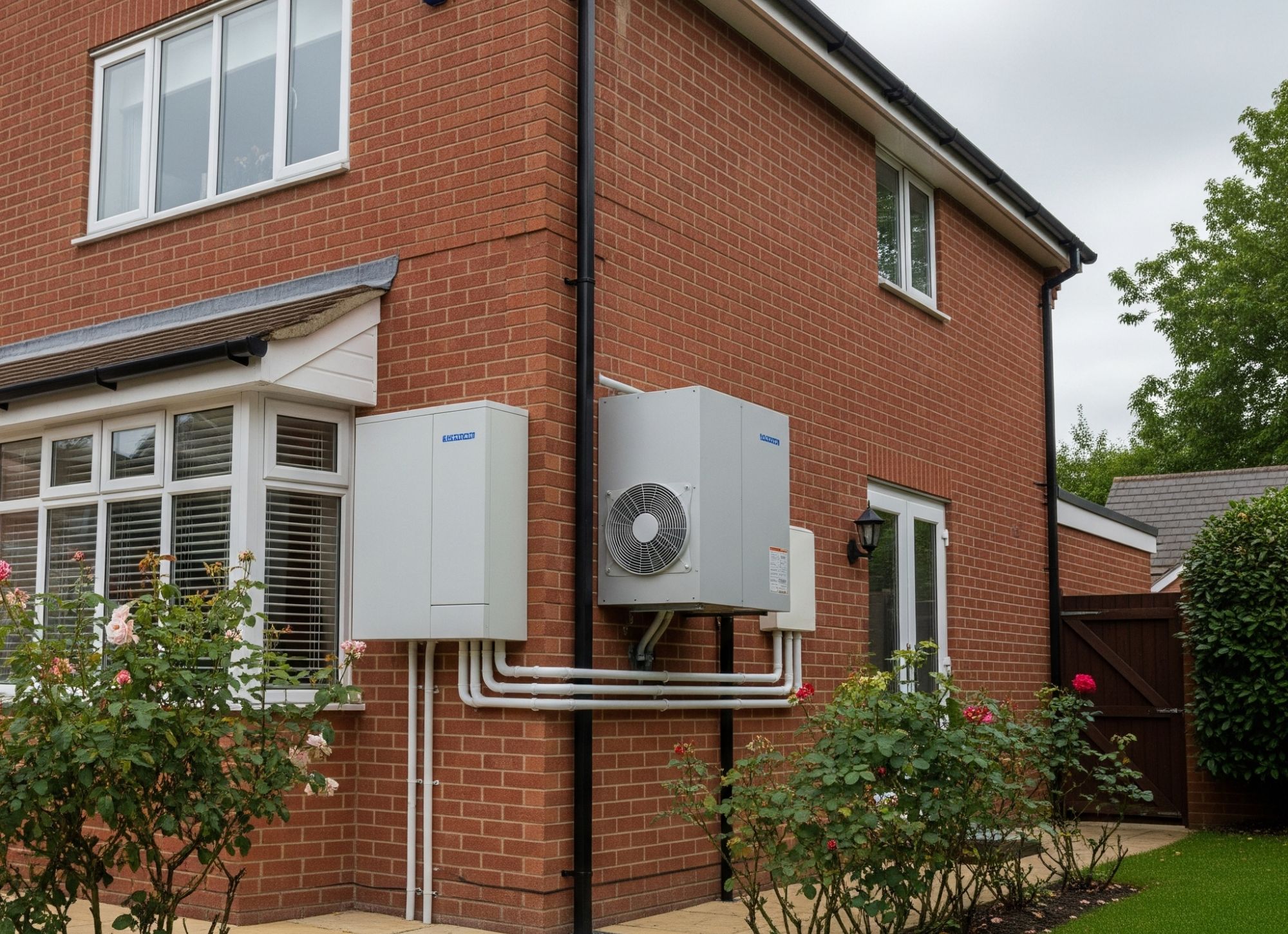
Can Air Source Heat Pumps Cool Your Home?
The short answer is yes, many reversible air source heat pumps (ASHPs) can provide effective cooling during hotter UK summers, while also delivering heating in winter. This dual functionality turns them into a smart, sustainable investment for reducing energy bills and carbon emissions.
As heatwaves become more frequent in regions like Southern England and Greater London, understanding this cooling capability helps homeowners, landlords, and eco-conscious families make informed decisions about renewable heating and cooling systems.
How do air source heat pumps cool your home?
Air source heat pumps can cool your home by operating in reverse mode, extracting warm air from indoors and releasing it outside, much like a refrigerator works in reverse for heating.
This process, known as active cooling or reversible operation, is available in many modern ASHP models, particularly air-to-air systems, which distribute cool air via fans or ducts.
Here’s a step-by-step explanation of how an air source heat pump works to cool your property:
- Absorbing Indoor Heat: The indoor unit’s evaporator coil absorbs heat from the warm air inside your home, using a refrigerant that evaporates at low temperatures.
- Compressing the Refrigerant: The compressor increases the pressure and temperature of the refrigerant gas, preparing it for heat release.
- Releasing Heat Outdoors: The hot refrigerant travels to the outdoor unit’s condenser coil, where it releases the absorbed heat into the outside air, aided by a fan.
- Expanding and Cooling: The refrigerant then passes through an expansion valve, dropping in pressure and temperature, ready to cycle back indoors.
- Distributing Cool Air: Cooled air is circulated through your home via air handlers, ducts, or underfloor systems, lowering the room temperature efficiently.
This cycle relies on electricity but uses far less than traditional resistive cooling methods. According to the Energy Saving Trust, reversible heat pumps can achieve efficiencies of 250-350% (COP 2.5-3.5) in cooling mode, meaning for every unit of electricity used, they provide 2.5-3.5 units of cooling.
In urban flats in London or Bristol, where space is limited, this low-profile system avoids the need for bulky external AC units that might violate planning rules.
What are the pros and cons of using an air source heat pump for cooling?
Using air source heat pumps for cooling offers several advantages and drawbacks, ideal for landlords in Bristol student housing seeking energy-efficient upgrades.
| Pros | Cons |
|---|---|
| Energy-efficient operation, often 300%+ COP, reducing bills compared to electric AC. | Higher initial investment than standalone AC units. |
| Dual heating and cooling in one unit, saving space in compact Cardiff Bay flats. | Less effective in extreme heat above 35°C, common in rare UK heatwaves. |
| Low carbon emissions, aligning with Future Homes Standard for new-builds in Swindon. | Requires good insulation for optimal performance in older Weston-super-Mare homes. |
| Quiet operation and long lifespan (15-20 years) with minimal maintenance. | Potential need for system modifications, like adding ducts. |
| Eligible for grants like the Boiler Upgrade Scheme, lowering upfront costs. | Electricity-dependent, so costs fluctuate with tariffs. |
Can an air source heat pump cool every room in your home?
An air source heat pump can cool every room in your home if integrated with a suitable distribution system, such as ductwork, fan coils, or underfloor cooling. For retirees in South Coast towns like Eastbourne or Torquay, this means even multi-room properties can achieve uniform cooling without multiple units.
However, effectiveness depends on insulation, layout, and system design. In Greater London apartments, where space constraints are common, multi-split air-to-air ASHPs can target individual rooms. According to the Heat Pump Association, proper zoning ensures even cooling distribution, with efficiencies reaching up to 350% (COP 3.5) in well-insulated homes.
What size air source heat pump is needed to cool different sized homes and flats?
The size of air source heat pump needed to cool your home or flat depends on factors like property size, insulation, and local climate, typically measured in kilowatts (kW).
For a standard 100m² three-bedroom house in Oxford or Southampton, a 5kW ASHP is often sufficient for cooling, while a 200m² family home in Bristol might require 10kW.
Here’s a table outlining recommended sizes based on UK property types for cooling, assuming average insulation and UK summer loads (5-10W/m²):
| Property Type | Approximate Size | Recommended ASHP Output (kW) for Cooling | Example Regions |
|---|---|---|---|
| Flats | |||
| Studio Flat | Up to 40m² | 3-4kW | London studios, Cardiff city flats |
| 1-Bedroom Flat | 40-70m² | 4-5kW | Bristol apartments, Swansea rentals |
| 2-Bedroom Flat | 70-100m² | 5-7kW | Greenwich high-rises, Southwark conversions |
| Houses | |||
| 1-Bedroom House | Up to 60m² | 3-5kW | Oxford cottages, Portsmouth bungalows |
| 2-Bedroom House | 60-100m² | 5-7kW | Brighton terraces, Newport semis |
| 3-Bedroom House | 100-150m² | 6-9kW | Southampton family homes, Exeter townhouses |
| 4-Bedroom House | 150-200m² | 8-11kW | Bournemouth detached, Swindon executives |
| 5-Bedroom House | 200-300m² | 10-15kW | Dorset country homes, Cardiff Bay villas |
These estimates assume average insulation; the Energy Saving Trust recommends a professional heat loss calculation for precise sizing. Oversizing can lead to inefficiency, while undersizing may not cool adequately during peaks.
For residents in Southern England, Greater London, South West England, and South Wales, where hotter summers increase cooling demand, EE Renewables offers expert air source heat pump installations tailored to your needs. Get in touch today for a free quote on a system suited to your location across these regions.
How much does an air source heat pump cost for cooling your home?
An air source heat pump costs between £8,000 and £15,000 for supply and installation in a typical UK home, with cooling-capable models at the higher end due to reversible features. After the £7,500 Boiler Upgrade Scheme grant, net costs can drop to £500-£7,500.
For eco-conscious households in Devon or Somerset, additional factors like ductwork might add £1,000-£3,000. According to Ofgem, grants make ASHPs accessible, with average installations recouping costs through savings.
To help you budget effectively, here’s a table showing estimated costs for different property types, based on recommended ASHP sizes for cooling. These figures include supply and full installation for reversible (cooling-enabled) systems and assume average UK insulation levels; prices can vary by location, brand, and extras like radiator upgrades (2025 data).
| Property Type | Recommended ASHP Output (kW) for Cooling | Estimated Total Cost (Supply & Installation) | Net Cost After £7,500 Grant | Example Regions |
|---|---|---|---|---|
| Flats | ||||
| Studio Flat | 3-4kW | £8,000 – £10,000 | £500 – £2,500 | London studios, Cardiff city flats |
| 1-Bedroom Flat | 4-5kW | £9,000 – £11,000 | £1,500 – £3,500 | Bristol apartments, Swansea rentals |
| 2-Bedroom Flat | 5-7kW | £10,000 – £12,000 | £2,500 – £4,500 | Greenwich high-rises, Southwark conversions |
| Houses | ||||
| 1-Bedroom House | 3-5kW | £9,000 – £11,000 | £1,500 – £3,500 | Oxford cottages, Portsmouth bungalows |
| 2-Bedroom House | 5-7kW | £10,000 – £12,000 | £2,500 – £4,500 | Brighton terraces, Newport semis |
| 3-Bedroom House | 6-9kW | £11,000 – £13,000 | £3,500 – £5,500 | Southampton family homes, Exeter townhouses |
| 4-Bedroom House | 8-11kW | £12,000 – £15,000 | £4,500 – £7,500 | Bournemouth detached, Swindon executives |
| 5-Bedroom House | 10-15kW | £14,000 – £18,000 | £6,500 – £10,500 | Dorset country homes, Cardiff Bay villas |
How much electricity does an air source heat pump use to cool your home?
An air source heat pump uses about 6-10 kWh of electricity per day for cooling an average 8kW system in mild UK summers, equating to 180-300 kWh monthly. In warmer regions like Portsmouth or Bournemouth, usage might rise to 12-15 kWh daily during heatwaves.
Compared to heating mode, cooling often consumes less due to smaller temperature differentials. The Department for Energy Security and Net Zero (DESNZ) reports that efficient ASHPs achieve a Coefficient of Performance (COP) of 2.5-3.5 in cooling, meaning low running costs of £0.50-£0.80 per hour at current electricity rates (24p/kWh).
What is the roi and payback period for an air source heat pump used for home cooling?
The ROI for an air source heat pump used for home cooling can reach 4-8% annually through energy savings, with a payback period of 7-15 years depending on grants and usage. In South Wales rental properties in Newport, combining heating and cooling savings accelerates returns.
For a £12,000 installation (post-grant), annual savings of £300-£600 on bills yield a 8-12 year payback. According to Nesta, with rising energy prices, ROI improves, especially for dual-purpose systems replacing both boilers and AC.
Can air source heat pumps work with existing air conditioners?
Air source heat pumps can work alongside existing air conditioners, creating a hybrid system that optimises energy use for both heating and cooling.
For instance, in South Wales cities like Cardiff and Swansea, where newer developments incorporate renewable tech, pairing an ASHP with an AC unit allows the heat pump to handle mild cooling loads while the AC takes over during extreme heatwaves.
This integration often involves smart controls to switch between systems based on outdoor temperatures or energy prices.
According to GOV.UK, such hybrids can enhance overall system efficiency, especially in homes transitioning to low-carbon solutions. However, compatibility depends on your setup. Consult an MCS Certified installer to ensure seamless operation without redundancy.
Do you still need an air conditioner if you have an air source heat pump?
You may not need a separate air conditioner if your air source heat pump is reversible and sized appropriately, as it can handle both heating and cooling duties effectively. In coastal areas of South West England, like Cornwall or Dorset, where humid summers are common, a well-designed ASHP can maintain comfortable indoor temperatures without additional AC.
That said, in very large homes or during prolonged heatwaves in Southern towns like Brighton or Portsmouth, supplementary AC might be beneficial for zoned cooling. The Energy Saving Trust notes that standalone ASHPs can reduce reliance on traditional AC by up to 100% in suitable properties, cutting overall energy consumption.
How do air source heat pump running costs compare to air conditioners?
Air source heat pump cooling running costs are often lower than traditional air conditioners, with ASHPs costing £200-£600 annually versus £300-£800 for AC in similar usage, making ASHPs better for year-round efficiency. In commercial spaces in Southampton, ASHPs excel due to their heating bonus.
The Energy Saving Trust highlights that ASHPs’ higher COP (3-4) versus AC’s (2-3) drives savings of 20-40% on cooling alone.
For a clearer breakdown, here’s a table comparing estimated annual running costs for cooling a typical UK property during summer months (assuming 500-1,000 hours of operation at current electricity rates of around 24p/kWh).
Costs vary by system size, efficiency, and usage, but ASHPs consistently outperform standalone AC units due to their superior energy transfer (20-30% savings).
| Property Type | ASHP Running Cost (Annual, Cooling Only) | AC Running Cost (Annual, Cooling Only) | Estimated Annual Savings with ASHP | Key Efficiency Factor (COP) |
|---|---|---|---|---|
| Flats | ||||
| Studio Flat | £200 – £300 | £300 – £450 | £100 – £150 | ASHP: 3.0 / AC: 2.5 |
| 1-Bedroom Flat | £250 – £350 | £350 – £550 | £100 – £200 | ASHP: 3.0 / AC: 2.5 |
| 2-Bedroom Flat | £300 – £450 | £450 – £650 | £150 – £200 | ASHP: 3.0 / AC: 2.5 |
| Houses | ||||
| 1-Bedroom House | £250 – £350 | £350 – £550 | £100 – £200 | ASHP: 3.0 / AC: 2.5 |
| 2-Bedroom House | £300 – £450 | £450 – £650 | £150 – £200 | ASHP: 3.0 / AC: 2.5 |
| 3-Bedroom House | £350 – £550 | £550 – £750 | £200 – £250 | ASHP: 3.5 / AC: 3.0 |
| 4-Bedroom House | £450 – £650 | £650 – £850 | £200 – £300 | ASHP: 3.5 / AC: 3.0 |
| 5-Bedroom House | £550 – £750 | £750 – £1,050 | £200 – £300 | ASHP: 3.5 / AC: 3.0 |
The Energy Saving Trust highlights that ASHPs’ higher COP (3.0-3.5) versus AC’s (2.5-3.0) drives savings of 20-30% on cooling alone.
Can pairing an air source heat pump with air conditioning save you money?
Pairing an air source heat pump with air conditioning can save you money by optimising loads, potentially reducing annual costs by £100-£300 through hybrid efficiency. For housing associations in Croydon, this setup handles base cooling with ASHP and peaks with AC.
According to the Centre for Sustainable Energy (CSE), savings reach 15-25% in mixed systems.
To illustrate the potential benefits, here’s a table showing estimated annual savings when combining an ASHP for base-load cooling with a supplementary AC unit for high-demand periods (e.g., heatwaves).
These figures assume moderate UK summer usage (500-800 cooling hours total), with the ASHP covering 70-80% of needs and AC handling peaks. Savings are calculated against standalone AC costs, factoring in hybrid efficiency gains (10-20%).
| Property Type | Standalone AC Annual Cost | Hybrid System Annual Cost (ASHP + AC) | Estimated Annual Savings | Percentage Savings | Ideal for Regions |
|---|---|---|---|---|---|
| Flats | |||||
| Studio Flat | £300 – £450 | £250 – £350 | £50 – £100 | 10-20% | London studios, Cardiff city flats |
| 1-Bedroom Flat | £350 – £550 | £280 – £400 | £70 – £150 | 15-25% | Bristol apartments, Swansea rentals |
| 2-Bedroom Flat | £450 – £650 | £350 – £500 | £100 – £150 | 15-25% | Greenwich high-rises, Southwark conversions |
| Houses | |||||
| 1-Bedroom House | £350 – £550 | £280 – £400 | £70 – £150 | 15-25% | Oxford cottages, Portsmouth bungalows |
| 2-Bedroom House | £450 – £650 | £350 – £500 | £100 – £150 | 15-25% | Brighton terraces, Newport semis |
| 3-Bedroom House | £550 – £750 | £400 – £550 | £150 – £200 | 20-30% | Southampton family homes, Exeter townhouses |
| 4-Bedroom House | £650 – £850 | £450 – £650 | £200 – £250 | 20-30% | Bournemouth detached, Swindon executives |
| 5-Bedroom House | £750 – £1,050 | £550 – £750 | £200 – £300 | 20-30% | Dorset country homes, Cardiff Bay villas |
How an air source heat pump used for cooling can cut your carbon emissions
Using an air source heat pump for cooling can cut your carbon emissions by transferring heat efficiently rather than generating it, reducing your household’s footprint by 50-65% compared to gas-based systems. In eco-focused areas like Cornwall, this supports net-zero goals.
The Department for Energy Security and Net Zero (DESNZ) states that ASHPs save around 1.4 tonnes of CO2 annually per home when replacing fossil fuel alternatives.
FAQs
Are air source heat pumps noisy when in cooling mode?
Air source heat pumps in cooling mode produce noise levels around 40-60 decibels, similar to a quiet conversation, but planning permissions may require placement away from neighbours in dense areas like London.
How does weather affect air source heat pump cooling performance?
In humid UK weather, air source heat pumps maintain cooling efficiency better than dry climates, but performance dips slightly below 10°C outdoors, which is rare in summer.
Can air source heat pumps provide dehumidification while cooling?
Yes, air source heat pumps naturally dehumidify air during cooling by condensing moisture on coils, improving indoor air quality in coastal regions like Dorset.
What maintenance is required for air source heat pump cooling function?
Annual checks by MCS Certified technicians, including filter cleaning and refrigerant levels, ensure optimal cooling, costing £100-£200 yearly.
Are there tax incentives for installing cooling-capable air source heat pumps?
Beyond grants, 0% VAT applies to energy-saving materials like ASHP installations until March 2027, potentially saving 20% on qualifying UK properties.
Final thoughts
Air source heat pumps offer a versatile, low-carbon solution for cooling alongside heating, with potential savings, grants, and environmental benefits making them a worthwhile investment for UK properties.
By considering size, costs, and integration options, you can achieve year-round comfort while supporting sustainability goals. For personalised advice, reach out to EE Renewables for your free quote today.
