


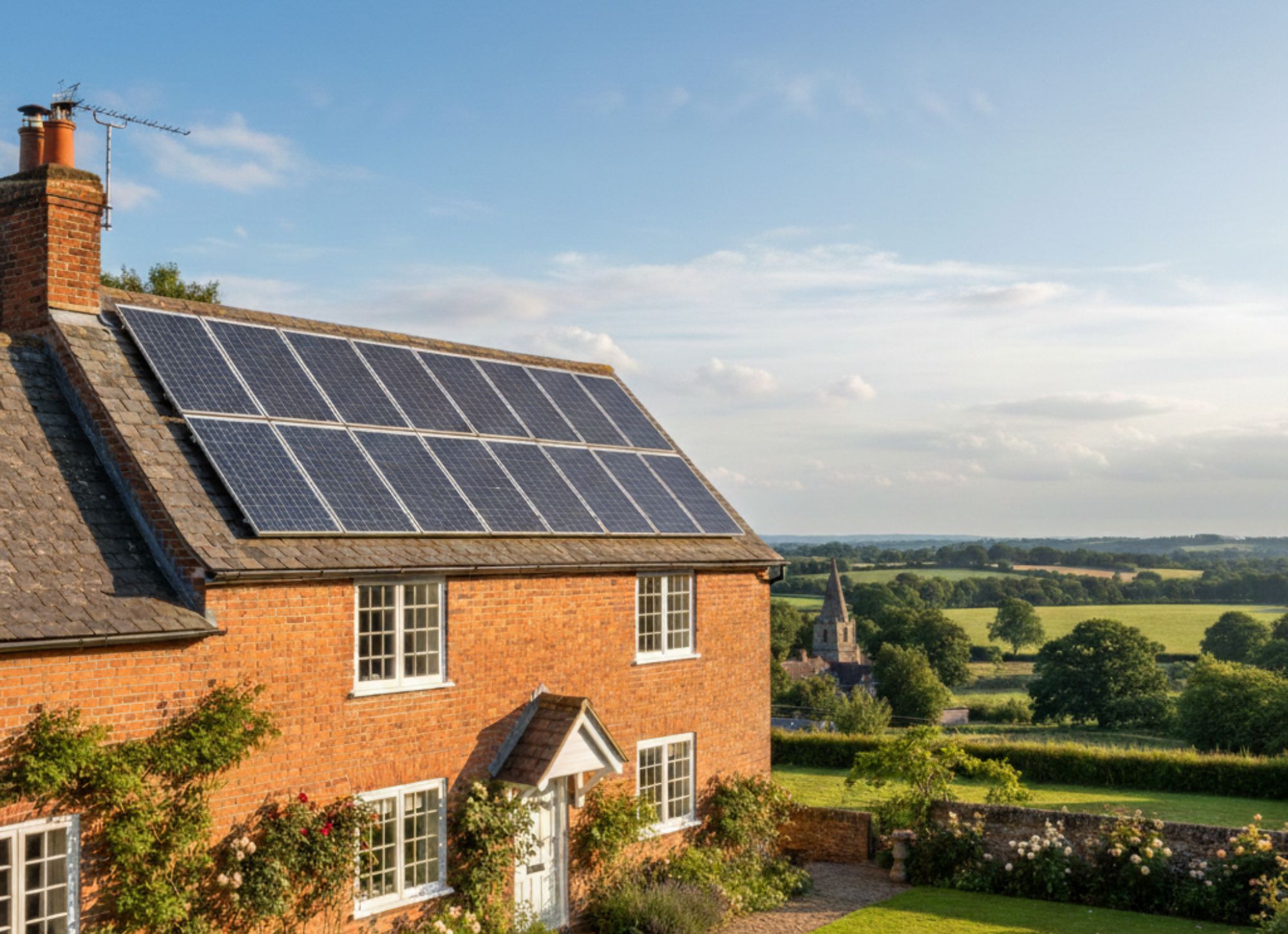
How Many Solar Panels Do I Need? Homeowners Guide
The number of solar panels you will need usually falls between 8 and 12 for the typical UK home that wants to cover most or all of its electricity bill. That range works well for average family houses using 2,700–4,100 kWh a year.
But the exact number that’s right for you depends on a few factors such as:
- how much electricity your household actually uses each year.
- how much sunlight your roof gets.
- which direction your roof faces.
- how efficient the panels are, and whether you want to cover 50% of your bill, 100%, or even generate extra to sell back to the grid.
In this guide I’ll walk you through everything step by step so you can work out the right number for your own home. We’ll look at simple calculations you can do yourself, real-life examples for different property sizes, the main factors that change the number, roof and location differences across the UK, and what it means for cost and savings.
By the end you’ll have a clear idea of how many panels make sense for you.
How Many Solar Panels Do I Need for My Property?
The exact number of solar panels you will need for your property depends on annual electricity usage, desired offset level, solar panel efficiency (typically 350-450W per panel), and local sunlight.
Tip: Aim for a system generating at least 850-1,000kWh per kW yearly in the UK. For partial bill offset (50-70%), fewer panels suffice, while full elimination of your electricity bill requires more to match 100% consumption plus surplus for export.
Below is a table based on average UK household electricity bills (from Ofgem data) for different property types. These examples assume standard 400W panels and typical generation (3,500-4,000kWh for a 4kW system in Southern England).
| Property Type | Avg. Annual Electricity Use (kWh) | Panels Needed for Partial Offset (50-70%) | Panels Needed for Full Offset (90-100%) | System Size (kW) Example |
|---|---|---|---|---|
| 1-Bed Flat | 1,800-2,000 | 4-6 | 6-8 | 2-3kW |
| 2-Bed Home | 2,000-2,700 | 6-8 | 8-10 | 3-4kW |
| 3-Bed Home | 2,700-3,500 | 8-10 | 10-12 | 4-5kW |
| 4-Bed Home | 3,500-4,100 | 10-12 | 12-14 | 5-6kW |
| 5+ Bed Home | 4,100-5,500+ | 12-14 | 14-16+ | 6kW+ |
These figures help match solar photovoltaic output to your needs. For example, a 3-bed home in Oxford (medium use) might start with 8 panels for partial offset, saving £400-£600 yearly, while full offset with 12 panels could eliminate bills entirely (plus SEG earnings of £150-£300).
How to Calculate the Number of Solar Panels Needed
If your goal is to eliminate your electricity bill completely (or even make a small profit), you need to size your solar system to produce 100% or slightly more than what your household uses in a full year. That usually means adding 2–4 extra panels compared to a partial system.
Why extra? Because in the UK the sun is stronger in summer and weaker in winter. You want enough panels to cover those darker months so your yearly total still matches or beats your usage. Any surplus power gets exported to the grid through the Smart Export Guarantee (SEG), which pays you 4–15p per kWh depending on your supplier.
For example:
- A typical 3–4 bedroom home in Bristol uses around 3,200–3,800 kWh per year.
- To cover 50–70% of that (a solid partial offset), you might need 8–10 panels (about 3.5–4 kW).
- To aim for full elimination (90–100%+), you’d usually go for 12–14 panels (5–6 kW). Those extra 2–4 panels help make sure you’re covered even on cloudy winter days.
The same logic applies everywhere. In sunnier spots like Brighton or Southampton you might need slightly fewer panels for the same coverage. In cloudier areas like parts of South Wales you might need one or two more to reach full offset.
Calculation:
To calculate the number of solar panels needed, divide your annual electricity use (kWh) by the expected yearly output per panel (typically 350-450kWh in the UK, depending on location and efficiency). Adjust for partial vs full offset by multiplying use by your target percentage (e.g., 0.5 for 50%).
For example, if your 3-bed home uses 3,000kWh yearly and you want 70% offset:
First, find needed generation = 3,000 x 0.7 = 2,100kWh.
Assuming 400kWh per panel, panels needed = 2,100 / 400 = 5.25 (round up to 6).
What Factors Affect The Number of Solar Panels Needed?
Several factors will influence the number of solar panels you will need. Here are the main ones:
Household Energy Consumption
The biggest factor is how much electricity you actually use each year. Look at your bills or smart meter readings. Low-use homes (around 2,000 kWh/year) might only need 6–8 panels.
High-use homes (4,000 kWh+ with kids, home working, electric car charging) often need 12–16 panels to cover everything properly.
Location and Sunlight Hours
Where you live makes a real difference. In sunnier parts of Southern England you get about 1,000 good sunlight hours a year, so you need fewer panels to produce the same amount of power.
In cloudier areas like parts of South Wales you get closer to 800 hours, so you usually need 2–4 more panels to hit the same output.
Roof Orientation and Tilt
Your roof direction and angle matter a lot. A south-facing roof tilted at 30–40 degrees is perfect . You’ll get the most power and need the standard number of panels (e.g. 10 for a 4 kW system).
East- or west-facing roofs produce 15–20% less power overall, so you typically need 20–30% more panels to make up for it.
Solar Panel Efficiency and Wattage
Not all panels are the same. Modern high-efficiency panels (22–25% efficient, around 450W each) let you cover the same electricity use with fewer panels, often 8–10 instead of 12–14.
Lower-efficiency panels (350W or less) mean you need more of them to reach the same output.
Roof Space and Layout Considerations
Your roof has to physically fit the panels you want. A standard panel is about 1.7 m long by 1 m wide (roughly 1.7 m² each). A decent south-facing roof with 25 m² of usable space can comfortably take 10–12 panels.
But things like chimneys, skylights, vents, or awkward shapes can eat into that space. In many London homes I see roofs that only allow 8–10 panels even if the energy need is higher. In those cases people often choose higher-wattage panels to get more power from fewer units.
Shading from trees or neighbouring buildings also matters. Even partial shade on one panel can reduce output. That’s why many people add power optimisers to get the most from the panels they can fit.
Future Energy Needs
Think ahead for a moment. Planning to get an electric car?
Thinking about a heat pump for heating?
Both add a lot of extra electricity use, sometimes 2,000–4,000 kWh more per year.
If you expect that in the next few years, it’s usually smart to add 4–6 extra panels now so your system is ready without having to come back and add more later.
What Are the Cost Implications of More Solar Panels?
More solar panels do cost more upfront, but they also give better value per pound spent. A 10-panel 4 kW system usually costs £6,000–£8,000 installed. Going up to 14 panels (around 6 kW) might cost £8,000–£10,000.
The good news? Larger systems often have a lower cost per kW (you pay less per unit of power produced).
They also give you faster payback and bigger savings because you generate and use more free electricity, plus you earn more from exporting surplus power through the Smart Export Guarantee.
Need a Solar Panel Installation Quote?
EE Renewables Ltd provides expert solar panel installation across Southern England, Greater London, South West England, and South Wales including London, Brighton, Oxford, Southampton, Bristol, and Cardiff. Contact us today for a free quote and get the perfect system size for your home.
FAQs
How Does Roof Material Affect Panel Count?
Roof material like slate or tile can limit panel count due to weight restrictions (150-300kg total), potentially reducing fits by 2-4 panels on older structures without reinforcements.
What If My Roof Has Chimneys or Skylights?
Chimneys or skylights reduce usable space, often cutting panel count by 20-30%—use optimisers to maximise output from fewer panels in obstructed layouts.
Can Ground-Mounted Panels Increase My Count?
Ground-mounted panels allow more (15-20+) without roof limits, ideal for large gardens but adding £1,000-£2,000 in costs for mounting and permissions.
How Do Panel Brands Influence Needed Numbers?
Premium brands like LONGi (higher wattage) require 2-4 fewer panels than budget ones for the same output, balancing upfront costs with efficiency.
What Role Does Planning Permission Play in Panel Quantity?
Planning permission may cap panel count in conservation areas, limiting to 8-10 even if space allows more, to preserve aesthetics.
