


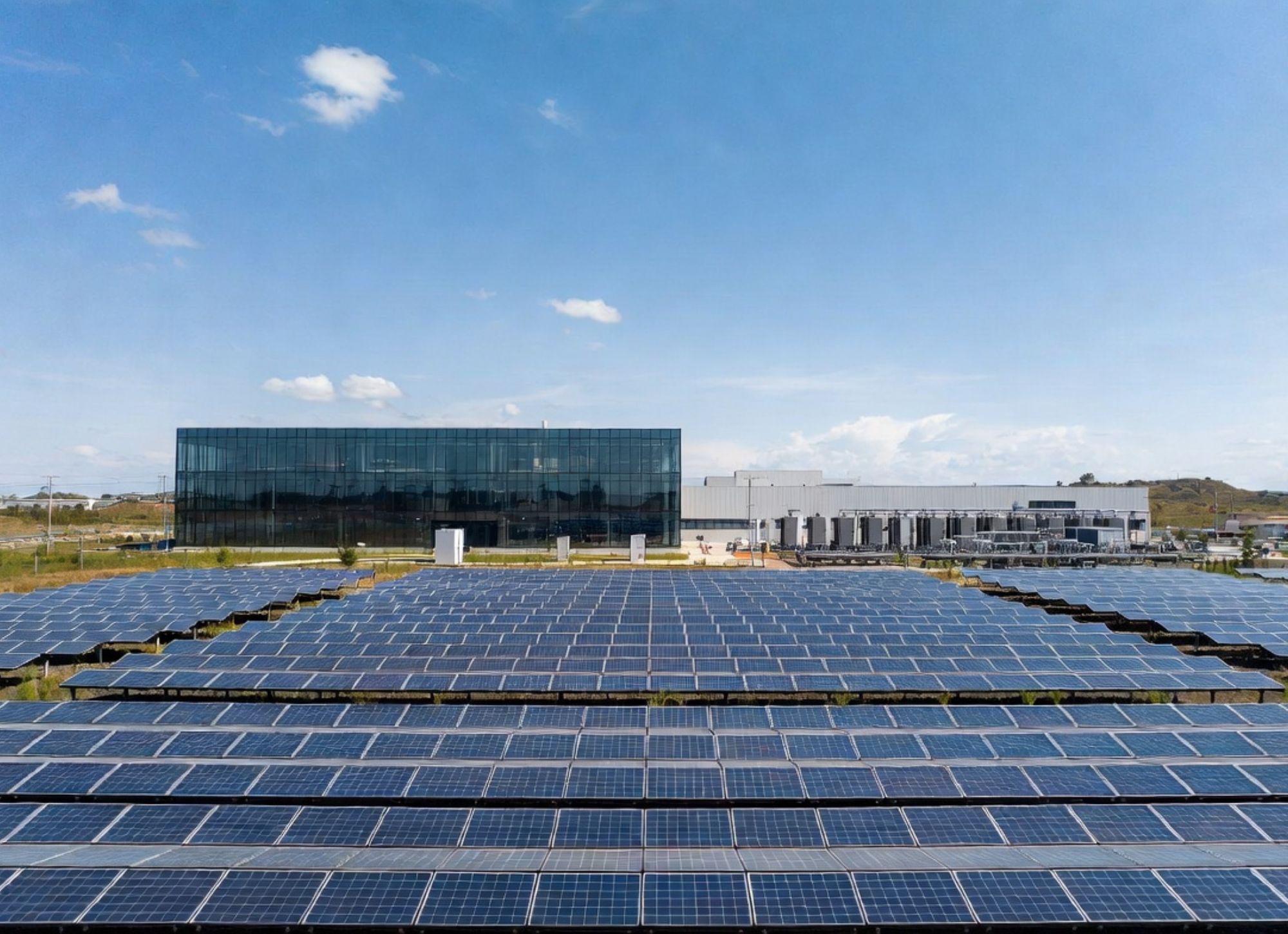
Solar Panels for Data Centres: Costs & Benefits
Data centres across the UK are under mounting pressure to cut energy costs and reduce carbon emissions, and solar panels for data centres offer one of the most effective ways to do both.
Whether you operate a hyperscale facility in London, a colocation hub in Bristol, or an edge data centre near Southampton, on-site solar power generation can dramatically lower your electricity bills, future-proof your operations against rising grid prices, and help you meet ambitious net-zero targets.
Are Solar Panels Worth It for Data Centres?
Solar panels are absolutely worth it for data centres, and the financial case has never been stronger. Energy costs represent 40 to 60% of total data centre operating expenditure, and with the 2026 Ofgem non-domestic electricity rate sitting at around 27.69p per kWh, a 5 MW facility can spend anywhere between £8 million and £12 million annually on electricity alone.
A well-designed solar photovoltaic (PV) system can offset a significant portion of that consumption, with industry data suggesting an average data centre can save in the region of £200,000 per year on electricity bills through solar, with total savings across a 25-year contract term reaching approximately £6.5 million.
Beyond the pure numbers, the broader energy landscape makes solar investment even more compelling. The UK now has over 514 data centres, surpassing both China and Canada individually in terms of facility numbers.
With AI workloads alone projected to consume the equivalent energy output of a country the size of the Netherlands by 2027, grid reliance without renewable supplementation is increasingly risky. Solar gives data centre operators a stable, predictable, and low-cost source of power that is not subject to the same volatility as grid electricity pricing.
Ready to explore solar for your commercial property or data centre facility in Southern England, Greater London, South West England, or South Wales? EE Renewables provides expert solar panel installation and battery storage solutions across areas including London, Brighton, Oxford, Southampton, Bristol, and Cardiff. Get in touch today for a free, no-obligation quote.
What Are the Key Benefits of Solar Panels for Data Centres?
The key benefits of solar panels for data centres go well beyond simple energy bill savings. Here is a full breakdown of the advantages:
Significant Cost Savings
Solar panels lock in electricity at a fixed, predictable cost over a 25-year period. This protects data centre operators from the electricity price volatility that has characterised UK energy markets over recent years. Over a full contract term, total savings can reach £6.5 million per facility, according to industry estimates.
Reduced Carbon Emissions
Data centres are among the most carbon-intensive commercial operations. The average UK data centre with a well-specified solar installation can reduce its carbon output by approximately 466,000 kg of CO2 annually. This directly supports ESG reporting obligations, investor expectations, and alignment with the UK government’s net-zero targets.
Energy Independence and Grid Resilience
Solar plus battery storage gives data centre operators a degree of energy independence that pure grid reliance cannot provide. Generating power on-site reduces exposure to grid outages, peak demand charges, and energy supply disruptions. For facilities where uptime is non-negotiable, this operational resilience is genuinely valuable.
Enhanced Commercial Reputation
Clients choosing data centre partners increasingly factor in sustainability credentials. A facility that can demonstrate a meaningful renewable energy profile stands out in procurement processes, particularly among large enterprise and public sector customers who are themselves under pressure to report Scope 3 emissions. Solar panels are a visible, credible signal of environmental commitment.
Improved PUE (Power Usage Effectiveness)
Power Usage Effectiveness is the key efficiency metric for data centres, measuring how much of total electricity consumption actually goes towards IT equipment rather than cooling, lighting, and other infrastructure. By supplementing grid power with lower-cost solar electricity, operators can reduce the effective energy cost per unit of computing work, improving PUE ratios over time.
How Can Solar Panels Power a Data Centre?
Solar panels power a data centre by converting sunlight into direct current (DC) electricity, which inverters then convert into the alternating current (AC) electricity used throughout the facility. The generated electricity feeds directly into the data centre’s power distribution system, reducing the amount of electricity drawn from the national grid.
There are three primary deployment configurations:
- Rooftop solar PV — Panels mounted on the roof of the data centre building itself. This is the most common approach for smaller and mid-sized facilities, particularly edge data centres
- Ground-mounted solar arrays — Installed on land adjacent to the facility, enabling much larger system capacities ideal for hyperscale and colocation data centres
- Solar canopies and carport systems — Panels mounted over car parks and access roads, making use of otherwise underutilised outdoor space without consuming extra land
Pairing Solar with Battery Storage
Battery storage systems work alongside solar panels to store surplus electricity generated during daylight hours for use during the night or periods of low sunlight. For data centres that operate 24 hours a day, seven days a week, battery storage is a critical companion technology.
It ensures that solar energy genuinely displaces grid consumption around the clock rather than only during peak generation hours, and it also provides a backup power buffer that supports operational resilience.
On-Site vs Power Purchase Agreements (PPAs)
Data centres do not necessarily need to purchase a solar system outright. A Power Purchase Agreement (PPA) allows a third-party provider to install and own the solar panels on your site, while you simply buy the electricity they generate at a fixed, pre-agreed rate. The rate is typically lower than the standard grid tariff.
PPAs generally run for 25 years and involve no upfront capital investment, making them accessible for operators who prefer to preserve capital while still benefiting from lower energy costs.
What Size Solar Panel System Does a Data Centre Need?
The size of a solar panel system for a data centre depends on the facility’s power consumption and the available roof or ground space. Average-sized data centres typically consume between 500 and 800 kWh per square metre annually, while larger facilities can consume 100 to 200 megawatts per month. Here is a general breakdown of typical system sizes by facility type:
| Facility Type | Typical System Size | Estimated Cost (UK) |
| Edge data centre | 50 kW to 300 kW | £45,000 to £270,000 |
| Mid-size colocation | 300 kW to 1 MW | £225,000 to £950,000 |
| Hyperscale / large campus | 1 MW+ | £700 to £900 per kW installed |
The cost per kW installed typically falls between £700 and £900 for systems above 1 MW, and between £750 and £950 for systems in the 300 kW to 1 MW range. UK capital allowances can cover 75 to 85% of the effective net cost of a commercial solar installation, substantially improving the return on investment.
Why Is Energy Such a Big Challenge for UK Data Centres?
Energy is the single biggest operational challenge for UK data centres because electricity demand in the sector is growing at an extraordinary pace. National Grid estimates that UK data centre electricity demand will rise from 7.6 TWh in 2024 to between 20 and 41 TWh by 2035, representing a more than fivefold increase in just over a decade.
Oxford Economics projects that data centres will account for 8.8% of total UK electricity demand by the time this growth curve plateaus, equivalent to 30.4% of all UK commercial electricity consumption.
This surge is being driven by cloud computing expansion, the rapid growth of AI infrastructure, and increasing digital consumption across every sector of the economy. London is already one of the top three data centre markets in the world by power consumption capacity, alongside Virginia in the United States and Beijing in China.
With grid capacity constraints becoming a serious bottleneck for new data centre development, generating power on-site through solar reduces the burden on grid connections and can actually accelerate planning and commissioning timelines for new facilities.
Real-World Case Studies: Solar Energy in Data Centres
Real-world examples of solar energy in data centres demonstrate that large-scale renewable integration is both technically feasible and commercially sound.
Google signed contracts in 2024 to purchase approximately 8 gigawatts (GW) of clean energy generation capacity, more than in any previous year in its history. Google’s data centres operate on a matched renewable energy basis, and the company has publicly committed to running on 24/7 carbon-free energy as a long-term goal.
Its data centre campuses increasingly incorporate on-site and adjacent solar generation as part of a broader clean energy strategy.
Microsoft, Amazon, and Apple
Microsoft, Amazon, and Apple have all achieved recognised green data centre status through direct investments in renewable energy projects and long-term Power Purchase Agreements.
Microsoft is actively exploring multiple renewable technologies, including solar PV integration at data centre campuses, while Amazon Web Services has become one of the world’s largest corporate buyers of renewable energy, with solar featuring prominently in its procurement portfolio.
UK Commercial Solar Data Centre Deployments
Within the UK, commercial solar deployments at data centre sites have demonstrated consistent savings.
Operators in the South East of England, the Midlands, and the South West have implemented both rooftop and ground-mounted systems ranging from 250 kW to over 2 MW, with payback periods typically falling between five and eight years for outright purchases, and immediate positive cash flow for PPA arrangements.
How Does Solar Energy Affect a Data Centre’s Carbon Footprint?
Solar energy directly and measurably reduces a data centre’s carbon footprint by displacing grid electricity, which in the UK still carries a carbon intensity figure that reflects the remaining fossil fuel generation in the national energy mix. Every kilowatt-hour generated by on-site solar instead of drawn from the grid avoids the associated carbon emissions entirely.
For context, a data centre generating 2,000,000 kWh per year from solar can eliminate approximately 466,000 kg of CO2 annually. Over a 25-year system lifespan, that represents a cumulative carbon saving of over 11.5 million kg per facility.
This is directly relevant to data centres that must report under frameworks such as the Carbon Disclosure Project (CDP), the Task Force on Climate-related Financial Disclosures (TCFD), or Streamlined Energy and Carbon Reporting (SECR) requirements.
Are There Any Challenges to Installing Solar at a Data Centre?
Installing solar at a data centre does come with practical challenges that are worth understanding before committing to a project.
Roof Suitability and Structural Load
Many data centres are purpose-built facilities with large, flat roofs, which are generally well-suited to solar panel installation. However, structural surveys are always required before installation to confirm the roof can bear the additional load. Some older facilities or buildings with complex roof profiles may require additional engineering work.
Planning Permission
For rooftop systems, most commercial solar installations fall under Permitted Development rights and do not require full planning permission, though a Permitted Development application is still required. Ground-mounted systems above certain sizes may need formal planning consent, particularly in Green Belt areas or land with specific designations.
Intermittency and Night-Time Operation
Data centres operate continuously, but solar only generates electricity during daylight. This is why battery storage integration is essential for maximising the value of a solar installation. Without storage, the effective offset is limited to daylight consumption; with storage, solar generation can cover a much higher proportion of total demand, including evening and early morning peak periods.
Grid Connection and Export
In some locations, the local Distribution Network Operator (DNO) may restrict the amount of electricity that can be exported back to the grid. This makes accurate system sizing important.
Oversized systems that cannot export surplus generation waste potential revenue, while undersized systems fail to capture the full financial benefit. An experienced installer will carry out a full DNO assessment as part of the design process.
Get a Free Solar Panel Installation Quote from EE Renewables
If you are looking to reduce your data centre’s energy costs, lower your carbon footprint, and secure a stable, long-term power supply, EE Renewables is ready to help. As a trusted commercial solar panel installation company serving Southern England, Greater London, South West England, and South Wales, we work with commercial clients across London, Brighton, Oxford, Southampton, Bristol, Cardiff, and the surrounding areas.
Our team handles every stage of your solar project, from initial survey and system design through to installation, grid connection, and ongoing support. We design systems around your facility’s unique energy profile, roof or land availability, and sustainability goals.
Contact EE Renewables today for a free, tailored solar installation quote. There is no obligation, and our team will give you an honest assessment of what solar can deliver for your specific site.
Frequently Asked Questions
Can solar panels supply 100% of a data centre’s electricity needs?
Solar panels can supply a substantial portion of a data centre’s electricity, but achieving 100% coverage from solar alone is not realistic in the UK given seasonal variation and the 24/7 nature of data centre operations.
Most operators use solar as a primary offset tool alongside grid electricity, aiming to cover 30 to 60% of total consumption depending on system size and the facility’s energy intensity. Combining solar with battery storage and Power Purchase Agreements for additional renewable electricity can push this figure higher over time.
Does solar generation count towards a data centre’s renewable energy certificates?
Yes. On-site solar generation produces Renewable Energy Guarantee of Origin (REGO) certificates or equivalent documentation that can be used to support renewable energy claims in corporate sustainability reporting. This is relevant for data centres that need to demonstrate renewable consumption to clients, investors, or under frameworks such as RE100, which commits signatories to 100% renewable electricity.
How long does a commercial solar installation take at a data centre?
For most commercial solar installations at data centre sites, the full process from initial survey to completed commissioning typically takes between three and six months. This timeline covers structural surveys, system design, DNO application and approval, procurement of equipment, and the installation itself.
Larger or more complex systems involving ground-mounted arrays or significant battery storage may take longer, particularly if formal planning permission is required.
Will solar panels affect my data centre’s business continuity or uptime?
A reputable solar installer will work around your operational schedule to ensure that installation causes minimal disruption to data centre operations. Panels are typically installed on external roof surfaces or adjacent ground areas that are entirely separate from active IT infrastructure.
Critically, solar systems are designed with automatic disconnection and bypass mechanisms so that any maintenance or fault condition does not affect your facility’s power supply or uptime.
What is the typical payback period for a data centre solar installation in the UK?
For outright purchases, the payback period for a commercial data centre solar installation in the UK typically falls between five and eight years, depending on system size, local solar irradiance, and the facility’s electricity consumption patterns. Under a PPA arrangement, there is no upfront capital cost, so cash flow benefits are immediate from day one.
After the payback period on an outright purchase, the electricity generated is effectively free for the remaining 17 to 20 years of the system’s operational life.
