


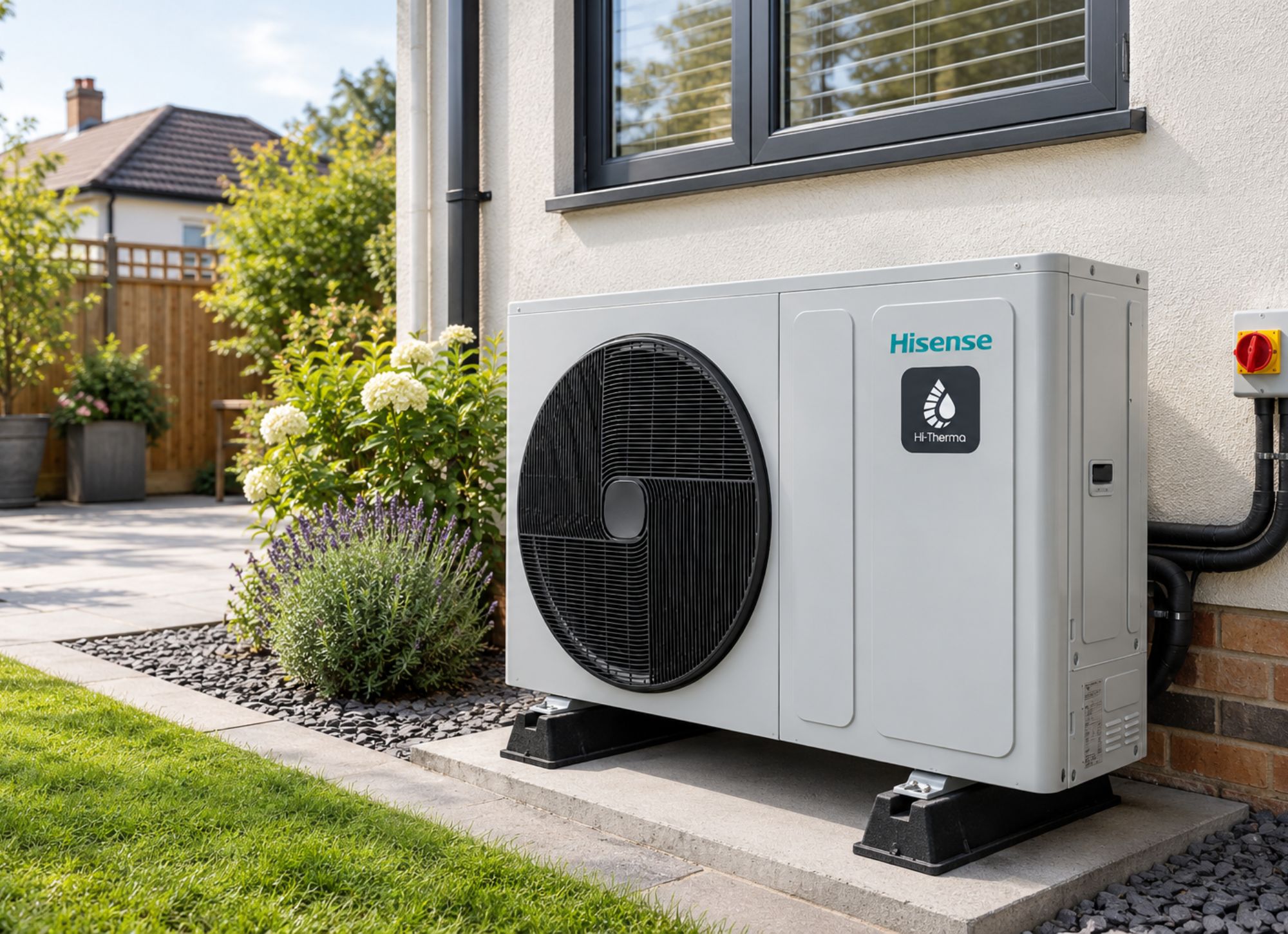
Hisense heat pump review 2026: Pricing, Pros & Cons
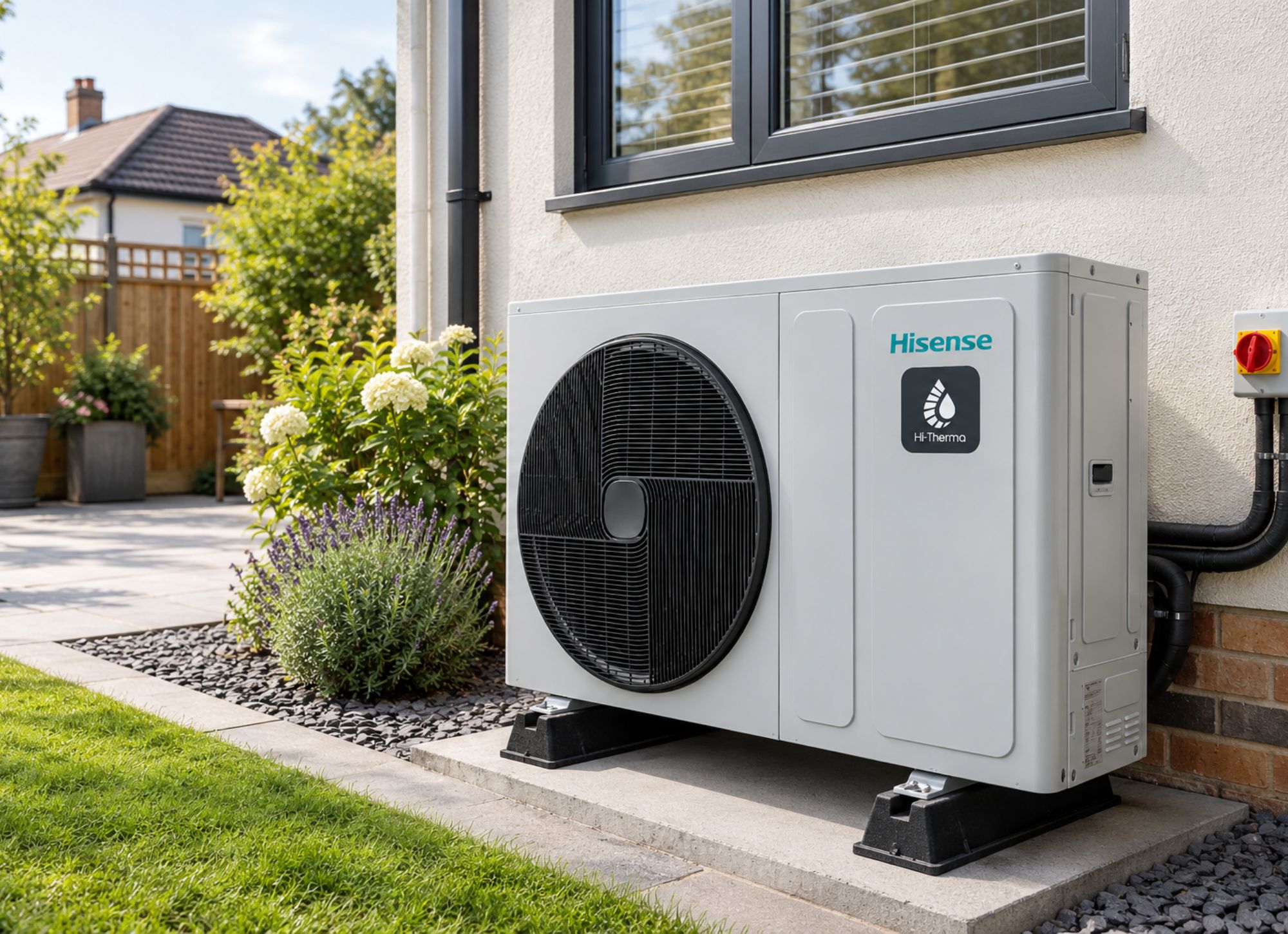
In this Hisense heat pump review, we explain what the Hi-Therma range costs, how efficient it is, what the warranty covers and which homes it suits. We also compare Hisense with names like Mitsubishi, Daikin, Vaillant and Samsung, and with fellow budget brands Midea, Gree and Haier.
We are EE Renewables Ltd, and air source heat pump installation is all we do. We fit heat pumps for homeowners and landlords across Greater London, Brighton, Oxford, Southampton, Bristol, Cardiff and the wider South of England and South Wales, so our advice is based on real homes rather than brochure claims.
Hisense heat pump review: At a Glance
Hisense heat pumps are low cost units from a global electronics and air conditioning giant, offering good value for money but a shorter UK heating track record than the established brands. Here is the Hisense Hi-Therma range at a glance.
| What you need to know | Hisense Hi-Therma heat pump |
|---|---|
| Manufacturer | Hisense Group, based in Qingdao, China, founded in 1969 |
| Range | Hi-Therma monobloc and split air to water heat pumps |
| Sizes | Roughly 4kW to 16kW |
| Refrigerant | R32 on most current UK models |
| Maximum flow temperature | Up to around 60°C to 65°C |
| Efficiency (SCOP) | Around 4.0 to 4.6 at 35°C flow; ErP rating A+++ at low temperature |
| Typical real world efficiency | Around 280% to 360% (2.8 to 3.6 units of heat per unit of electricity) |
| Unit price (supply only) | Roughly £2,300 to £4,500 depending on size |
| Typical installed cost before grant | Around £7,500 to £12,000 |
| Typical cost after £7,500 Boiler Upgrade Scheme grant | Around £500 to £4,500 |
| Typical annual running cost | Around £830 to £1,150 for an average 3 bed home |
| Warranty | Typically around 3 to 5 years, varying by UK distributor and installer |
| Trustpilot rating (Hisense UK) | Mixed, and mostly about TVs and appliances rather than heat pumps |
| Which? rating | No Which? brand score for Hisense heat pumps |
| Noise | Roughly 55 to 66 dB(A) sound power; quiet mode available |
| Maintenance | One professional service a year recommended |
| Controls | Wired controller with weather compensation; ConnectLife app on compatible models |
| Best for | Budget conscious homeowners, landlords, modern or well insulated 2 to 4 bed homes |
| Less ideal for | Draughty period homes, or owners who want strong local brand support |
On price, Hisense sits with Gree, Haier and Midea at the budget end of the market, well below mid range brands like Ideal, Grant and Baxi.
Are Hisense heat pumps worth it?
Hisense heat pumps are worth it for homeowners and landlords who want a low cost heat pump for a modern or well insulated home and are happy to choose a brand that is newer to UK home heating. You get capable hardware at a good price, but less warranty cover, UK support and long term track record than with Mitsubishi, Daikin or Vaillant.
In the UK, Hisense heat pumps are mainly sold through specialist distributors and independent installers. The Hi-Therma range includes monobloc units, where everything sits in the outdoor box, and split systems with an indoor hydro unit. Most UK homes use the monobloc, which is simpler and cheaper to fit.
EE Renewables Ltd only provides air source heat pump installation, and we cover Southern England, Greater London, South West England and South Wales, including London, Brighton, Oxford, Southampton, Bristol and Cardiff. If you would like honest advice on whether a Hisense heat pump suits your home, get in touch today for a heat pump quote tailored to your location.
Pros & Cons of Hisense heat pumps
| Pros | Cons |
|---|---|
| Low upfront price compared with most major brands | Smaller UK heat pump support and engineer network |
| Backed by a large global manufacturer with compressor expertise | Shorter typical warranty than Vaillant, Mitsubishi or Aira |
| Good lab efficiency figures for the price | Real world results depend heavily on the installer |
| The £7,500 BUS grant can cover most of the cost on smaller homes | Uses R32 rather than the lower impact R290 used by Vaillant and Ideal |
| Monobloc and split options | Maximum flow temperature limits use with small radiators |
| Compact units on smaller models | Spare parts can take longer to arrive |
| App control on compatible models | Very few UK heat pump reviews and no Which? score |
Is a Hisense Heat Pump Right For Your Property?
Choose Hisense if…
- Keeping upfront costs low is your top priority.
- You live in a modern or well insulated 2 to 4 bed home, such as newer estates around Reading, Swindon or Basingstoke.
- You are a landlord upgrading several properties on a budget.
- Your installer has experience with Hisense and can handle servicing and parts.
- You are happy to upgrade a few radiators so the system can run at lower temperatures.
Do Not Choose Hisense If…
- You want a big UK heating brand with plenty of local engineers.
- You want the longest warranty you can get.
- You have a large, draughty period home that needs high flow temperatures.
- You want a low impact R290 refrigerant.
- You prefer an all in one package with app, tariff and installation, like Octopus Cosy 6 or Aira.
How efficient are Hisense heat pumps?
Hisense heat pumps are efficient on paper, with seasonal efficiency (SCOP) figures of around 4.0 to 4.6 at a 35°C flow temperature. In simple terms, a Hisense Hi-Therma can produce roughly 4 units of heat for every unit of electricity it uses, compared with about 90% efficiency for a modern gas boiler.
SCOP and SPF explained simply
SCOP, or seasonal coefficient of performance, is the average efficiency measured in testing over a full heating season. SPF, or seasonal performance factor, is what your heat pump actually achieves in your home. Your MCS installer estimates SPF during the design, and this real world figure is what shapes your bills.
How flow temperature affects a Hisense heat pump
The hotter the water a heat pump sends to your radiators, the harder it works. Hi-Therma units reach up to around 60°C to 65°C. Here is a rough guide:
| Flow temperature | Typical efficiency (approx.) | What it means for you |
|---|---|---|
| 35°C (underfloor heating, large radiators) | 400% to 460% | Lowest running costs |
| 45°C (some upgraded radiators) | 320% to 360% | A good balance for most homes |
| 55°C (mostly original radiators) | 250% to 290% | Higher bills, still cheaper than direct electric heating |
| 60°C to 65°C (maximum output) | 210% to 250% | Best kept for hot water or very cold days |
A well designed Hisense system running at 45°C to 50°C in a Southern England home can typically achieve real world efficiency of around 290% to 350%.
Lab figures versus real homes
Hisense’s lab figures are close to those of Panasonic Aquarea, LG Therma V and Hitachi Yutaki units of a similar size. The difference tends to show up after installation. Mitsubishi Ecodan, Daikin Altherma and Vaillant aroTHERM plus have years of UK installer training and setup guidance behind them, which makes it easier to hit design targets. With Hisense, more depends on the installer’s own experience.
Does the mild Southern climate help?
Yes, the milder weather in Southern England and South Wales helps every heat pump. Average winter temperatures in places like Southampton, Brighton, Exeter and Cardiff often sit around 5°C to 8°C, giving a budget unit like Hisense an easier job than it would face further north.
How much does a Hisense heat pump cost?
A Hisense heat pump costs around £7,500 to £12,000 fully installed before grants, and around £500 to £4,500 after the £7,500 Boiler Upgrade Scheme (BUS) grant. The unit alone usually costs £2,300 to £4,500, which puts Hisense among the cheapest MCS listed options. The rest covers the cylinder, pipework, radiator upgrades, controls, labour and MCS certification.
Hisense Hi-Therma pricing table
| Model (approx. output) | Typical home size | Unit price (supply only, approx.) | Installed cost before grant (approx.) | Installed cost after £7,500 BUS grant (approx.) |
|---|---|---|---|---|
| Hi-Therma 4kW to 6kW | Flat or well insulated 2 bed home | £2,300 to £2,900 | £7,500 to £9,000 | £500 to £1,500 |
| Hi-Therma 8kW | Small 3 bed home | £2,700 to £3,300 | £8,000 to £9,500 | £500 to £2,000 |
| Hi-Therma 10kW | Average 3 bed semi or terrace | £3,000 to £3,700 | £8,500 to £10,500 | £1,000 to £3,000 |
| Hi-Therma 12kW to 14kW | Larger 3 bed or 4 bed home | £3,500 to £4,200 | £9,500 to £11,500 | £2,000 to £4,000 |
| Hi-Therma 16kW | Large 4 bed detached | £3,900 to £4,500 | £10,000 to £12,000 | £2,500 to £4,500 |
What affects your final installation cost
- Radiator upgrades. Larger radiators may be needed so the system can run cooler, typically £300 to £600 each.
- Hot water cylinder. Homes with combi boilers usually need a cylinder, around £1,200 to £2,500 fitted.
- Pipework. Old or narrow pipes may need upgrading.
- Location. Labour in London often costs more than in places like Winchester, Weston-super-Mare or Bridgend.
- Split versus monobloc. Split systems need refrigerant work by an F gas qualified engineer, which can add cost.
Grants and tax savings
The Boiler Upgrade Scheme gives homeowners and landlords in England and Wales £7,500 off an air source heat pump, paid straight to your MCS certified installer. Heat pump installations also currently benefit from 0% VAT in Great Britain until March 2027. Always check the exact Hisense model on your quote is MCS listed, as this is required for the grant.
Be wary of very cheap quotes
A rock bottom price can hide a rushed heat loss survey, undersized radiators or a low quality cylinder. A poorly designed system can cost far more to run over 15 years than a slightly dearer, well designed one. Always compare quotes like for like.
How Hisense pricing compares with other brands
Hisense is priced alongside Gree, Haier and Midea. Mid range brands such as Ideal, Grant, Baxi and Worcester Bosch typically cost £1,000 to £2,500 more installed, while premium brands like Viessmann, NIBE and Stiebel Eltron can be £3,000 to £5,000 more. Octopus Cosy 6 and Aira use bundle pricing that includes installation and smart controls.
What are the running costs of a Hisense heat pump?
The running costs of a Hisense heat pump are typically around £830 to £1,150 a year for an average 3 bed home in Southern England on a standard electricity tariff. On a dedicated heat pump or time of use tariff, this can fall to around £560 to £780 a year.
A worked example for a typical 3 bed home
A typical 3 bed home needs around 12,000 kWh of heat a year for heating and hot water. Assuming electricity at around 26p per kWh (close to current Ofgem price cap levels, which change every quarter), here is what a Hisense Hi-Therma would cost to run:
| Real world efficiency (SPF) | Electricity used per year (approx.) | Yearly cost at 26p/kWh (approx.) | Yearly cost on a 17p/kWh heat pump tariff (approx.) |
|---|---|---|---|
| 2.8 (older radiators, higher flow temperature) | 4,290 kWh | £1,120 | £730 |
| 3.2 (typical well designed system) | 3,750 kWh | £980 | £640 |
| 3.6 (low flow temperature, good insulation) | 3,330 kWh | £870 | £570 |
The same home on a modern gas boiler would use about 13,300 kWh of gas, costing roughly £870 a year plus a gas standing charge of around £100 to £120. When you remove your gas supply, that standing charge goes too.
Weighing upfront savings against running costs
A Hisense heat pump could save you £1,500 to £3,000 upfront compared with a premium brand. If it runs a little less efficiently, you might pay £50 to £150 more a year in electricity. Over a 15 to 20 year lifespan, good design is what makes the budget option a smart choice.
Tips to lower your running costs
- Use weather compensation. It lowers water temperatures on milder days, which is most of the year in the South.
- Run it low and steady. Heat pumps work best holding a constant temperature.
- Pick a heat pump tariff. Octopus, OVO, EDF and others offer cheaper rates at set times.
- Add solar PV. Solar panels can cover much of your hot water need in spring and summer.
Smart systems like the Octopus Cosy 6 and Aira automate much of the bill saving through their apps and tariffs. With Hisense, careful setup by your installer does most of that work.
What warranty comes with a Hisense heat pump?
The warranty that comes with a Hisense heat pump is typically around 3 to 5 years in the UK, depending on the distributor and installer that supplies it. Some suppliers extend cover if the unit is registered and serviced every year, so always ask to see the full warranty terms in writing before you sign.
Questions to ask about a Hisense warranty
- Is the warranty provided by Hisense, the UK distributor or the installer?
- Does it cover parts and labour, or parts only?
- How quickly can replacement parts be sourced in the UK?
- Is an annual service required to keep it valid?
- Who honours the warranty if the installer stops trading?
How Hisense’s warranty compares
| Brand | Typical maximum heat pump warranty (approx.) |
|---|---|
| Hisense Hi-Therma | Around 3 to 5 years, varies by distributor |
| Haier | Around 3 to 5 years, varies by distributor |
| Midea | Around 3 to 7 years depending on distributor |
| Vaillant aroTHERM plus | Up to 10 years via approved installers |
| Mitsubishi Ecodan | Up to 7 years via accredited installers |
| Samsung EHS | Up to 7 years via approved installers |
| Aira | 15 year package cover including installation |
Hisense’s warranty is shorter than most established heat pump brands, which is part of the trade off for its lower price. Your MCS installer should also give you a separate workmanship warranty. At EE Renewables, we explain exactly who covers what on every quote.
Which property types are Hisense heat pumps best suited for?
Hisense heat pumps are best suited for modern or well insulated 2 to 4 bed homes, new builds and rental properties where a low upfront cost is the priority. Because the Hi-Therma works best at moderate flow temperatures, it performs most reliably in homes that hold their heat well.
| Property type | How well a Hisense heat pump suits it | Things to consider |
|---|---|---|
| Modern new build (post 2000) | Excellent | Low heat loss suits a small, low cost unit |
| Rental property (landlords) | Very good | Low upfront cost helps across several properties |
| 3 bed semi detached (1930s to 1970s) | Good | Usually a 10kW model; radiator upgrades likely |
| Bungalow | Good | Space for the outdoor unit and short pipe runs |
| Large 4 bed detached | Fair | The 16kW model may be needed; check heat loss carefully |
| Victorian or Edwardian terrace | Fair | High heat loss and small radiators may suit a higher temperature R290 unit better |
| Upper floor flats and listed buildings | Limited | Planning, space and noise rules can rule out outdoor units |
A note for landlords
The government has proposed that privately rented homes in England and Wales should reach EPC band C by 2030. Hisense’s low price can make upgrading several rental homes more affordable, and the £7,500 BUS grant is available where the property meets the scheme rules. Check that your installer can respond quickly to faults, as tenants will expect fast repairs.
When a premium brand may be the better bet
For large or complex period properties, such as Georgian homes in Bath or Victorian houses in Clifton, Islington or Hove, brands with long UK track records like Vaillant, Viessmann, NIBE or Mitsubishi are often a safer long term choice.
How noisy are Hisense heat pumps?
Hisense heat pumps are reasonably quiet, with sound power levels of roughly 55 to 66 dB(A) depending on the model and how hard it is running. A few metres away, most people would describe the sound as a gentle hum, much like a fridge.
What the noise figures mean
The datasheet figure is sound power, which is the noise at the unit itself. What you and your neighbours actually hear is sound pressure, and that drops quickly with distance. Under the MCS planning standard, noise at a neighbour’s nearest window must stay at or below 42 dB(A) for permitted development, about the level of a quiet library.
Quiet mode and placement
Hi-Therma units include a quiet or night mode that slows the fan and compressor during set hours. Good placement matters just as much. In close packed terraces in London, Brighton or Bristol, we avoid fitting units under bedroom windows or in enclosed corners where sound echoes.
How Hisense compares on noise
The Vaillant aroTHERM plus and Samsung EHS Mono R290 are among the quietest heat pumps you can buy, with Daikin Altherma 3 and Hitachi Yutaki also known for low noise. Hisense is broadly similar to Gree, Haier and Midea units of the same size and close to Panasonic Aquarea and LG Therma V. Older designs from Dimplex and York can be a little louder.
What maintenance and servicing do Hisense heat pumps need?
Hisense heat pumps need one professional service each year, plus a few simple checks you can do at home. An annual service typically costs around £120 to £200 in Southern England. As with other budget brands, the most important thing is having an engineer who knows Hisense and has a reliable source of spare parts.
What a yearly service includes
- Inspecting the outdoor unit’s fan, coil and electrical connections
- Checking system pressure and topping up if needed
- Cleaning the strainer and magnetic filters
- Checking frost protection settings
- Reviewing flow temperatures, weather compensation and schedules
- Testing the hot water cylinder and safety valves
- Recording the service for your warranty
Simple checks you can do yourself
- Keep leaves, snow and plants at least 30cm clear of the outdoor unit.
- Check the pressure gauge every few months.
- Make sure nothing blocks airflow at the front of the unit.
- Note any error codes on the controller and pass them to your installer.
Spare parts and engineer support
Hisense’s UK heat pump network is far smaller than those of Worcester Bosch, Baxi, Ideal, Grant or Mitsubishi, which all have large teams of trained engineers and UK parts stock. A fault on a Hisense unit can take longer to fix if parts need ordering from a distributor. Ask your installer how they handle repairs and typical parts lead times before you commit.
How long does a Hisense heat pump last?
A well maintained air source heat pump usually lasts 15 to 20 years. Hisense’s experience with compressors, including through its Sanden business, is encouraging, but its UK home heating history is much shorter than Daikin, Mitsubishi or NIBE, so long term reliability data in British homes is still limited.
What do Hisense heat pump ratings and reviews say?
Hisense heat pump ratings and reviews are limited in the UK. Hisense’s Trustpilot feedback is mixed and mostly about TVs and kitchen appliances, and Which? has no brand score for Hisense heat pumps. So there is very little independent feedback on the heat pumps themselves.
Trustpilot
Hisense’s UK Trustpilot reviews mostly cover televisions, fridges and after sales service rather than heating. Feedback that does mention Hisense heat pumps often reflects the installer as much as the product. The common themes are:
- Positive: low upfront cost, modern looking units and reasonable heat output for the price.
- Negative: slower support when faults occur and less UK specific technical guidance than established heating brands.
By comparison, Octopus Energy and Aira have thousands of Trustpilot reviews from direct customers, and heating manufacturers like Vaillant, Worcester Bosch and Baxi have large review bases focused on heating.
Which?
Which? tests many Hisense products, especially TVs and fridge freezers, but it has not published a brand score for Hisense heat pumps. Which? only scores heat pump brands where enough owners respond to its surveys, and Mitsubishi, Vaillant, Daikin and Samsung have featured thanks to their large UK installed base. Which? also points out that installation quality has a huge effect on owner satisfaction.
What this means for you
With so few heat pump reviews available, your installer’s experience matters most. Choose an MCS certified installer who has fitted Hisense before, ask to speak to past customers and check their aftercare arrangements.
What does installing a Hisense heat pump involve?
Installing a Hisense heat pump usually takes 2 to 5 days once the design is agreed, and most homes do not need planning permission. To claim the £7,500 grant, the exact Hisense model must be MCS certified and installed by an MCS certified installer, so check both before you go ahead.
The installation process step by step
- Home survey. An MCS certified installer checks each room, your insulation, windows, radiators and possible spots for the outdoor unit.
- System design and quote. You get a quote with the recommended Hi-Therma model, cylinder, any radiator upgrades and the expected efficiency.
- MCS and BUS checks. Your installer confirms the model is MCS listed and applies for the Boiler Upgrade Scheme grant.
- Installation. The old boiler is removed, and the outdoor unit, cylinder, pipework and any new radiators are fitted.
- Commissioning. The system is filled, tested and set up with weather compensation and schedules.
- Handover. You receive your MCS certificate, warranty paperwork and a walk through of the controls.
Planning permission in Southern England and South Wales
In England, most air source heat pumps count as permitted development. The rule that units must sit at least 1 metre from a boundary was removed in 2025, helping homes with small gardens in London, Brighton and Portsmouth. Units must still meet MCS noise limits, and flats, listed buildings and some conservation areas may need permission. Wales has its own permitted development rules, so homes in Cardiff, Swansea and Newport should have this checked during the survey.
Why the installer matters even more with Hisense
Every heat pump, whether NIBE, Viessmann, Panasonic or Hisense, relies on good design. With a brand that is newer to UK heating, there is less manufacturer support to fall back on. An installer who knows the Hi-Therma controls and sets flow temperatures correctly makes all the difference.
What controls and smart features do Hisense heat pumps have?
Hisense heat pumps come with a wired controller offering weather compensation, heating and hot water schedules and a quiet mode, and compatible models can be controlled through Hisense’s ConnectLife smartphone app. The controls handle the essentials, though they are less tailored to UK home heating than those from the leading brands.
Key control features
- Weather compensation. Adjusts water temperature to match the outdoor weather and keep bills down.
- Scheduling. Separate timings for heating and hot water.
- Quiet mode. Reduces noise at night or set times.
- App control. ConnectLife lets you change settings remotely on compatible models with Wi-Fi.
- Legionella protection. Periodically heats stored water to a higher temperature to keep it safe.
How Hisense’s controls compare
The Octopus Cosy 6 and Aira are built around polished apps with live efficiency data and smart tariff features. Mitsubishi’s MELCloud, Daikin’s Onecta and Samsung’s SmartThings are also more developed for home heating. If smart data and automation matter to you, those brands may suit you better. If you simply want to set your heating and forget about it, Hisense’s controls do the job.
Ready to get a free air source heat pump quote from EE Renewables?
Getting a free air source heat pump quote from EE Renewables is quick, simple and comes with no obligation. Our MCS certified team will survey your home, work out exactly what size heat pump you need and show you the real cost, including the £7,500 Boiler Upgrade Scheme grant.
Request your free heat pump quote today and find out how much you could save with a heat pump tailored to your home and location.
EE Renewables Ltd only provides air source heat pump installation, so it is all we focus on. We help homeowners and landlords across Southern England, Greater London, South West England and South Wales, including London, Brighton, Oxford, Southampton, Bristol and Cardiff. Whether a budget friendly Hisense heat pump suits your home or another brand would be a better long term fit, we will give you honest, independent advice.
Frequently Asked Questions
Do Hisense heat pumps work in freezing weather?
Yes, Hisense heat pumps work in freezing weather and are designed to keep heating homes in outdoor temperatures well below zero, down to around minus 20°C to minus 25°C depending on the model. The unit runs short defrost cycles to clear ice from the outdoor coil, which is normal. In Southern England, temperatures rarely drop below minus 5°C.
Are Hisense and Hitachi heat pumps the same?
No, Hisense and Hitachi heat pumps are not the same. Hisense has partnered with Hitachi on air conditioning in some markets, but the Hisense Hi-Therma and Hitachi Yutaki are separate product ranges, with different designs, controls, warranties and UK support networks.
Can a Hisense heat pump cool my home in summer?
A Hisense heat pump can cool your home in summer if the model is reversible and your home has suitable emitters, such as fan coil units or underfloor heating set up for cooling. Standard radiators are not designed for cooling. Ask your installer whether cooling is possible with your system before relying on it.
Can I keep my gas boiler alongside a Hisense heat pump?
You can keep a gas boiler alongside a heat pump in a hybrid setup, but you would not be eligible for the £7,500 Boiler Upgrade Scheme grant. The BUS grant requires the heat pump to fully replace your fossil fuel heating. A correctly sized Hisense heat pump is designed to heat your home on its own.
Does a Hisense heat pump add value to my home?
A Hisense heat pump can add value to your home by improving its EPC rating and lowering running costs for future buyers. Research from property and energy groups has suggested homes with better EPC ratings can sell for several percent more. The effect is strongest when paired with good insulation.
