


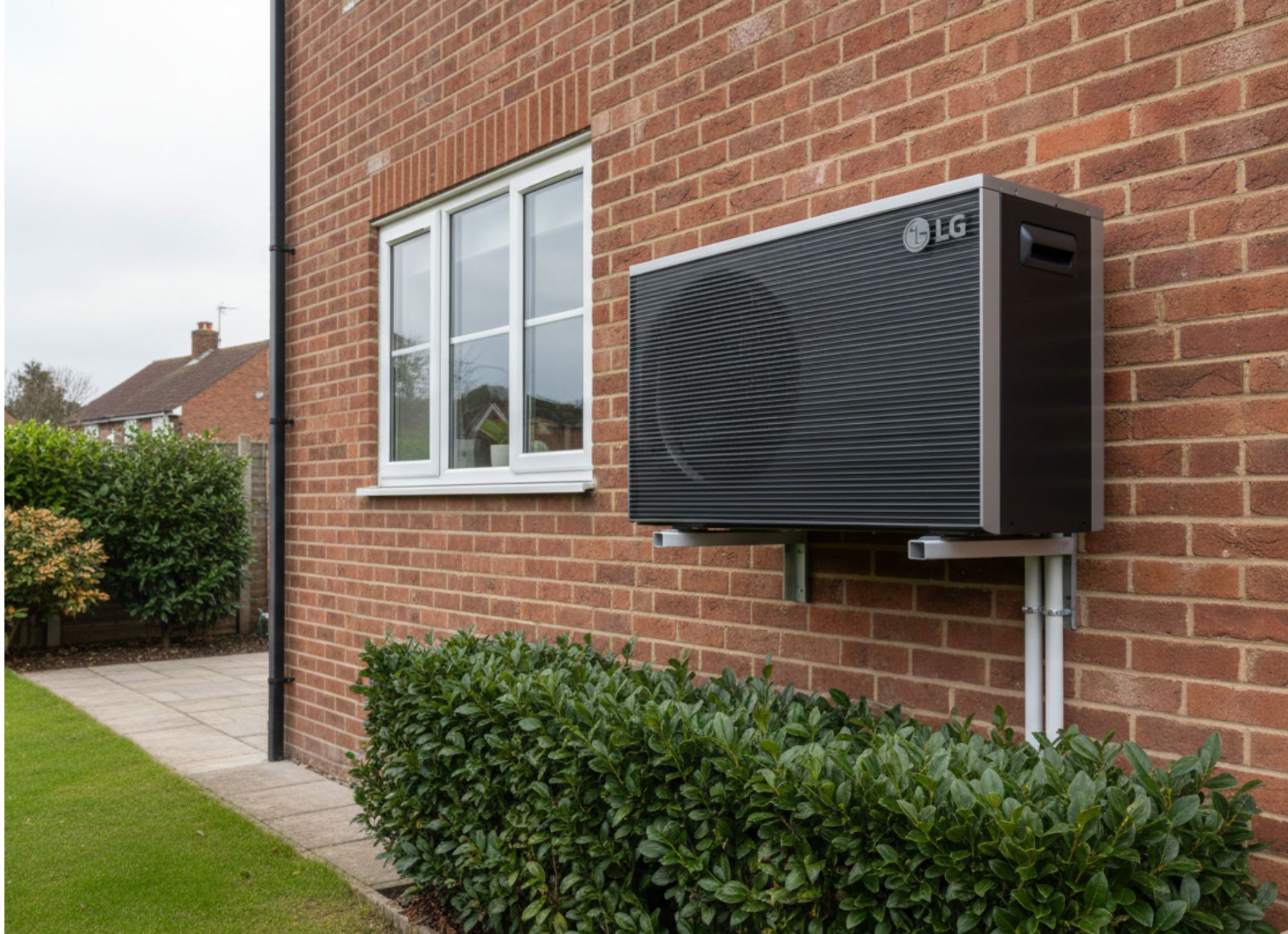
Air Source Heat Pump: How It Works
Understanding how air source heat pumps work helps UK homeowners and landlords make confident decisions about switching to efficient, low-carbon renewable heating solutions.
This guide explains the process step by step in plain English, focusing on practical details relevant to homes and properties across Southern England, Greater London, South West England, and South Wales.
How Does an Air Source Heat Pump Work?
Air source heat pumps work by extracting heat energy from the outside air—even when it’s cold—and transfers that heat indoors to warm your home and hot water. Unlike boilers that burn fuel to create heat, air source heat pumps move existing heat using electricity, achieving high efficiency through a closed-loop refrigerant cycle.
Key Stages of Operation
- The outdoor unit draws in ambient air over an evaporator coil containing low-temperature refrigerant.
- The refrigerant absorbs heat from the air and evaporates into a gas.
- A compressor raises the refrigerant’s temperature and pressure.
- Hot refrigerant gas flows indoors to a condenser (or heat exchanger), releasing heat into your central heating system or hot water cylinder.
- The refrigerant cools, turns back to liquid via an expansion valve, and returns to the outdoor unit to repeat the cycle.
Understanding this process also helps clarify many of the pros and cons of air source heat pumps, particularly why these systems are highly efficient but perform best in well-prepared homes.
Homeowners and landlords in London, Brighton, Oxford, Southampton, Bristol, and Cardiff can request a free air source heat pump quote from EE Renewables for a personalised assessment of how this process performs in your specific property.
What Are the Main Components of an Air Source Heat Pump?
Air source heat pumps rely on four primary components that work together to move heat efficiently. The outdoor unit contains the evaporator, fan, compressor, and expansion valve, while the indoor unit includes a heat exchanger (condenser) and controls.
- Evaporator coil: Absorbs heat from outdoor air into the refrigerant.
- Compressor: The “heart” of the system—compresses refrigerant gas to increase temperature.
- Condenser: Releases captured heat indoors to your radiators or underfloor heating.
- Expansion valve: Reduces refrigerant pressure so it can absorb heat again.
What Is the Refrigerant Cycle in an Air Source Heat Pump?
Air source heat pumps are driven by the refrigerant cycle, also called the vapour-compression cycle. A special refrigerant fluid circulates continuously, changing states to absorb and release heat.
In the evaporator, low-pressure liquid refrigerant boils at very low temperatures, absorbing heat from outside air. The compressor then squeezes this vapour, raising its temperature significantly. In the indoor condenser, the hot gas condenses back to liquid, releasing its heat into your home’s water-based heating system.
Finally, the expansion valve drops the pressure, cooling the refrigerant ready to absorb more heat outdoors.
This clever thermodynamic process allows the system to deliver 3–4 units of heat for every 1 unit of electricity used.
How Does an Air Source Heat Pump Extract Heat from Cold Air?
Air source heat pumps extract heat from cold using the fan which draws air across the evaporator fins. The refrigerant inside the coil is colder than the air, so heat naturally transfers into the refrigerant.
Defrost cycles occasionally melt any ice buildup on the outdoor coil during UK winters. This makes air source heat pumps reliable for British homes throughout the heating season.
Pro tip: Because performance depends on heat retention indoors, understanding whether your home is suitable for a heat pump is an important step before installation.
How Efficient Are Air Source Heat Pumps in UK Weather?
Air source heat pumps are super efficient in UK climates thanks to high Coefficient of Performance (COP) ratings—usually 3.0–4.5 in mild weather. Efficiency drops slightly in very cold snaps but remains superior to gas boilers.
Well-insulated properties achieve the best results. Factors like underfloor heating or oversized radiators help maximise performance at lower flow temperatures (35–55°C). When paired with solar PV panels, running costs can drop further through self-consumption of renewable electricity.
System performance also depends on correct capacity, which is why understanding what size air source heat pump you need is essential to avoid excessive cycling or reduced efficiency.
Pro tip: In properties where low-temperature operation isn’t practical, a high temperature air source heat pump can deliver hotter water for existing radiators, though usually at the cost of reduced efficiency.
Ready to Install an Air Source Heat Pump?
Ready to experience the benefits of renewable heating in your property? EE Renewables Ltd specialises in expert air source heat pump installation across Southern England, Greater London, South West England, and South Wales.
Request your free, tailored quote today and discover how an air source heat pump can work perfectly for your home or commercial building.
FAQs
What is the difference between monobloc and split air source heat pumps?
Monobloc systems house all components outdoors with pipes running indoors, while split systems have the compressor outdoors and the heat exchanger indoors for reduced pipe freezing risk in very cold weather.
How often does an air source heat pump need a defrost cycle?
Defrost cycles typically occur automatically when outdoor temperatures drop below 5–7°C and humidity causes frost buildup, lasting 5–10 minutes every few hours during cold, damp UK winter conditions.
Can an air source heat pump be integrated with existing solar PV panels?
Yes, air source heat pumps pair very effectively with solar PV, using excess daytime electricity to run the compressor and reduce reliance on grid power, improving overall system efficiency.
What size air source heat pump do I need for my property?
Heat pump size (measured in kW) depends on your home’s heat loss calculation, insulation levels, and hot water demand—professional heat loss surveys ensure accurate sizing for optimal performance.
How does an air source heat pump handle power cuts?
Most systems include backup electric immersion heaters in the hot water cylinder, though heating performance is limited during extended outages; battery storage can provide greater resilience.
