


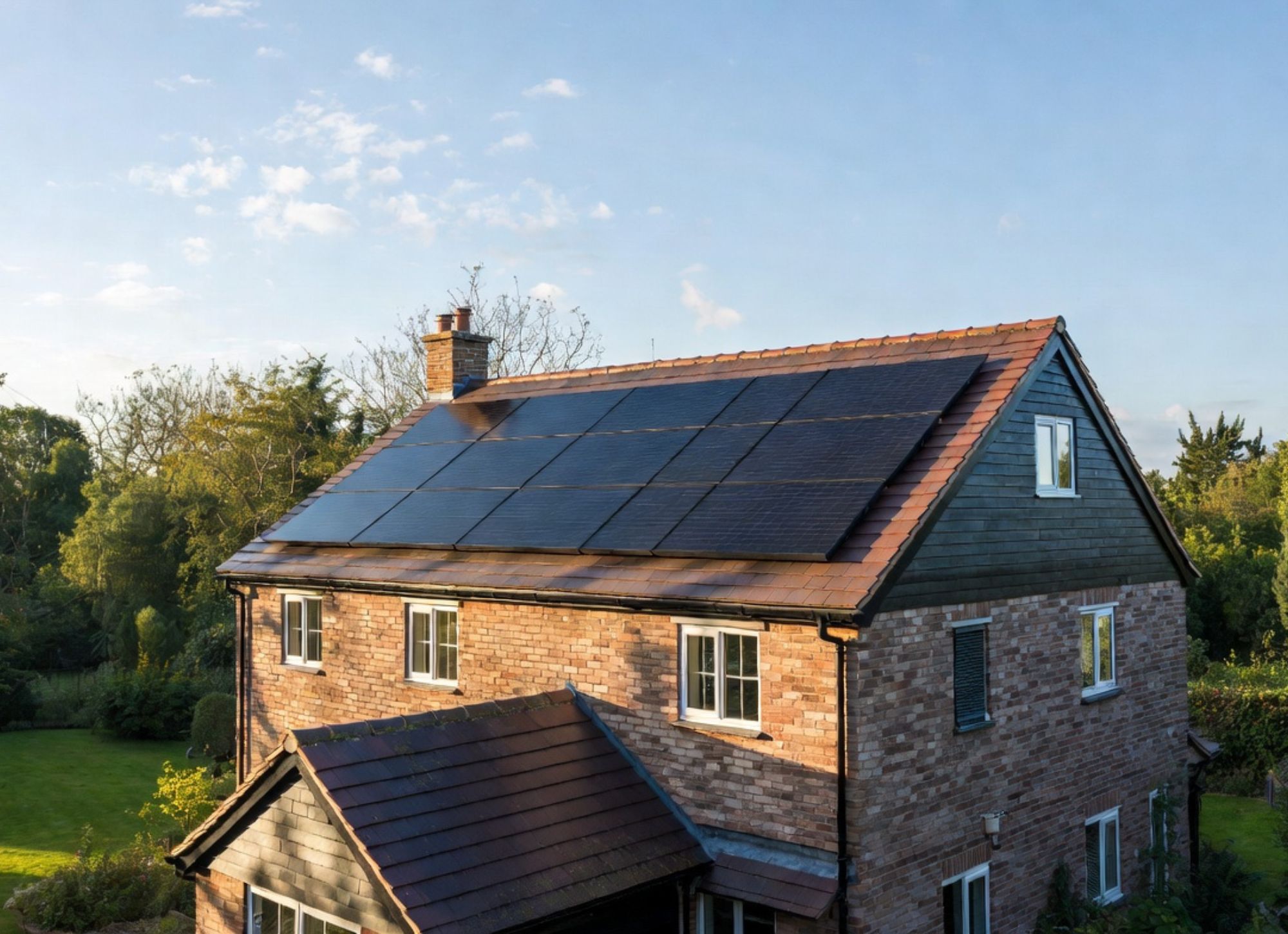
Can Solar Panels Be Installed On A Garage Roof?
Yes, solar panels can be installed on a garage roof, and for many UK homeowners it is actually one of the smartest places to put them. Whether your garage has a pitched tiled roof, a flat felt roof, a metal sheet roof, or a concrete surface, there is a mounting solution that works.
Installing solar panels on a garage roof is a practical and increasingly popular option for properties where the main house roof is not ideal, faces the wrong direction, or simply does not have enough space.
If you own a home across Southern England, Greater London, the South West, or South Wales, your garage roof could be generating clean, free electricity right now.
Can You Install Solar Panels on a Garage Roof?
You can install solar panels on a garage roof, and in many cases it is every bit as viable as installing them on the main house roof. The approach depends on the type of garage roof you have. Pitched tiled roofs use the same hook-and-rail mounting system as a standard house installation.
Flat roofs use angled ballast frames to tilt the panels at the optimal angle. Metal sheet roofs use seam clamps or through-fix brackets depending on the profile. Each of these methods is well established and widely used by MCS-accredited installers across the UK.
The key consideration is that the garage roof must be structurally sound and in reasonable condition, the roof surface must be large enough to accommodate a useful number of panels, and the orientation must be broadly southerly to justify the investment.
A garage roof that faces south or south-west and sits in open sunlight without significant shading from trees or neighbouring buildings is an excellent candidate for solar. Even an east or west facing garage roof can deliver a worthwhile return.
One important practical consideration is how the electricity generated on the garage roof gets back to the house. This requires a cable run, either underground or overhead, from the garage to the main property’s consumer unit.
This is a routine part of any garage roof solar installation and adds a modest amount to the overall project cost, but it is entirely straightforward for a qualified installer.
Pros and Cons of Solar Panels on a Garage Roof
Here is a clear and honest summary of what installing solar on a garage roof involves:
Pros:
- A well-oriented garage roof can generate just as much electricity as a main house roof installation
- Ideal for properties where the main house roof faces north, is heavily shaded, or has insufficient space
- Flat garage roofs allow panels to be angled in the optimal direction regardless of building orientation
- A garage roof solar installation is eligible for MCS certification and full Smart Export Guarantee payments
- Garage roof installations are often straightforward and can be completed quickly with minimal disruption to the household
- The electricity generated feeds directly into the home’s consumer unit, reducing your grid import costs in exactly the same way as a house roof installation
- Can be a cost-effective way to add solar capacity alongside an existing house roof system
Cons:
- A cable run from the garage to the house adds cost compared to a standard house roof installation
- Smaller garage roofs may only accommodate a limited number of panels, reducing the overall system capacity
- Older garage structures with deteriorating roofs or weak roof timbers may need repair or reinforcement before panels can be fitted
- Flat felt garage roofs nearing the end of their service life should be replaced before installation to avoid costly removal and reinstallation later
- If the garage is detached and set back from the house, cable routing can be more complex and may require trenching under a path or driveway
- Some garage roofs are partially shaded by the main house itself, particularly integral garages at the side of a property
What Factors to Consider Before Installing Solar Panels on a Garage Roof?
Before going ahead with a garage roof solar installation, there are several important factors that a professional installer will assess and that you as a homeowner should understand. Working through these carefully at the planning stage protects your investment and ensures the system performs well over its full service life.
Garage Roof Type and Condition
The type and condition of your garage roof is the starting point for any installation assessment. Pitched tiled garage roofs in sound condition are straightforward to work with and use the same mounting hardware as a standard house roof. Flat felt or EPDM rubber roofs must be assessed for their remaining service life.
If your flat garage roof is already leaking, showing blistering or cracking, or has been in place for more than 20 years without refurbishment, it is sensible to replace the roof surface before installing solar panels on top of it.
Removing and reinstalling a solar system to repair a roof that fails prematurely adds significant unnecessary cost. Metal sheet garage roofs are well-suited to solar and use appropriate seam or through-fix mounting systems depending on the profile.
Structural Integrity of the Garage
Garage structures vary considerably in their build quality, and not all of them are designed with the additional load of a solar panel system in mind. A standard solar installation adds approximately 15 to 25 kilograms per square metre to the roof structure, depending on the mounting system and panel specification. For a solidly built brick-built or concrete garage, this is rarely a concern. For older timber-framed garages or prefabricated concrete panel garages, a structural assessment may be advisable to confirm the roof can safely carry the additional load. Your installer will carry out a visual assessment during the survey and flag any concerns before work proceeds.
Roof Orientation and Shading
The compass direction your garage roof faces determines how much electricity the panels will generate. A south facing garage roof at a pitch of 30 to 40 degrees is the ideal configuration and will deliver the highest annual output. South-west and south-east facing roofs perform nearly as well.
East and west facing roofs generate around 15% to 20% less than south facing but can still provide a very worthwhile return. A flat garage roof is particularly flexible because the ballast mounting frames can orient the panels in any direction, so even a garage that faces north or east can have a south facing solar array on its roof.
Shading from the main house, from boundary trees, or from neighbouring structures is worth assessing carefully. Garage roofs attached to the side of a house can be partially shaded by the house itself during certain hours of the day, and a shading analysis by the installer will quantify whether this is likely to have a material impact on output.
Cable Routing Between Garage and House
For a detached or semi-detached garage, the electrical connection between the solar system and the house consumer unit requires a cable run that must be planned before installation begins. The most common approaches are burying an armoured cable underground in a conduit trench between the garage and the house, or running a surface cable along a fence line or wall.
Underground cable routes typically require digging a trench to a minimum depth of 500mm beneath paths and driveways and 450mm beneath open ground. The length and routing of this cable run is assessed during the pre-installation survey, and the cost is included in the overall installation quote.
For integral garages connected directly to the house structure, internal cable routing through the wall is straightforward and adds very little to the project cost.
Planning Permission for Garage Roof Solar
Most garage roof solar installations in England and Wales fall within permitted development rights, meaning no formal planning application is required. However, there are conditions that must be met. The panels must not protrude more than 200mm beyond the roof plane, must not be on a wall or roof slope fronting a highway, and must not exceed the highest point of the existing roof.
For listed buildings and properties within designated conservation areas in places such as central London, parts of Brighton, Oxford city centre, or Bath, additional planning considerations may apply. An experienced installer will confirm the planning position for your specific property during the survey.
How Are Solar Panels Installed on a Garage Roof?
Solar panels are installed on a garage roof using a professional step-by-step process that varies slightly depending on the roof type. Here is what a complete garage roof solar installation looks like from beginning to end.
Step 1: Pre-Installation Survey
The installation begins with a thorough site survey of the garage and the main property. The installer assesses the garage roof type, pitch, orientation, structural condition, and available roof area. They also plan the cable route between the garage and the house consumer unit, identify the inverter location, and use solar modelling software to calculate the expected annual generation.
A detailed system design and written quotation is produced before any work is committed to.
Step 2: Cable Route Preparation
If the garage is detached, the cable route is prepared before the roof installation begins. For underground routes, a trench is dug to the required depth between the garage and the house, and an armoured cable is laid in conduit and backfilled.
For surface routes along fencing or walls, cable containment clips or trunking are fitted at this stage. This preparatory work ensures the electrical connection is ready to receive the solar system once the roof installation is complete.
Step 3: Safe Access Arrangement
Appropriate safe access to the garage roof is arranged in accordance with the Work at Height Regulations 2005. For low single-storey garage roofs, this typically involves a secured ladder and edge protection barriers at the roof perimeter.
For taller structures or larger roof areas, a mobile scaffold or tower may be erected. The access arrangement is confirmed during the survey stage and is in place before any roof work begins.
Step 4: Mounting System Installation
For pitched tiled garage roofs, stainless steel roof hooks are fitted beneath the tiles at the pre-planned fixing locations, secured to the roof battens, and tiles are replaced neatly around them. For flat garage roofs, protective matting is laid first, then angled ballast frames are positioned and loaded with the calculated ballast weight to secure the system against wind uplift.
For metal sheet garage roofs, seam clamps or through-fix brackets with EPDM sealing gaskets are fitted at the appropriate fixing points across the roof. In all cases, the mounting system is installed in alignment with the system design layout to ensure the panels sit correctly.
Step 5: Aluminium Mounting Rail Installation
Aluminium mounting rails are attached across the fixed roof hooks, brackets, or ballast frames and carefully levelled and aligned. These rails form the structural spine of the solar array and provide the surface onto which the panels are clamped.
Rail lengths and connections are specified to suit the panel layout, and expansion connectors are included where necessary for longer rail runs.
Step 6: Solar Panel Fitting and DC Cabling
The solar panels are lifted onto the mounting rails and secured with end and mid clamps. DC cables are connected between the panels in the configuration specified by the system design and are routed neatly back to the cable entry point into the garage structure.
From here, the DC cable follows the pre-prepared route to the inverter, which is typically wall-mounted inside the garage or, where preferred, inside the main house.
Step 7: Inverter Installation and Connection to House Consumer Unit
The inverter is installed and the DC cable from the panels is connected to it. The inverter output is then connected via the pre-prepared cable route to the main house consumer unit. A generation meter is installed at this point to record the electricity the system produces. A qualified electrician carries out a full electrical test of the complete installation in accordance with BS 7671.
Step 8: System Commissioning and MCS Registration
The system is powered up and fully tested. The installer checks that each panel is generating correctly, verifies the inverter operation, and confirms the system output against the modelled expectations. The installation is registered with the MCS database, making it eligible for Smart Export Guarantee payments.
The homeowner receives the MCS installation certificate, all product warranties, and the electrical installation certificate.
How Much Does It Cost to Install Solar Panels on a Garage Roof?
Installing solar panels on a garage roof in the UK typically costs between £3,500 and £8,000 for a standard domestic installation, depending on the system size, roof type, and the complexity of the cable route between the garage and the house.
The installation itself is priced in the same way as a house roof installation, with the cable route adding a modest additional cost that varies depending on the distance and routing method required.
| Option | No. of Panels | Output | Typical Cost | Annual Generation |
|---|---|---|---|---|
| Small System | 4–8 panels | 1.6kWp–3.2kWp | £3,500–£5,500 | 1,400–2,800 kWh |
| Medium System | 8–12 panels | 3.2kWp–4.8kWp | £5,500–£7,500 | 2,800–4,200 kWh |
| Cable Route Addition | — | — | +£300–£800 | — |
| With Battery Storage | — | — | +£2,500–£5,000 | — |
Small System (4 to 8 Panels, 1.6kWp to 3.2kWp) for Garage Roof
A small system suited to a single garage or a garage with limited south facing roof space typically costs between £3,500 and £5,500. This size of system generates between 1,400 and 2,800 kWh annually on a well-oriented roof in Southern England, which represents a meaningful contribution to a typical household’s electricity consumption.
Medium System (8 to 12 Panels, 3.2kWp to 4.8kWp) for Garage Roof
A medium system for a larger double garage or a garage with good south facing roof area typically costs between £5,500 and £7,500. Annual generation of 2,800 to 4,200 kWh covers a substantial portion of the average UK household’s electricity use and delivers a strong financial return.
Cable Route Addition
The cable run between a detached garage and the main house typically adds £300 to £800 to the overall installation cost, depending on the length of the route, whether trenching under hard surfaces is required, and the cable specification needed.
This cost is included in a comprehensive installation quotation and should be confirmed clearly at the quotation stage.
Adding Battery Storage
A solar battery storage system added alongside the garage roof installation typically costs an additional £2,500 to £5,000. Battery storage is particularly effective for garage roof installations because it allows the household to store daytime solar generation and use it in the evening, maximising self-consumption regardless of where the panels are physically located.
Can a Garage Roof Solar System Power the Whole House?
A garage roof solar system can contribute significantly to a household’s electricity needs, though whether it covers all consumption depends on the size of the garage roof and the household’s overall electricity usage.
A typical double garage in Southern England may have a south facing roof area of 20 to 30 square metres, which can accommodate 8 to 12 panels and a system of 3.2kWp to 4.8kWp. This generates between 2,800 and 4,200 kWh per year, which compares favourably to the average UK household electricity consumption of around 3,500 kWh annually.
For an energy-efficient household, a well-sized garage roof system can genuinely cover the majority of electricity needs, particularly when combined with battery storage to capture daytime generation for evening use.
For households with higher electricity consumption, perhaps those running an electric vehicle, a heat pump, or multiple occupants, the garage roof system is best thought of as a significant contributor rather than a complete solution.
Combining the garage roof installation with additional panels on the main house roof, where space and orientation allow, is the most effective route to maximum energy independence.
Can Solar Panels on a Garage Roof Charge an Electric Vehicle?
Solar panels on a garage roof are an excellent match for electric vehicle charging, and this combination is one of the most compelling arguments for a garage roof installation for homeowners across Southern England, Greater London, the South West, and South Wales.
A home EV charger installed in or adjacent to the garage can draw directly from the solar generation during daylight hours, meaning your car can be charged using free electricity from the sun rather than paying peak grid rates. A smart EV charger that communicates with the solar system and prioritises charging when solar generation is high can maximise this benefit and significantly reduce the ongoing running cost of an electric vehicle.
With a 4kWp garage roof system generating around 3,500 kWh per year, and the average electric car consuming roughly 3 to 4 kWh per 10 miles of driving, there is a very practical alignment between what a garage roof solar system can produce and what a typical household’s EV actually needs.
Adding battery storage to the combination takes this further by storing surplus solar generation during the day for EV charging in the evening when the car arrives home.
Does a Garage Roof Solar Installation Increase Property Value?
A professionally installed, MCS-certified solar panel system on a garage roof can contribute positively to a property’s overall value and energy performance credentials.
While the primary financial benefit of solar is the ongoing reduction in electricity bills and Smart Export Guarantee income, there is growing evidence that buyers in the UK increasingly regard solar panels as a desirable feature rather than a neutral or negative one.
A garage roof solar installation also improves the property’s overall energy generation capacity, which can be reflected in an improved Energy Performance Certificate rating when the system is documented as part of an EPC assessment.
For landlords in particular, improving EPC ratings has become increasingly important given the direction of UK government policy on minimum energy efficiency standards for rental properties.
Get a Free Solar Panel Installation Quote From EE Renewables
If your home has a garage roof and you are ready to find out whether it is suitable for solar panels, EE Renewables is here to help you get the most from your property.
We provide expert solar panel installation and solar battery storage installation across Southern England, Greater London, South West England, and South Wales, including London, Brighton, Oxford, Southampton, Bristol, Cardiff, and all surrounding areas.
Get your free, no-obligation solar installation quote from EE Renewables today and start making your garage roof work harder for your household.
Our installation teams are experienced with every garage roof type, from flat felt and EPDM roofs to pitched tiled roofs and corrugated metal sheets, and we handle the cable routing, structural assessment, and MCS certification as part of a complete, professionally managed service.
We will survey your garage roof, assess every available option on your property, and give you honest, clear advice on what will deliver the best return for your specific situation.
Frequently Asked Questions
Does my garage need its own electricity supply before solar panels can be installed?
Your garage does not necessarily need its own existing electricity supply before a solar installation can proceed. The solar panels generate DC electricity on the roof, which travels via the inverter and then a cable run back to your main house consumer unit. The garage itself simply acts as the structure that supports the panels.
However, if the inverter is to be located inside the garage rather than in the house, a basic electrical supply to the garage will be needed to power the inverter’s monitoring and communication functions. Your installer will advise on the best inverter location as part of the system design process.
Can I install solar panels on a garage roof without the panels being visible from the street?
For most detached or side-access garages, panels installed on the rear or side roof slope that faces away from the street will not be visible from the pavement or road. Flat garage roofs are particularly discreet because the panels sit within the parapet wall in many cases and are invisible from ground level.
If your garage faces a public highway directly and the front roof slope is the only viable south facing surface, the panels will be visible from the street. In this situation, the installation still typically falls within permitted development rights for most properties, but if you live in a conservation area or your property is listed, it is worth checking with your local planning authority or asking your installer to confirm the position.
Can I add panels to my house roof later if I start with a garage roof installation?
Yes, starting with a garage roof installation and adding house roof panels later is a very practical approach. The inverter specified for the initial garage system should ideally have sufficient input capacity to accommodate additional panels, or a second inverter can be added alongside it when the house roof panels are installed. Planning for future expansion at the time of the initial installation, by asking your installer to specify an inverter with headroom for additional strings, avoids unnecessary replacement costs later.
This staged approach is popular with homeowners who want to start benefiting from solar immediately while managing upfront costs.
Will the solar generation from my garage roof be affected if I add insulation inside the garage?
Adding insulation inside the garage, such as insulating the ceiling or roof structure, does not affect the electricity generation of the solar panels on the outer roof surface. The panels generate electricity from sunlight falling on their outer surface, and what happens inside the garage structure has no bearing on this process.
Where insulation can indirectly benefit a solar installation is by reducing heat loss from the property overall, which means the household needs less energy for heating, and the proportion of total energy needs met by the solar system increases as a result.
Can I monitor the electricity generated by solar panels on my garage roof?
Yes, virtually all modern solar inverters include monitoring functionality that allows you to track your system’s electricity generation in real time and review historical generation data via a smartphone app or web portal. This applies equally to garage roof installations as it does to house roof systems.
Monitoring lets you see how much electricity your garage panels are generating at any given moment, how much you are consuming directly from the solar system, how much you are exporting to the grid, and how the system is performing against its design expectations over time.
Some monitoring platforms also integrate with battery storage systems and smart EV chargers, giving you a comprehensive view of your property’s energy flows in one place.
