


Types of Heat Pumps in the UK
The main types of heat pumps used in UK homes are air source heat pumps, ground source heat pumps, water source heat pumps, hybrid heat pumps and exhaust air heat pumps.
Each one does the same basic job: it moves warmth from outside (the air, the ground or a nearby river or lake) into your home to heat your rooms and hot water. What sets them apart is where they collect that heat from, how much they cost to install, and which kinds of property they suit best.
At EE Renewables Ltd, we install heat pumps in homes and rental properties every week, and we know that choosing the right system can feel like a big decision. This guide walks you through every option, with estimated costs, real efficiency figures and the grants available right now.
By the end, you will know which type is the best fit for your home, your budget and your plans.
Types of Heat Pumps Available in the UK
The different types of heat pumps available in the UK fall into three main groups, based on where they take their heat from: the air, the ground or water. Within those groups you will also find hybrid systems and a few specialist designs for flats and new builds.
Here is a quick summary of each:
- Air source heat pumps (ASHP): Pull heat from the outside air using a unit that sits outside your home. These are by far the most popular choice in the UK because they are affordable, quick to fit and work in almost any property with a bit of outdoor space.
- Ground source heat pumps (GSHP): Collect heat from pipes buried in your garden or in a deep borehole. They are very efficient but cost much more to install.
- Water source heat pumps (WSHP): Take heat from a nearby lake, river or pond. They are rare and only suit homes next to a suitable body of water.
- Hybrid heat pumps: Pair a heat pump with an existing gas or oil boiler, which takes over on the coldest days.
- Exhaust air heat pumps (EAHP): Recover heat from stale air leaving your home. They are mostly used in small, well insulated flats and new builds.
Air source heat pumps make up the large majority of installations. According to the Heat Pump Association, around 98,000 heat pumps were sold in the UK in 2024, and most of those were air source models. The UK Government wants to reach 600,000 installations a year by 2028, so demand is growing quickly across every region.
Air Source Heat Pumps
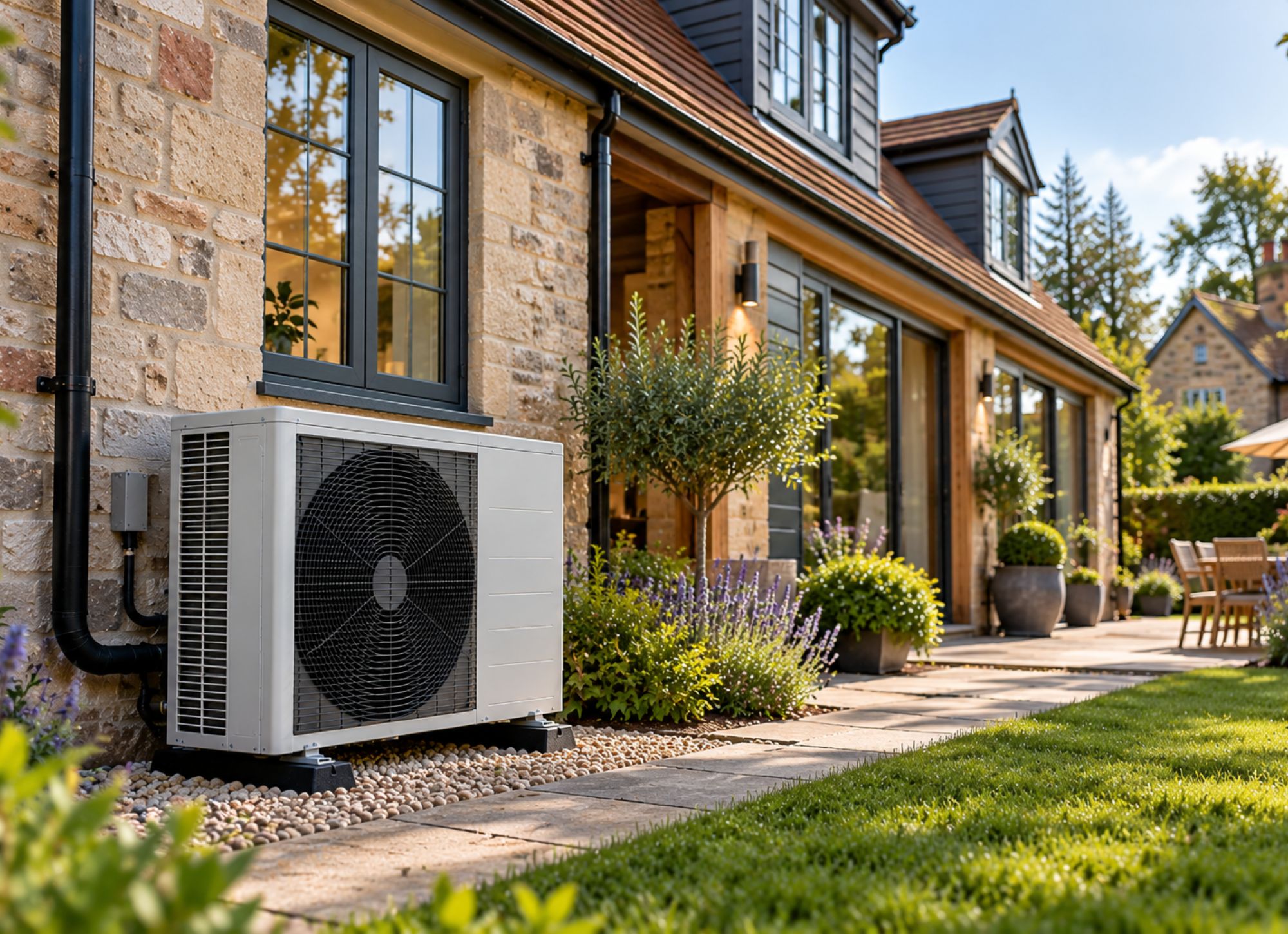
An air source heat pump is a system that takes heat from the outside air and uses it to warm your home and your hot water. It is the most common type of heat pump in the UK, and it is the one most homeowners and landlords choose when they replace a gas or oil boiler.
The outdoor unit looks a bit like an air conditioning unit. It is usually placed against a side or back wall, on a flat roof or in the garden. Modern models keep working in temperatures as low as minus 20°C, which is far colder than winters in London, Bristol or Cardiff ever get.
In fact, the mild climate across Southern England and South Wales is ideal for air source systems, because milder air means the heat pump works more efficiently for more of the year.
Air source heat pumps typically cost between £8,000 and £15,000 to install before grants, depending on the size of your home and the work needed. With the £7,500 Boiler Upgrade Scheme grant, many households pay much less.
Air to Water Heat Pumps
Air to water heat pumps are the standard type of air source heat pump. They heat water that flows through your radiators or underfloor heating, and they also heat a hot water cylinder for your taps, showers and baths. If you currently have a boiler with radiators, this is almost certainly the type that will replace it. Air to water systems are eligible for the Boiler Upgrade Scheme.
Air to Air Heat Pumps
Air to air heat pumps blow warm air directly into your rooms through indoor wall units, rather than heating water. Many can also cool your home in summer, working like air conditioning. They do not provide hot water, so you would still need a separate way to heat water.
They can suit small flats, home offices, conservatories and garden rooms, but they are rarely a full replacement for a central heating system.
Monobloc and Split Systems
Monobloc and split systems are two different ways an air source heat pump can be built. A monobloc keeps all the main parts in a single outdoor unit, and water pipes connect it to your home. It is simpler and quicker to install. A split system divides the parts between an outdoor unit and an indoor unit, linked by refrigerant pipes.
Split systems can suit homes with limited outdoor space or where the outdoor unit needs to sit further away from the house. Your installer will recommend the right design after surveying your property.
Pros and Cons of Air Source Heat Pumps
| Pros | Cons |
|---|---|
| Lowest upfront cost of any full heat pump system | Outdoor unit needs wall or garden space |
| Eligible for the £7,500 Boiler Upgrade Scheme grant | Slightly less efficient in very cold weather |
| Quick install, usually within a week | May need larger radiators in older homes |
| Suits most UK homes, from terraces to detached houses | Usually needs a hot water cylinder |
| Low maintenance, one service a year | Makes a gentle hum when running |
Thinking about an air source heat pump? EE Renewables provides expert air source heat pump installation across Southern England, Greater London, South West England and South Wales, including London, Brighton, Oxford, Southampton, Bristol and Cardiff. Get in touch today for a free heat pump quote tailored to your location.
Ground Source Heat Pump
A ground source heat pump is a system that collects natural warmth stored in the earth and uses it to heat your home and hot water. A metre or two below the surface, the ground in the UK stays at a fairly steady 8°C to 12°C all year round. This stable temperature makes ground source systems slightly more efficient than air source systems, especially in the depths of winter.
The heat is gathered through a network of plastic pipes, called a ground loop, filled with water and antifreeze. A heat pump unit inside your home, often in a utility room or garage, then boosts the temperature for your heating.
The big drawback is cost and disruption. Installing a ground source heat pump typically costs between £20,000 and £40,000 or more, because of the digging or drilling involved. They suit larger homes, farmhouses and rural properties with plenty of land, or new builds where groundwork is already happening.
Horizontal Ground Loops
Horizontal ground loops are pipes laid in trenches about 1 to 2 metres deep across a large area of garden or field. They are cheaper to install than boreholes, but they need a lot of space. As a rough guide, you may need a garden two to three times the floor area of your home.
Vertical Boreholes
Vertical boreholes are deep holes drilled straight down into the ground, often between 50 and 200 metres deep, with pipes lowered inside. They take up very little surface space, so they can work in smaller plots, but drilling is expensive and needs specialist equipment and a geological check.
The pipework in a ground loop can last 50 years or more, which makes ground source a strong long term investment for the right property. For most homes in towns and cities such as London, Brighton or Southampton, though, the cost and space needed mean an air source heat pump is the more practical option.
Pros and Cons of Ground Source Heat Pumps
| Pros | Cons |
|---|---|
| Very efficient, even in deep winter | High installation cost, often £20,000 to £40,000+ |
| Ground loops can last 50 years or more | Needs a large garden or costly borehole drilling |
| Eligible for the £7,500 grant | Major disruption to your garden during install |
| Almost silent, with no outdoor fan unit | Longer installation time |
| Steady performance all year round | Rarely practical for city homes |
Water Source Heat Pump
A water source heat pump is a system that draws heat from a nearby lake, river, pond or stream to warm a building. Pipes are either sunk into the water (a closed loop) or water is pumped through the system and returned (an open loop). Because water holds heat well and stays at a fairly constant temperature, these systems can be very efficient.
In practice, water source heat pumps are uncommon for individual homes. You need a suitable body of water close by, and in England and Wales you may need permission from the Environment Agency or Natural Resources Wales to take water from a river or lake.
They are more often used for larger schemes, such as the Kingston Heights development in London, which uses water from the River Thames to heat hundreds of homes and a hotel.
If your home sits next to a large pond or river, a water source system may be worth exploring. For almost everyone else, air source or ground source will be the better choice.
Pros and Cons of Water Source Heat Pumps
| Pros | Cons |
|---|---|
| Highly efficient thanks to stable water temperatures | Needs a suitable lake, river or pond nearby |
| Eligible for the £7,500 grant | May need Environment Agency or NRW permission |
| Quiet, with no outdoor fan unit | Complex design and variable costs |
| Great for larger or shared heating schemes | Very few homes are suitable |
Hybrid Heat Pump
A hybrid heat pump is a heating system that combines a heat pump, usually an air source model, with a gas, LPG or oil boiler. The heat pump handles most of your heating for most of the year. On the very coldest days, or when you need a quick burst of hot water, the boiler steps in. Smart controls decide which source to use based on outdoor temperature and running costs.
Hybrid systems can be a useful stepping stone for homes that are hard to insulate, or for people who are not ready to give up their boiler completely. They can cut carbon emissions and heating bills compared with a boiler on its own.
There are some downsides to keep in mind:
- You still have a fossil fuel boiler to service, insure and eventually replace.
- You keep paying the gas standing charge, which is currently around £100 or more a year.
- Hybrid systems are not eligible for the Boiler Upgrade Scheme, because the grant requires the heat pump to fully replace fossil fuel heating.
For most homes, a well designed air source heat pump on its own will heat the property comfortably, so a hybrid is usually only needed in special cases.
Pros and Cons of Hybrid Heat Pumps
| Pros | Cons |
|---|---|
| Lower upfront cost than a full heat pump system | Not eligible for the Boiler Upgrade Scheme |
| Boiler backup on the coldest days | Still relies partly on fossil fuels |
| Works well in hard to insulate homes | Two systems to service and maintain |
| Often keeps your existing radiators | Gas standing charge remains |
What Other Types of Heat Pumps Are There?
Other types of heat pumps include exhaust air heat pumps, high temperature heat pumps, solar assisted heat pumps and shared ground loop systems. These are less common, but they can be the right answer for certain properties.
Exhaust Air Heat Pumps
Exhaust air heat pumps recover warmth from the stale, moist air leaving your kitchen and bathroom, then use it to heat water and fresh incoming air. They work best in small, airtight homes such as new build flats, and they usually struggle to heat larger or older properties on their own.
Pros and Cons of Exhaust Air Heat Pumps
| Pros | Cons |
|---|---|
| No outdoor unit needed | Struggles to heat larger or older homes |
| Provides ventilation as well as heat | Needs a very airtight property |
| Compact, fits in an indoor cupboard | Lower efficiency than air or ground source |
| Ideal for flats and new builds | Limited grant support |
High Temperature Heat Pumps
High temperature heat pumps can heat water to 70°C or more, close to what a gas boiler delivers. This means they can often work with your existing radiators in older homes, such as Victorian terraces in London or Georgian properties in Bristol and Bath, with fewer upgrades needed.
Many now use R290 (propane), a natural refrigerant with a very low impact on the climate. The trade off is that they tend to be slightly less efficient when running at those higher temperatures.
Pros and Cons of High Temperature Heat Pumps
| Pros | Cons |
|---|---|
| Heats water to 70°C or more | Less efficient at higher temperatures |
| Often works with existing radiators | Higher running costs than a low temperature system |
| Fewer upgrades needed in older homes | Usually a higher purchase price |
| Many use eco friendly R290 refrigerant | Fewer models to choose from |
Solar Assisted Heat Pumps
Solar assisted heat pumps use solar thermal panels or hybrid solar panels (known as PVT) to collect heat from the sun and feed it into the heat pump. Separately, many homeowners pair a standard air source heat pump with solar PV panels and a battery so the system can run on free electricity generated on their own roof.
Pros and Cons of Solar Assisted Heat Pumps
| Pros | Cons |
|---|---|
| Uses free energy from the sun | Higher combined installation cost |
| Can lower running costs further | Needs suitable, unshaded roof space |
| Pairs well with batteries and smart tariffs | Solar output drops in winter |
| Cuts your carbon footprint even more | More complex system to design |
Shared Ground Loop Systems
Shared ground loop systems connect several homes to one network of boreholes, with each home having its own small heat pump. They are used for blocks of flats, new estates and social housing, and they help spread the high cost of drilling across many households.
Pros and Cons of Shared Ground Loop Systems
| Pros | Cons |
|---|---|
| Drilling costs shared across many homes | Only possible for blocks, estates or groups |
| Ground source efficiency at a lower price per home | Needs agreement between owners or a developer |
| Each home controls its own heat pump | Ongoing network charges may apply |
| Quiet, with no outdoor fan units | Rarely an option for a single house |
How Do the Types of Heat Pumps Compare?
The types of heat pumps compare most clearly on installation cost, efficiency, space needed and grant eligibility. Air source heat pumps offer the best balance for most UK homes, while ground source systems win on efficiency but cost far more to fit.
| Type | Typical installed cost (before grants) | Typical efficiency (SCOP) | Space needed | Typical lifespan | Boiler Upgrade Scheme |
|---|---|---|---|---|---|
| Air source (air to water) | £8,000 to £15,000 | 3.0 to 4.0 | Small outdoor area or wall | 15 to 20 years | Yes, £7,500 |
| Air to air | £3,000 to £10,000 | 3.0 to 5.0 | Wall space indoors and out | 12 to 15 years | No |
| Ground source | £20,000 to £40,000+ | 3.5 to 4.5 | Large garden or borehole | 20 to 25 years (loop 50+) | Yes, £7,500 |
| Water source | Varies widely | 3.5 to 5.0 | Nearby lake or river | 20 to 25 years | Yes, £7,500 |
| Hybrid | £4,000 to £10,000 (heat pump part) | Depends on use | Small outdoor area plus boiler | 15 to 20 years | No |
| Exhaust air | £5,000 to £10,000 | 2.5 to 3.5 | Indoor cupboard | 15 to 20 years | Limited |
Figures are approximate and based on typical UK installations. Your actual cost depends on your home’s size, insulation, radiators and whether you need a new hot water cylinder.
Running costs depend heavily on how well the system is designed and which energy tariff you use. Many heat pump owners switch to a specialist heat pump or time of use electricity tariff, which can cut running costs noticeably compared with a standard tariff.
Heating our homes accounts for around 17% of the UK’s carbon emissions, and a heat pump can reduce a typical home’s heating emissions by around 70% compared with a gas boiler.
Which Type of Heat Pump Is Best for Your Home?
The best type of heat pump for most homes in Southern England, Greater London, South West England and South Wales is an air to water air source heat pump. It costs less to install than a ground source system, qualifies for the £7,500 grant, fits most gardens, driveways and side passages, and performs very well in our relatively mild regional climate.
That said, the right choice depends on a few key factors:
- Outdoor space: A small garden or side wall is enough for air source. Ground source needs a large plot or the budget for a borehole.
- Budget: Air source has the lowest upfront cost of any full central heating replacement.
- Insulation: Well insulated homes get the most from any heat pump. Older homes may benefit from loft insulation, cavity wall insulation or a few larger radiators.
- Property type: Flats with no outdoor space might suit exhaust air or a communal system. Rural homes off the gas grid, common in parts of Somerset, Devon and the Welsh valleys, often see the biggest savings when replacing oil or LPG.
Heat Pumps for Homeowners
For homeowners, an air source heat pump is usually the smartest long term choice. It removes the need for a gas supply, protects you from future changes to gas prices and policy, and can add appeal when you come to sell.
In towns and cities such as Oxford, Brighton and Southampton, homes come in all shapes and sizes, from terraces to detached family houses, and a properly sized air source system can heat them all. Upgrade rules in England now make it easier too, as most installations count as permitted development and do not need planning permission.
Heat Pumps for Landlords
For landlords, heat pumps can help improve a property’s Energy Performance Certificate (EPC) rating. The Government has set out plans for privately rented homes in England and Wales to reach EPC band C by 2030, so many landlords are planning upgrades now rather than later.
Air source heat pumps are popular with landlords because they need very little maintenance, usually just one service a year, and tenants benefit from steady, comfortable heat. Fewer breakdowns also mean fewer emergency call outs between tenancies.
What Grants and Funding Are Available for Heat Pumps?
The grants and funding available for heat pumps in England and Wales are led by the Boiler Upgrade Scheme, which gives £7,500 off the cost of an air source or ground source heat pump. Your installer applies for the grant on your behalf and takes it off your bill, so you never have to pay the full amount upfront and claim it back.
To qualify for the Boiler Upgrade Scheme, you generally need to:
- Own the property, as a homeowner, landlord or small business owner
- Live in England or Wales
- Replace an existing fossil fuel heating system such as gas, oil or LPG
- Have a valid EPC with no outstanding recommendations for loft or cavity wall insulation, unless you have an exemption
- Use an MCS certified installer
Other support worth knowing about includes:
- 0% VAT: Installing a heat pump currently attracts zero VAT in Great Britain until 31 March 2027, saving you 20% compared with standard rates.
- Warm Homes Nest scheme (Wales): The Welsh Government’s Nest scheme offers free energy efficiency improvements, sometimes including a heat pump, to eligible low income households in Wales.
- ECO4 and local council schemes: Some households on certain benefits or with low incomes may qualify for further help through energy supplier and council run schemes.
Grant rules and budgets change from time to time, so it is always worth checking the latest eligibility before you commit. At EE Renewables, we handle the Boiler Upgrade Scheme application for you as part of every eligible installation.
Ready for a Free Air Source Heat Pump Quote From EE Renewables?
Choosing the right air source heat pump starts with understanding your property’s heating requirements and installation costs. EE Renewables Ltd offers free, no-obligation heat pump quotes to help you explore your options and find a system that suits your home and budget.
Request your free air source heat pump quote from EE Renewables today and discover the right heating options for your property.
Our team can assess your property’s needs, explain the different heat pump options and help you understand the potential energy savings.
Our MCS-certified team provides expert air source heat pump installation across Southern England, Greater London, South West England and South Wales, including London, Brighton, Oxford, Southampton, Bristol, Cardiff and surrounding areas.
Whether you are a homeowner replacing an ageing gas, oil or LPG boiler or a landlord looking to improve your rental property’s energy efficiency ahead of tighter EPC requirements, we can help you find a suitable heating solution.
Frequently Asked Questions
How Noisy Is an Air Source Heat Pump?
An air source heat pump typically produces around 40 to 60 decibels at one metre, which is similar to a quiet conversation or a modern fridge. Ground source and exhaust air units are quieter still because the main parts sit indoors. To meet permitted development rules, an installation must not exceed 42 decibels at the nearest neighbouring window, and a good installer will check this before fitting.
What Size Heat Pump Do I Need?
The size of heat pump you need depends on how much heat your home loses, worked out through a room by room heat loss calculation. As a rough guide, a typical three bedroom semi detached house needs a 5kW to 8kW unit, while larger detached homes may need 10kW to 14kW. Choosing the wrong size reduces efficiency and comfort, so always ask for a proper survey.
Do All Heat Pumps Need a Hot Water Cylinder?
Most air to water and ground source heat pumps need a hot water cylinder, because they heat water gradually rather than instantly like a combi boiler. A typical family home uses a cylinder of around 150 to 250 litres. If space is tight, compact heat batteries are an alternative that can store heat in a much smaller unit.
How Long Does It Take to Install a Heat Pump?
Installing an air source heat pump usually takes two to five days for a typical home, including fitting the outdoor unit, cylinder and any radiator upgrades. Ground source installations take longer, often one to three weeks, because of trenching or borehole drilling. Most homes keep their hot water running for much of the work.
Can You Install a Heat Pump in a Listed Building or Conservation Area?
You can install a heat pump in a listed building or conservation area, but you will usually need listed building consent or planning permission first. This is common in historic areas such as Bath, Brighton and parts of London. Placing the outdoor unit out of view from the street often helps an application succeed, and your installer can advise on the best position.
