


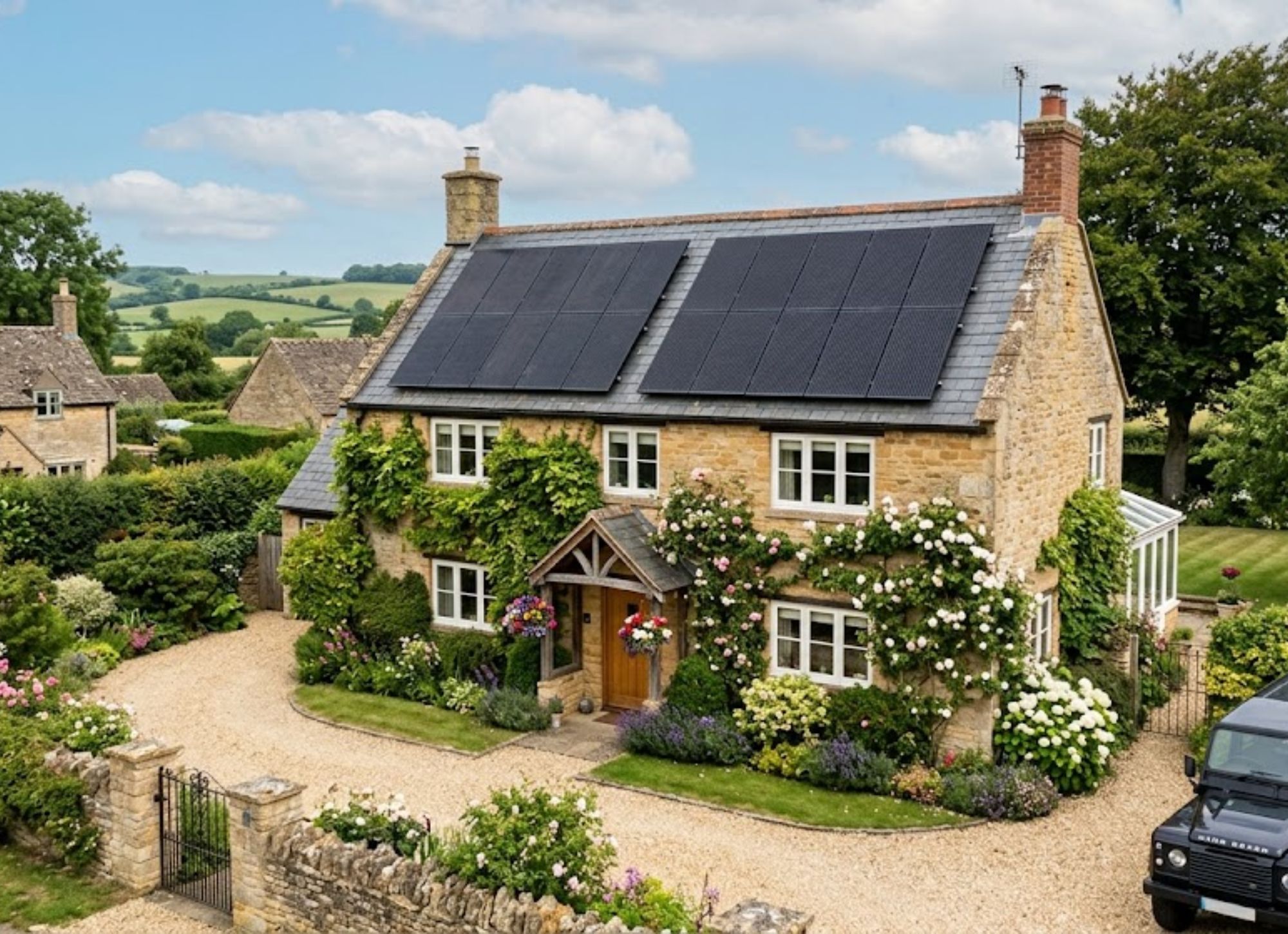
How to Choose Solar Panels: A UK Homeowner’s Guide (2026)
Choosing solar panels is one of the most significant home improvement decisions you can make. Get it right, and you could be cutting your electricity bills, earning money back through the Smart Export Guarantee, and reducing your carbon footprint for the next 25 years or more. Get it wrong, and you may find yourself with a system that underperforms, underdelivers, or simply does not suit your home.
This guide walks you through everything you need to know about how to choose solar panels in the UK, written specifically for homeowners and landlords across Southern England, Greater London, South West England, and South Wales.
How to choose the right solar panels for your home?
Choosing the right solar panels for your home comes down to seven core factors: your energy needs, your roof suitability, the type of panels you select, the efficiency rating, and the warranties on offer. Before you can make a confident, informed choice, you need to understand each of these in turn.
1. Energy needs
Your energy needs are the starting point for every solar panel decision. Before you can size a system, choose a panel type, or get a meaningful quote, you need to understand how much electricity your household actually uses.
How to work out your energy consumption
Start by pulling together your last 12 months of electricity bills and calculating your average monthly usage in kilowatt-hours (kWh). Most UK households use somewhere between 2,700 kWh and 4,100 kWh per year, though this varies significantly depending on the number of people in the home, the appliances you run, and whether you have an electric vehicle or electric heating.
Think about your future plans too. If you are planning to install an electric vehicle charger, switch to a heat pump, or add a home office, your energy demands are going to rise. Sizing your solar system for where you are heading, rather than just where you are now, is one of the smartest decisions you can make.
2. Choosing the right system size for your household
The size of your solar panel system is measured in kilowatts peak (kWp), which indicates the maximum output the system can achieve under ideal conditions. As a general guide:
- 1-2 people: A 3kW system (approximately 6-8 panels) is often sufficient
- 3-4 people: A 4kW system (approximately 8-10 panels) is typically recommended
- 5+ people: A 5kW or 6kW system may be more appropriate
A 4kW system in southern England — covering areas like Southampton, Brighton, and London — can generate between 3,500 and 4,200 kWh per year, which is enough to power a typical family home. For roof space, a rough guide is that you need around 5 square metres of usable roof space per kilowatt of solar capacity.
3. Choosing the right type of solar panels
The main solar panel types available to UK homeowners are monocrystalline, polycrystalline, thin-film, and hybrid panels. For most residential installations, the decision comes down to the following options:
- Monocrystalline panels — The most popular choice for UK homes in 2026. Made from a single pure silicon crystal, they deliver efficiency ratings of 19 to 23 percent and perform well even in low light. Recognisable by their uniform black appearance, they are the go-to recommendation for most installers.
- Polycrystalline panels — Made from multiple silicon crystals melted together, giving them a blue, speckled look. They are cheaper to produce but offer lower efficiency (14 to 17 percent), meaning you need more panels to generate the same output. Their use in the residential market has declined as monocrystalline panels have become more affordable.
- Thin-film panels — Lightweight and flexible, these are better suited to commercial or industrial roofs that cannot support heavier panels. They are rarely the right choice for a standard UK home installation.
- PERC monocrystalline panels — An upgraded version of standard monocrystalline technology that captures reflected light from the rear of the cell, boosting efficiency to 18 to 21 percent. A strong option for homes with moderate roof space.
- Hybrid panels — Combine solar PV electricity generation with thermal technology to also produce hot water from the same panel, making them a versatile option for homeowners looking to reduce both their electricity and heating costs.
4. Your roof suitability
Your roof suitability is one of the most important things to establish before choosing solar panels, because no matter how good the panels are, a poorly positioned roof will limit what they can do.
5. Roof orientation
South-facing roofs are the gold standard for solar panel installations in the UK. They receive the most direct sunlight throughout the day, especially at solar noon, which is when the sun is at its strongest. If your home is in London, Oxford, Cardiff, or Bristol, and you have a south-facing roof, you are in an excellent position to get strong returns from a solar installation.
East and west-facing roofs are also viable. An east-facing roof will capture morning sun, while a west-facing roof generates more electricity in the afternoon and early evening — which can actually align better with when most households use electricity. North-facing roofs are generally unsuitable and will significantly reduce the performance of any system installed on them.
6. Roof pitch
The optimal pitch for solar panels in the UK falls between 30 and 40 degrees, which happens to coincide with the typical pitch of most UK roofs. At this angle, rainwater naturally washes over the panels, keeping them clean, while the tilt maximises the amount of sunlight captured throughout the year.
If your roof pitch sits outside this range, do not assume solar panels will not work for you. Experienced installers can use adjustable mounting systems to tilt panels slightly and improve their angle. Flat roofs are also very much workable — ballasted or angled mounting frames are used to position the panels at the ideal angle regardless of the roof surface beneath.
7. Roof Condition and Shading
Before any panels are installed, your roof should be structurally sound. If you suspect your roof will need replacing within the next few years, it makes sense to carry that work out before installation, rather than having to remove and reinstall panels later. Your installer will assess this during a site survey.
Shading is another key consideration. Trees, chimneys, neighbouring buildings, and dormer windows can all cast shadows on your roof at different times of day. Even partial shading across a small section of your array can reduce output across the whole system if the panels are wired in series.
A good installer will account for this during the design phase, potentially recommending optimisers or microinverters to minimise the impact.
How solar panel efficiency affects your choice?
Solar panel efficiency affects your choice by determining how much electricity a panel can generate from a given area of roof space. A panel with a 22 percent efficiency rating converts 22 percent of the sunlight hitting its surface into usable electricity.
The UK does not enjoy the year-round sunshine of southern Europe, but it receives considerably more solar energy than many homeowners expect. Southern England, which includes London, Brighton, Southampton, and Oxford, receives around 20 percent more solar energy than the northern parts of the UK. For homeowners in these areas, investing in higher efficiency panels means generating more electricity even on overcast days — and the UK has plenty of those.
Higher efficiency panels are particularly valuable when roof space is limited. If you have a smaller south-facing roof section, a more efficient panel will extract more value from every square metre available. For larger roofs, lower efficiency panels may still provide excellent value if the upfront cost savings outweigh the efficiency difference.
What efficiency rating should you look for?
As a practical guide for UK homeowners:
| Panel Type | Typical Efficiency Range |
|---|---|
| Standard monocrystalline | 15% to 18% |
| High-efficiency monocrystalline (PERC) | 18% to 21% |
| Premium monocrystalline | 21% to 23%+ |
For most homes in London, Bristol, Cardiff, Oxford, Southampton, or Brighton, a system in the 18 to 21 percent efficiency range will strike the right balance between cost and performance.
What solar panel warranties should you look for?
The solar panel warranties you should look for cover three distinct areas: the product warranty, the performance warranty, and the installation warranty. Understanding what each one covers will help you compare quotes on a like-for-like basis.
Product warranty
A product warranty covers defects in materials or manufacturing. If a panel fails due to a fault in how it was made, the manufacturer will repair or replace it at no cost to you. Most reputable manufacturers offer product warranties of between 10 and 15 years.
When comparing quotes, look for a minimum of 10 years on the product warranty, and treat anything shorter as a red flag.
Performance warranty
A performance warranty guarantees that your panels will continue to produce a minimum percentage of their original output over time. Panels naturally degrade slightly each year, typically by around 0.5 to 0.8 percent. A solid performance warranty will guarantee at least 90 percent of original output after 10 years, and 80 percent after 25 years.
Some premium manufacturers now offer 30-year performance warranties, which is a strong indicator of long-term quality confidence.
Installation warranty
Your installation warranty covers the workmanship of the installation itself. This typically lasts between 2 and 10 years, depending on the installer. Choosing an MCS-certified installer — which EE Renewables is — means your installation meets the Microgeneration Certification Scheme’s standards, which is also a requirement for accessing Smart Export Guarantee payments.
Ready to Get Solar Panels Installed? Request Your Free Quote from EE Renewables
If you are ready to take the next step, EE Renewables is here to help. We provide expert solar panel installation and solar battery storage solutions across Southern England, Greater London, South West England, and South Wales — serving homeowners and landlords in London, Brighton, Oxford, Southampton, Bristol, Cardiff, and the surrounding areas.
Our team will carry out a full property assessment, recommend the right system for your home and energy needs, and provide you with a clear, transparent, no-obligation quote. We are MCS-certified, committed to quality, and focused on delivering installations that perform for decades.
Get your free solar panel installation quote today.
Frequently Asked Questions
Can solar panels work on a flat roof?
Yes, solar panels can work very effectively on a flat roof. Installers use angled mounting frames to tilt the panels at the optimum 30 to 40-degree angle, compensating for the flat surface. Flat roof installations are common in both residential extensions and commercial buildings, and they can perform just as well as pitched roof systems when correctly designed.
Do solar panels affect the value of my home?
Research consistently shows that solar panels have a positive effect on UK property values. Homes with solar installations are increasingly attractive to buyers looking to reduce running costs, and properties with an improved EPC (Energy Performance Certificate) rating, which solar panels contribute to.
How long do solar panels last in the UK?
Solar panels are built to last. The average working lifespan of a solar panel module is around 25 to 30 years, with many panels continuing to generate electricity well beyond that point. Performance degrades gradually over time, typically by 0.5 to 0.8 percent per year but even after 25 years, most quality panels will still be operating at 80 percent or more of their original output capacity.
What happens to surplus solar energy if I do not have a battery?
Without a battery, any electricity your panels generate that your household does not immediately use is automatically exported to the National Grid. If you are registered with a Smart Export Guarantee (SEG) tariff, your energy supplier will pay you for every unit of electricity you export.
Rates vary by supplier, but in 2026 some tariffs offer up to 20p per kWh for exported energy. Adding a battery at a later stage is also possible if your circumstances or budget change.
Is there any government support available for solar panels in the UK in 2026?
While the Feed-in Tariff closed to new applicants in 2019, the Smart Export Guarantee (SEG) remains available and requires licensed energy suppliers to pay homeowners for surplus solar electricity exported to the grid.
Additionally, the Warm Homes Plan offers support of up to £30,000 for whole-house energy efficiency measures including solar PV and battery storage for eligible households. Your installer can advise you on which schemes you may qualify for based on your location and circumstances.
Does planning permission affect your choice of solar panels?
In most cases, planning permission does not affect your choice of solar panels in the UK. Solar panel installation on a standard pitched roof typically falls under Permitted Development rights, meaning you can install them without applying for planning permission. However, there are exceptions that are worth being aware of.
If your home is a listed building, sits within a conservation area, or is in a National Park, you may need to apply for planning permission before installation. The rules differ slightly across England and Wales, so it is worth checking with your local authority if you are unsure. Your installer should be familiar with local planning regulations in your area and can advise you accordingly.
