


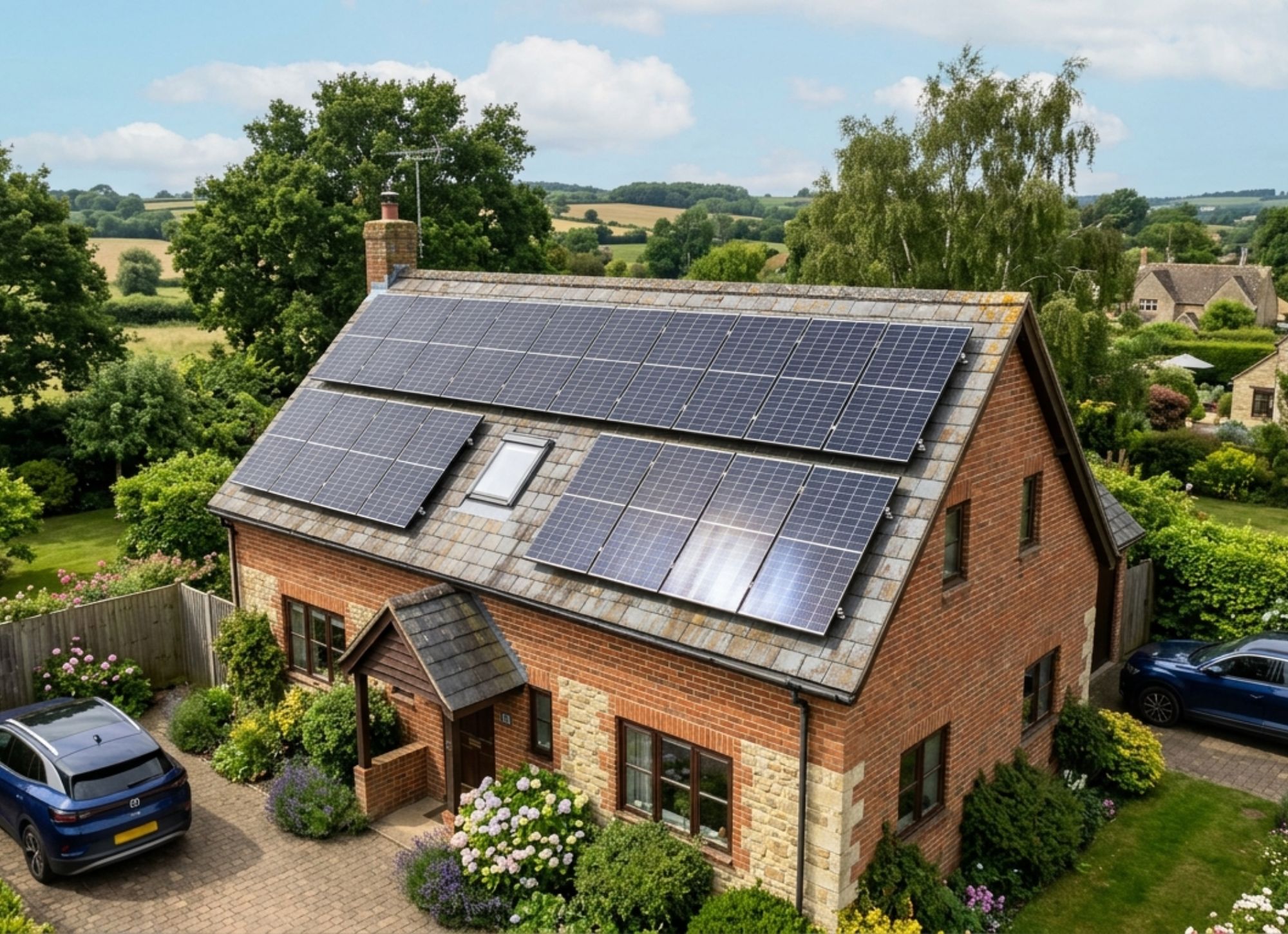
Bifacial Solar Panels Explained: Costs, Pros & Cons
Bifacial solar panels are a type of solar panel that generates electricity from both the front and back surfaces, capturing direct sunlight as well as light reflected off the roof, ground, or surrounding surfaces. This makes them more efficient than standard panels in the right setting, though they’re not always the best fit for every home.
This guide covers everything UK homeowners and landlords across Southern England, Greater London, the South West, and South Wales need to know before choosing bifacial panels for their property.
What Are Bifacial Solar Panels?
Bifacial solar panels are solar panels designed with photovoltaic cells on both the front and rear surface, rather than just the front like standard monocrystalline or polycrystalline panels. This dual sided design allows them to generate additional electricity from sunlight that reflects off the roof surface, ground, or nearby light coloured materials, on top of the direct sunlight hitting the front.
They’re typically built with a glass on glass construction rather than the glass and plastic backing used on standard panels, which also tends to make them more durable and better protected against weather damage.
How Do Bifacial Solar Panels Work?
Bifacial solar panels work by using transparent or semi-transparent backing instead of the solid opaque backing found on standard panels, allowing light to pass through and be captured by photovoltaic cells on the rear side as well as the front.
When installed with some elevation above a reflective surface, such as a white flat roof or light coloured gravel, the rear side picks up reflected sunlight that would otherwise be wasted, boosting overall electricity generation.
The extra output this generates is often referred to as the “bifacial gain,” and it typically adds an extra 5% to 20% more energy compared with an equivalent standard panel, depending on the reflectivity of the surface underneath and how the panel is mounted.
What Are the Pros and Cons of Bifacial Solar Panels?
Bifacial solar panels come with genuine advantages in the right setting, but they also have some drawbacks worth weighing up before deciding if they’re right for your property. Here’s a straightforward breakdown of both sides.
Pros
- Higher overall energy yield thanks to capturing light from both sides of the panel
- Particularly effective on flat roofs, ground mounted arrays, and extensions with a reflective surface below
- Sturdier glass on glass construction, often leading to a longer practical lifespan
- Can perform well even in diffuse or hazy UK daylight conditions, not just direct sun
Cons
- Higher upfront cost compared with standard monocrystalline or polycrystalline panels
- Limited extra benefit on typical pitched, tiled roofs without a reflective surface underneath
- Heavier than standard panels, which needs checking against roof load capacity
- Fewer installers currently specialise in bifacial mounting systems compared with standard panels
How Much Do Bifacial Solar Panels Cost?
Bifacial solar panels typically cost between £180 and £320 per panel, with a fully installed system costing somewhere in the range of £1,250 to £1,800 per kW of capacity, depending on system size, mounting method, and property complexity. The table below gives a general guide to what different system sizes tend to cost once installation is included.
| System size | Est. installed cost |
|---|---|
| 3kW | £3,750-£5,400 |
| 4kW | £5,000-£7,200 |
| 5kW | £6,250-£9,000 |
| 6kW | £7,500-£10,800 |
| 10kW | £12,500-£18,000 |
How Many Bifacial Solar Panels Do I Need?
The number of bifacial solar panels you will need depends heavily on your property size, your average electricity use, and whether you want to power your entire home or simply offset part of your bill while staying connected to the grid.
| Property type | Typical annual usage | Recommended system size | Approx. panel count |
|---|---|---|---|
| Small flat or terraced house | 2,000-2,700 kWh | 3kW-4kW | 8-11 panels |
| Larger detached family home | 4,000-5,000 kWh | 6kW-10kW | 16-28 panels |
| Whole-home independence (with battery) | Varies, typically higher usage | Larger system, sized to usage | Higher panel count, plus battery storage |
| Grid-connected, bill offset only | Any usage level | Smaller, well-positioned array | Lower panel count |
A smaller flat or terraced property in London or Bristol using around 2,000 to 2,700 kWh a year might only need a 3kW to 4kW system, roughly 8 to 11 panels, to make a noticeable dent in the electricity bill.
A larger detached family home using closer to 4,000 to 5,000 kWh a year, particularly one running an electric vehicle or electric heating, would likely need a 6kW to 10kW system, which could mean anywhere from 16 to 28 panels depending on their individual output.
Homeowners aiming to power their whole house independently, rather than simply reduce their grid reliance, generally need a larger system paired with battery storage, while those happy to stay grid connected and simply lower their monthly bill can often get strong results from a smaller, well positioned array.
How Are Bifacial Solar Panels Installed?
Bifacial solar panels are installed using mounting systems that raise the panel slightly above the roof or ground surface, rather than sitting it flush against the surface like standard panels, so that light can reach the rear side and reflect back up into the cells.
On flat roofs, this usually means a tilted frame with a reflective membrane or light coloured surface beneath the panels, while ground mounted bifacial systems are often elevated on frames with light gravel or reflective ground covering underneath.
Pitched roof installations are possible too, though the bifacial benefit is reduced since there’s little reflective surface behind a panel mounted close to standard roof tiles.
How Long Do Bifacial Solar Panels Last?
Bifacial solar panels typically last 25 to 30 years, often slightly longer than standard panels, thanks to their sturdier glass on glass construction, which offers better protection against moisture ingress and general wear.
Most manufacturers back this up with performance warranties covering 25 years or more, guaranteeing the panels will still produce a high percentage of their original output well into their later years. Proper installation and periodic checks help ensure panels reach or exceed this expected lifespan.
What Properties Are Best Suited to Bifacial Solar Panels?
Properties best suited to bifacial solar panels are those with flat roofs, extensions, or available ground space, since these setups allow the panels to be elevated and positioned above a reflective surface to capture the rear side benefit properly.
Commercial style flat roofed extensions and garages common in parts of Southampton and Bristol, along with detached homes with garden space suitable for ground mounted arrays, tend to see the most genuine benefit from choosing bifacial over standard panels.
Standard pitched, tiled roofs, which make up the majority of housing stock across London and the wider South East, generally see a smaller uplift from bifacial technology, since there’s minimal reflective surface behind a closely mounted panel.
Do You Need Planning Permission for Bifacial Solar Panels?
You generally don’t need planning permission for bifacial solar panels on most residential properties, since rooftop solar installations typically fall under permitted development rights across England and Wales.
Exceptions apply for listed buildings, properties within conservation areas, or ground mounted systems that exceed certain size or height thresholds, in which case planning permission may be required. It’s always worth checking with your local council before installation, particularly for larger ground mounted bifacial arrays which are more likely to need formal approval than a standard roof mounted system.
How Do I Know if My Roof Is Suitable for Bifacial Solar Panels?
You’ll know if your roof is suitable for bifacial solar panels by having a qualified installer assess your roof type, pitch, structural condition, and the surface underneath and around any proposed mounting area.
Flat roofs, extensions, and properties with usable garden space for ground mounted systems tend to be genuinely well suited, while standard pitched, tiled roofs can technically host bifacial panels but often won’t see much extra benefit over standard alternatives.
A proper site survey will also check your roof’s structural capacity, since bifacial panels are generally heavier than standard panels due to their glass on glass build.
What Maintenance and Servicing Is Required for Bifacial Solar Panels?
Maintenance and servicing required for bifacial solar panels is broadly similar to standard panels, involving occasional cleaning to remove dirt, bird droppings, or debris, along with periodic inspection of mounting hardware and electrical connections.
Because bifacial panels rely on both front and rear light capture, keeping the surface beneath the panels clean and reflective, whether that’s a membrane roof or ground covering, also helps maintain their extra output over time. Most homeowners find an annual check, sometimes bundled into a wider solar maintenance package, is enough to keep the system performing well.
Will I Need a Solar Battery for Bifacial Solar Panels?
You won’t necessarily need a solar battery for bifacial solar panels, since they work perfectly well feeding electricity directly into your home or exporting surplus power to the grid through the Smart Export Guarantee without any storage at all.
That said, adding a battery lets you store the extra electricity bifacial panels generate during the day and use it in the evening, which often improves the overall financial return, particularly given their typically higher generation levels compared with standard panels.
Whether a battery makes sense depends on your household’s usage patterns and how much of your generated electricity you’d otherwise export rather than use yourself.
Are Bifacial Solar Panels Right for Your Property?
Choose bifacial solar panels if…
- You have a flat roof, extension, or ground space suitable for elevated, reflective mounting
- You want the highest possible energy yield from a limited amount of installation space
- Your roof structure can comfortably support a heavier panel type
- You’re planning a ground mounted array and want to maximise output from that specific investment
Do not choose bifacial solar panels if…
- You have a standard pitched, tiled roof with no reflective surface behind the panels
- Budget is your primary concern and standard monocrystalline panels would meet your needs
- Your roof has limited structural capacity for heavier panel systems
- You’re prioritising the lowest possible upfront cost over maximum output
Get a Free Bifacial Solar Panel Quote From EE Renewables
If you think bifacial solar panels could be the right fit for your property, EE Renewables provides expert solar panel installation and battery storage installation across Southern England, Greater London, South West England, and South Wales, covering London, Brighton, Oxford, Southampton, Bristol, and Cardiff.
Our team will assess your roof or available ground space properly to confirm whether bifacial technology will deliver a genuine return for your specific situation.
Get in touch today for a free quote tailored to your location, and find out if bifacial solar panels are the right choice for your home.
Frequently Asked Questions
Do bifacial solar panels work well in the UK’s cloudy climate?
Bifacial solar panels work reasonably well in the UK’s cloudy climate, since diffuse daylight still reflects off surrounding surfaces and contributes to the rear side generation, though the bifacial gain is generally strongest on bright, sunny days. Overall, they remain a solid performer across the UK’s variable weather conditions compared with standard panels in similar settings.
Can bifacial solar panels be used on a conservatory or glass roof?
Bifacial solar panels are not typically recommended for conservatories or glass roofs, since these structures usually aren’t designed to support the additional weight or provide the elevated mounting bifacial panels need to perform effectively. A standard lightweight thin-film option is often better suited to these unusual roof types.
Do bifacial solar panels produce more heat than standard panels?
Bifacial solar panels don’t inherently produce more heat than standard panels, though their glass on glass construction can sometimes run at slightly different temperatures depending on airflow around the elevated mounting frame. Proper installation with adequate ventilation beneath the panels helps maintain efficient performance in warmer weather.
Is there a specific inverter needed for bifacial solar panels?
Bifacial solar panels don’t require a fundamentally different inverter to standard panels, though the inverter does need to be correctly sized to handle the potentially higher output bifacial panels can generate under strong reflective conditions. A qualified installer will size the inverter appropriately as part of the system design.
Can bifacial solar panels be retrofitted onto an existing standard solar array?
Bifacial solar panels can technically be added alongside an existing standard array, but they’re usually installed as a separate, dedicated system with its own inverter circuit rather than mixed directly into an existing setup. This is mainly due to differences in performance characteristics between panel types affecting the electrical balance of a combined array.
