


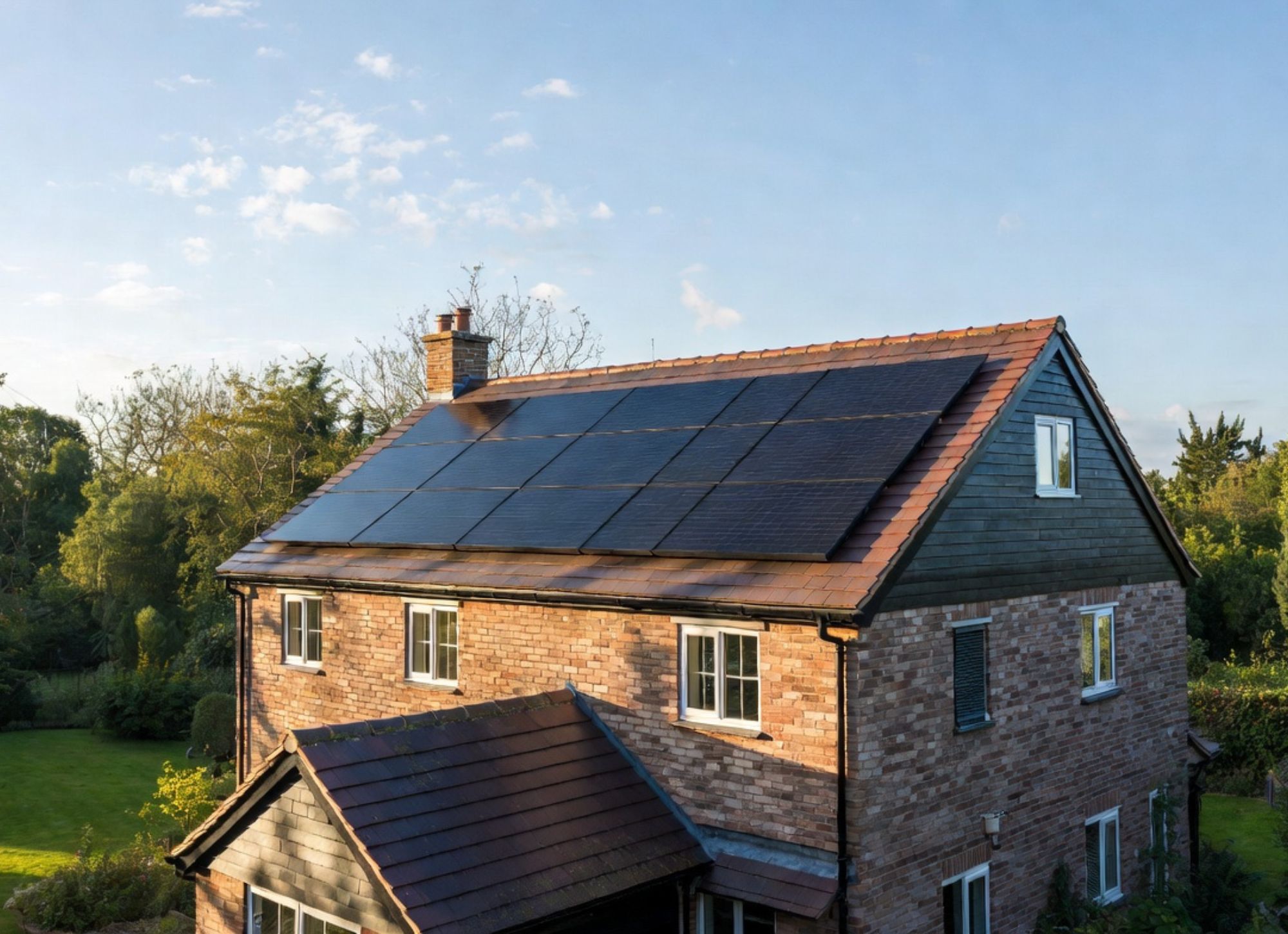
6 Best Solar Panels in 2026: Reviewed & Ranked By Our Experts
The best solar panels available in the UK right now are:
- LONGi Hi-MO X10 485W is the best overall solar panel for most UK homes in 2026
- AIKO Neostar 3S, REA Fusion2 Type R,
- JA Solar JAM54D-40-455,
- REC Alpha Pure,
- Qcells Q.Peak DUO BLK ML-G9 for budget-conscious buyers
Whether you are in London, Brighton, Bristol, Southampton, Oxford, or Cardiff, the right panel for your roof depends on your available space, budget, and energy goals. Read on for our full breakdown of each one.
6 Best Solar Panels in 2026: At A Glance
The best solar panels are not a one-size-fits-all decision. Here is a quick comparison of our top-ranked solar panels to help you get a feel for how each one stacks up before we dive into the full reviews.
| Solar Panel | Best For | Efficiency | Power Output | Product Warranty | Performance Warranty |
|---|---|---|---|---|---|
| LONGi Hi-MO X10 485W | Best overall | 23.8% | 485W | 30 years | 88.85% after 30 years |
| AIKO Neostar 3S | Highest efficiency | 22.4–23.5% | 460–515W | 25 years | 90.3% after 25 years |
| REA Fusion2 Type R | Premium UK weather performance | 22.1–23.6% | 440–470W | 25 years | 88.5% after 25 years |
| JA Solar JAM54D-40-455 | Best value | ~22.5% | 420–455W | 25 years | 87%+ after 25 years |
| REC Alpha Pure | Compact premium | ~22.3% | 400–430W | 25 years | 92% after 25 years |
| Qcells Q.Peak DUO BLK ML-G9 | Budget-friendly brand | 20.6% | 385W | 12 years | 86% after 25 years |
6 Best Solar Panels in 2026: Ranked By Our Experts
The best solar panels ranked by our experts cover every type of UK homeowner, from those who want the highest efficiency to those looking for reliable performance at a sensible price. Below, we walk through each panel in detail so you can make a confident, informed choice for your home.
1. LONGi Hi-MO X10 485W: Best Overall Solar Panel
The LONGi Hi-MO X10 485W earns its place at the top of our best solar panels list by combining outstanding efficiency, strong power output, and impressive long-term performance credentials that suit the vast majority of UK roofs.
LONGi is the largest solar panel manufacturer in the world by volume, and the Hi-MO X10 is their flagship residential panel, built on their advanced HPBC 2.0 (all back-contact) cell technology. What does back-contact mean in simple terms?
It means all the electrical connections are moved to the rear of the panel, which frees up more of the front surface to absorb sunlight. The result is a cleaner-looking, all-black panel that also performs better.
At 23.8% efficiency and 485 watts of power output, the Hi-MO X10 delivers a huge amount of energy from a relatively small area of roof. For UK homes, where usable roof space is often limited by chimneys, skylights, and roof angles, that matters enormously.
The panel also has a first-year degradation of less than 1% and just 0.35% annual degradation from year two onwards, meaning it holds its performance well over the decades.
The 30-year product warranty and 30-year performance warranty are exceptional for a mainstream residential panel and give homeowners genuine confidence in their long-term investment.
Key Stats at a Glance:
- Power output: 485W
- Efficiency: 23.8%
- Product warranty: 30 years
- Performance warranty: 88.85% output after 30 years
- Temperature coefficient: -0.26%/°C
- Cell technology: HPBC 2.0 back-contact
- Weight: 21.6kg
- Estimated panel cost: £90–£120 per panel
- Estimated installed system cost (4kW, ~8 panels): £7,500–£10,000
Pros:
- Very high 23.8% efficiency, ideal for limited roof space
- Strong 485W power output
- Clean all-black aesthetic suits most UK homes
- Industry-leading 30-year product and performance warranty
- Low annual degradation rate for long-term savings
- Widely available through UK installers
Cons:
- Warranty is manufacturer-backed, not insurance-backed
- Premium performance comes with a higher upfront panel cost
Is the LONGi Hi-MO X10 Right for You?
Choose the LONGi Hi-MO X10 if…
- You want the best overall solar panel for a typical UK pitched roof
- Your roof space is limited and you need maximum output per panel
- You value a long 30-year warranty from a globally trusted manufacturer
- Aesthetics matter to you and you want a sleek all-black finish
Do not choose the LONGi Hi-MO X10 if…
- You are on a tight budget and a reliable mid-range panel would meet your energy needs just as well
- Your installer does not supply or recommend this model, as system design matters as much as panel choice
2. AIKO Neostar 3S: Best for Efficiency and Low-Light Performance
The AIKO Neostar 3S is the most technically efficient solar panel in our ranking of the best solar panels for 2026, and it stands out as a superb choice for homes where squeezing maximum output from every square metre of roof is the priority.
AIKO was founded in 2009 and has quickly become one of the most respected names in high-efficiency cell technology. The Neostar 3S uses all back-contact (ABC) cell architecture, which removes the metal busbars from the front of the panel and moves all electrical contacts to the rear. This expands the active cell area and drives efficiency up to an impressive 22.4–23.5% range.
What makes the AIKO particularly well-suited to UK conditions is its excellent shade-mitigation behaviour. Unlike conventional panels, which can lose output from an entire third of their surface when even a small shadow falls across them, the AIKO’s back-contact technology allows current to flow through smaller groups of cells independently.
In other words, a passing shadow from a chimney or nearby tree causes far less disruption to your overall output.
The AIKO also performs very well in terms of temperature. Its temperature coefficient sits at around -0.22%/°C, which is the best in our entire comparison. On hot summer days when roof temperatures can climb to 60–70°C, the AIKO loses less power than most rivals.
Key Stats at a Glance:
- Power output: 440–515W
- Efficiency: 22.4–23.5%
- Product warranty: 25 years
- Performance warranty: 90.3% after 25 years
- Temperature coefficient: -0.22%/°C
- Weight: 20.6kg
- Estimated panel cost: £100–£130 per panel
- Estimated installed system cost (4kW, ~8 panels): £8,000–£11,000
Pros:
- One of the highest efficiency ratings of any residential solar panel available in the UK
- Excellent shade performance thanks to back-contact cell design
- Best-in-class temperature coefficient for hot weather output
- 25-year product warranty with strong degradation profile
- Lightweight relative to its power output
Cons:
- Higher-output AIKO versions can be physically larger, which may cause layout challenges on smaller UK roofs
- Some higher-wattage variants use a white backsheet rather than all-black
- Generally priced above budget and mid-range alternatives
Is the AIKO Neostar 3S Right for You?
Choose the AIKO Neostar 3S if…
- Efficiency is your top priority and you want the best watts per square metre
- Your roof is partially shaded and you want a panel that handles it well
- You are installing in summer months and want strong heat performance
Do not choose the AIKO Neostar 3S if…
- Your roof is small and the larger panel dimensions create layout difficulties
- You need a fully all-black aesthetic and only want to consider panels with a black backsheet
3. REA Fusion2 Type R: Best Premium Panel for UK Weather
The REA Fusion2 Type R is one of the most compelling premium solar panels on the UK market in 2026, and it earns a strong place on our best solar panels list because it was genuinely designed with the unpredictability of British weather in mind.
REA panels use high-efficiency N-type HJT (heterojunction) cells, which are known for excellent performance in low light and cloudy conditions. Given that the UK sky is overcast for a significant portion of the year in areas like London, Bristol, Southampton, and Cardiff, this is a real advantage rather than just a marketing claim.
The bifacial design of the Fusion2 Type R means the panel can also capture reflected light from both sides, which is particularly useful on flat roofs or ground-mounted systems.
Perhaps the biggest differentiator for the REA Fusion2 is its insurance-backed warranty. Most solar panel warranties are tied directly to the financial health of the manufacturer. If a company ceases trading in 15 years, the warranty may become worthless.
REA’s insurance-backed warranty means there is a separate insurance policy covering the guarantee, providing homeowners with an additional layer of protection. The double-glazed construction further increases durability and reduces the risk of long-term deterioration.
Key Stats at a Glance:
- Power output: 440–470W (AC module: 460–515W)
- Efficiency: 22.1–23.6%
- Product warranty: 25 years
- Performance warranty: 88.5% after 25 years
- Temperature coefficient: -0.26%/°C
- Bifacial: Yes
- Warranty type: Insurance-backed
- Estimated panel cost: £110–£140 per panel
- Estimated installed system cost (4kW, ~8 panels): £8,500–£12,000
Pros:
- Excellent low-light and cloudy day performance, ideal for the UK
- Bifacial design for better energy capture in suitable conditions
- Double-glazed, durable build quality
- Insurance-backed warranty adds significant reassurance
- AC module version available with integrated Enphase microinverter
- Strong choice for shaded or multi-aspect roofs
Cons:
- Among the more expensive options per panel
- More limited availability than larger global brands like LONGi or JA Solar
- The premium features may not be necessary on a simple, unshaded south-facing roof
Is the REA Fusion2 Type R Right for You?
Choose the REA Fusion2 Type R if…
- You want a premium panel backed by a fully insurance-backed warranty
- Your roof faces multiple directions or receives partial shading
- You have a flat roof or ground-mounted system where bifacial gain is achievable
- You want one of the strongest low-light performers available in the UK
Do not choose the REA Fusion2 Type R if…
- Budget is your primary concern and a reliable mid-range panel would serve your roof equally well
- Your roof is large, simple, and unshaded, meaning the premium features would not be fully utilised
4. JA Solar JAM54D-40-455: Best Value Solar Panel
The JA Solar JAM54D-40-455 is our best value pick among the best solar panels in 2026, offering a compelling blend of reliable performance, strong efficiency, and an accessible price that suits a wide range of UK homeowners.
JA Solar is one of the most widely used Tier 1 solar panel manufacturers in the world, with a long track record of producing dependable residential panels at competitive prices. The JAM54D-40-455 uses modern cell technology to deliver approximately 22.5% efficiency, which is a very respectable figure that comfortably outperforms many older-generation panels still being installed across the UK.
With a 25-year product warranty and a performance warranty guaranteeing over 87% of original output after 25 years, the JA Solar offers solid long-term protection for your investment. Individual panels typically cost between £71 and £86, making them significantly more affordable than premium alternatives, without a dramatic drop in performance.
For homeowners in areas like Southampton, Brighton, or Oxford who want a reliable solar installation without stretching their budget to the absolute maximum, JA Solar represents one of the most sensible choices on the market.
Key Stats at a Glance:
- Power output: 420–455W
- Efficiency: ~22.5%
- Product warranty: 25 years
- Performance warranty: 87%+ after 25 years
- Temperature coefficient: -0.26%/°C
- Weight: 22.2kg
- Typical panel cost: £71–£86
- Estimated panel cost: £71–£86 per panel
- Estimated installed system cost (4kW, ~9–10 panels): £6,500–£8,500
Pros:
- Excellent value for money relative to performance
- Strong 22.5% efficiency competitive with far pricier panels
- Reliable Tier 1 manufacturer with global track record
- 25-year product warranty and solid degradation profile
- One of the most widely available panels in the UK
Cons:
- Not the highest-output or most premium option in our list
- Temperature performance is decent but not class-leading
- Bifacial variants available but not standard on all models
Is the JA Solar JAM54D-40-455 Right for You?
Choose the JA Solar JAM54D-40-455 if…
- You want reliable, efficient solar panels at a lower cost
- Your roof is a good size and you are happy to fit a few more panels rather than pay a premium per panel
- You want a widely available panel from a globally trusted manufacturer
Do not choose the JA Solar JAM54D-40-455 if…
- Your roof space is very limited and you need the absolute maximum efficiency per panel
- You want an insurance-backed warranty or specific premium features like bifacial design
5. REC Alpha Pure: Best Compact Premium Solar Panel
The REC Alpha Pure ranks among the best solar panels for homeowners who prioritise long-term build quality, outstanding degradation performance, and a well-established brand reputation above chasing the absolute highest wattage.
REC was founded in Norway in 1996, with manufacturing based in Singapore, and the company has built a strong reputation for producing high-quality panels with less reliance on the manufacturing practices associated with some lower-cost Chinese brands.
The Alpha Pure range uses a distinctive cell architecture with independent generating sections that improve output and shade tolerance compared with traditional string-cell layouts.
What really sets the REC Alpha Pure apart is its degradation guarantee. It guarantees 92% of original output after 25 years, which is notably stronger than most rivals in our list and means your panels will still be generating at close to their best well into the 2050s. The panels are also lead-free and RoHS compliant, which is worth knowing for environmentally conscious homeowners.
The main practical limitation is that the power output now looks modest compared with the latest 485W to 515W panels. For large, open roofs, the lower wattage per panel means you may need more panels to achieve the same system size. However, for compact or constrained rooftops, the REC Alpha Pure remains one of the most trusted choices available.
Key Stats at a Glance:
- Power output: 400–430W
- Efficiency: ~22.3%
- Product warranty: 25 years
- Performance warranty: 92% after 25 years
- Temperature coefficient: -0.26%/°C
- Weight: 21.5kg
- Estimated panel cost: £95–£125 per panel
- Estimated installed system cost (4kW, ~9–10 panels): £7,500–£10,500
Pros:
- Industry-leading 92% output retention after 25 years
- Excellent build quality and long-term reliability
- Lead-free, environmentally responsible manufacturing
- Strong brand reputation and installer confidence
- Good shade tolerance from independent cell architecture
Cons:
- Lower maximum wattage than many newer panels on the market
- Higher price per watt relative to competitors with more modern output levels
- Not the best choice for maximising output on large roofs
Is the REC Alpha Pure Right for You?
Choose the REC Alpha Pure if…
- You want a premium panel with one of the best long-term degradation guarantees available
- You care about brand heritage, build quality, and environmental credentials
- Your roof space is limited and you want a compact panel that holds its performance extremely well over time
Do not choose the REC Alpha Pure if…
- You have a large, open roof and want to maximise total system output, where a higher-wattage panel makes more economic sense
- Budget is the primary consideration
6. Qcells Q.Peak DUO BLK ML-G9: Best Budget-Friendly Brand Option
The Qcells Q.Peak DUO BLK ML-G9 rounds out our best solar panels ranking as a solid, budget-conscious option from a well-known solar brand that many UK homeowners will recognise.
Qcells has a respected history in the solar industry, and the Q.Peak DUO range has been widely installed across UK homes over the past several years. The all-black design gives it a clean aesthetic, and the -0.25%/°C temperature coefficient is respectable.
At approximately 19.1kg, it is also lighter than most of the other panels in our comparison, which can be helpful for roofs with structural limitations.
The honest assessment is that the Qcells Q.Peak DUO BLK ML-G9 is no longer cutting-edge. With 20.6% efficiency and 385W of power, it trails the top 2026 panels by a meaningful margin.
Its 12-year product warranty is also shorter than the 25-year warranties offered by most of its rivals. However, for homeowners on a tighter budget who want a panel from a familiar, reputable brand, it remains a perfectly viable option.
Key Stats at a Glance:
- Power output: 385W
- Efficiency: 20.6%
- Product warranty: 12 years
- Performance warranty: 86% after 25 years
- Temperature coefficient: -0.25%/°C
- Weight: 19.1kg
- Typical panel cost: £63–£99
- Estimated panel cost: £63–£99 per panel
- Estimated installed system cost (4kW, ~10–11 panels): £5,500–£7,500
Pros:
- Recognised, trusted brand name with a track record in the UK
- Lightweight design suitable for roofs with structural constraints
- Good heat resistance performance
- Often available at a lower installed cost
- All-black design maintains a clean roofline appearance
Cons:
- Lower efficiency and output than all other panels in our ranking
- 12-year product warranty is shorter than competitors
- No longer a market-leading panel in terms of technology
Is the Qcells Q.Peak DUO BLK ML-G9 Right for You?
Choose the Qcells Q.Peak DUO BLK ML-G9 if…
- Budget is your primary constraint and you want a panel from a known brand
- Your roof has structural limitations and a lighter panel is important
- You are not looking for maximum output and just want a reliable, solid installation
Do not choose the Qcells Q.Peak DUO BLK ML-G9 if…
- You want the best efficiency or highest-output panel available in 2026
- Long warranty coverage is important to your decision-making
How Did We Rank the Best Solar Panels?
At EE Renewables, we ranked the best solar panels based on hands-on installation experience across Southern England, Greater London, South West England, and South Wales, combined with a rigorous assessment of technical data and real-world performance in UK conditions. We have assessed hundreds of systems installed on UK homes in locations ranging from London and Brighton to Bristol and Cardiff, giving us genuine insight into how different panels perform on British rooftops across different seasons, roof types, and shading scenarios.
Our ranking criteria are designed to go beyond headline wattage figures and focus on what actually matters once your panels are installed and generating electricity for your home. Here is what we assessed:
- Real-world UK performance: How well the panel generates electricity under cloudy skies, in low-light conditions, and during the UK’s cooler months, not just in ideal test conditions
- Panel efficiency: The percentage of sunlight converted into usable electricity, a critical factor for homes with limited roof space
- Power output (wattage): The maximum power a single panel can produce, which directly influences the size of system you can fit on your roof
- Product warranty length: How long the manufacturer guarantees the panel against defects in materials and build quality
- Performance warranty and degradation rate: How much power the panel retains over 25–30 years, since lower degradation means higher long-term generation and savings
- Temperature coefficient: How much performance is lost as the panel heats up on sunny days, when roof temperatures can reach 60–70°C
- Shade mitigation technology: How the panel handles partial shading from chimneys, trees, and neighbouring rooftops, a common challenge across UK urban and suburban homes
- Build quality and durability: Including glass type, frame construction, and resistance to moisture ingress
- Brand reputation and financial stability: Whether the manufacturer has a reliable global presence and is likely to honour warranties in 10, 20, or 30 years
- UK availability and installer support: Whether the panel is readily available to MCS-certified UK installers
- Value for money: The balance between panel cost and performance across the full lifetime of the system, not just purchase price
- Aesthetics: Particularly the all-black designs most popular with homeowners across Southern England and South Wales who want a clean, unobtrusive roofline
How to Choose the Best Solar Panels for Your Property
Choosing the best solar panels for your property involves more than just picking the highest-wattage model from a list. The right panel for a London terraced house with a partially shaded roof is very different from the right panel for a large detached home in Cardiff with a wide, open south-facing roof. Here is what you should think through before making any decisions.
Your Available Roof Space
Your available roof space is one of the most important factors in choosing between solar panels, because it directly affects how many panels you can fit and therefore how large your solar system can be.
If your usable roof area is limited, higher-efficiency panels like the LONGi Hi-MO X10 or AIKO Neostar 3S are worth the premium cost because they generate more electricity per square metre. On a larger roof, you can often achieve a similar system output by fitting more panels at a lower cost per panel, making value-oriented options like the JA Solar JAM54D-40-455 a smarter financial choice.
Shading and Roof Orientation
Shading and roof orientation have a significant influence on which solar panel will deliver the best real-world results for your property, particularly in urban areas across Greater London and Southern England where nearby buildings, trees, and chimneys are common.
Panels with advanced back-contact or multi-diode technology, such as the AIKO Neostar 3S, LONGi Hi-MO X10, and REA Fusion2 Type R, handle partial shading much better than standard panels. South-facing roofs with no shading give every panel the best conditions, but east-west split orientations can also work well, especially when combined with battery storage.
A professional site survey from an MCS-certified installer will assess your specific shading patterns accurately. EE Renewables offer free site surveys.
Your Budget and Long-Term Goals
Your budget and long-term goals will shape which tier of solar panel is the right fit, since the gap between premium and budget options is often smaller in real-world output than the price difference suggests.
A complete solar panel installation for a typical three-bedroom UK home costs between £6,500 and £9,000 for panels only, rising to around £10,000 to £14,000 or more if you include battery storage. If you plan to stay in the property for 20 or more years, investing in a premium panel with a longer warranty and lower degradation rate makes strong financial sense.
If you are a landlord or plan to sell in fewer than 10 years, a reliable mid-range panel like the JA Solar may offer a better return on investment. The payback period for a well-designed UK solar system typically falls between six and ten years.
Panel Efficiency and Power Output
Panel efficiency and power output are closely related but not the same thing, and understanding both will help you compare solar panels more accurately.
Efficiency is expressed as a percentage and tells you how much of the sunlight hitting the panel is converted into electricity. A 23.8% efficient panel like the LONGi Hi-MO X10 converts nearly a quarter of all incoming sunlight into usable power.
Power output, measured in watts, tells you the maximum electricity a single panel produces under ideal test conditions. Higher efficiency usually means you can generate more power from a smaller physical area, which is valuable on most UK rooftops.
Warranty Coverage
Warranty coverage is an aspect of solar panel selection that homeowners often overlook but which matters enormously over the lifetime of a solar system.
There are two warranties to compare. The product warranty covers manufacturing defects and physical faults. The performance warranty guarantees that the panel will still be producing a minimum percentage of its original output after a set number of years.
A panel like the REC Alpha Pure guarantees 92% of output after 25 years, which is among the best in the industry. You should also check whether the warranty is insurance-backed, as with the REA Fusion2 Type R, because a manufacturer-only warranty is only as good as the company that stands behind it.
Solar Battery Storage Compatibility
Solar battery storage compatibility is increasingly important for UK homeowners who want to make the most of their solar generation, especially during the shorter days of autumn and winter.
Adding a solar battery to your system means you can store electricity generated during the day and use it in the evening when the sun is not shining. This significantly increases the proportion of your own solar power you actually consume, known as self-consumption, reducing what you need to buy from the grid.
The most popular battery brands in the UK include Tesla Powerwall, GivEnergy, SolarEdge, and Sonnen. Your installer should confirm that your chosen panel brand is compatible with the battery and inverter system they recommend for your home.
Aesthetics and Planning Considerations
Aesthetics and planning considerations matter more than many homeowners initially expect, particularly in older residential areas, conservation zones, or properties with heritage features across parts of London, Bristol, and Cardiff.
Most UK homes use standard pitched tiled roofs where all-black panels are the preferred choice for a clean, unobtrusive appearance. The LONGi Hi-MO X10, AIKO Neostar 3S, and JA Solar full-black variants all offer sleek all-black aesthetics that blend well with dark roof tiles.
If your property is listed or falls within a conservation area, you may need to check with your local planning authority before installation, though the majority of residential solar installations in England and Wales fall under permitted development rights.
Get Your Free Solar Panel Installation Quote from EE Renewables
At EE Renewables, we make it straightforward to find out exactly which solar panels are right for your home and what your installation will cost. We provide expert solar panel installation and solar battery storage solutions across Southern England, Greater London, South West England, and South Wales, covering areas including London, Brighton, Oxford, Southampton, Bristol, and Cardiff.
Request your free, no-obligation solar panel installation quote today.
Every quote we provide is tailored to your specific property, roof type, and energy use. We do not offer generic off-the-shelf pricing because no two roofs are the same. Whether you want the best overall performance, the most affordable option, or a premium system with battery storage, our team will help you find the right solution and give you all the information you need to make a confident decision.
Frequently Asked Questions About the Best Solar Panels
Can I mix different brands of solar panels on the same roof?
Technically, it is possible to mix different solar panel brands on the same system, but it is generally not recommended. Panels with different wattages, efficiencies, and electrical characteristics can create compatibility issues within a string inverter system, where the lowest-performing panel can drag down the output of the whole string.
If you need to replace a damaged panel years after installation, your installer will try to match the original specification as closely as possible. For a new installation, choosing a single consistent panel brand and model throughout your system is always the better approach.
Do solar panels add value to a UK home?
Research and industry evidence consistently suggest that solar panels add value to UK residential properties. A home with an existing solar panel system and a strong Energy Performance Certificate (EPC) rating is increasingly attractive to buyers who want to reduce their energy costs from day one.
The Smart Export Guarantee means the new owner can also earn income from surplus electricity exported to the grid, adding another financial incentive. The exact uplift in property value varies by location and system size, but solar panels are now widely recognised as a positive addition rather than a cosmetic concern.
What size solar panel system do I need for my home?
The right system size depends on your household’s electricity consumption, the size of your roof, and how much you want to offset from the grid. As a general guide, a typical two-bedroom home uses around 2,500–3,000 kWh of electricity per year and suits a 3–4kW solar system.
A three to four-bedroom family home typically uses 3,500–4,500 kWh per year and suits a 4–6kW system. Adding battery storage means you can make better use of a larger system because you store surplus daytime generation for evening use rather than exporting it at a lower rate.
How long do solar panels actually last?
Modern solar panels are built to last 25 to 30 years and often continue generating electricity beyond that, though at a reduced level due to natural degradation. The performance warranties offered by brands like LONGi, AIKO, and REC all guarantee meaningful output levels at the 25 or 30-year mark, typically in the range of 87–92% of original capacity.
The inverter, which converts the DC electricity from your panels into usable AC electricity for your home, generally has a shorter lifespan of 10–15 years and may need replacing during the lifetime of the system.
Will solar panels work on a north-facing roof?
North-facing roofs are not ideal for solar panels in the UK, as they receive significantly less direct sunlight than south, east, or west-facing roofs. That said, a north-facing installation is not necessarily worthless.
Depending on your location, roof pitch, and how much of the year sees diffuse daylight rather than direct sun, a north-facing system can still generate a meaningful contribution to your electricity needs. Your installer should model your specific roof accurately using solar design software before making any recommendations.
For homes with both a south-facing and north-facing roof section, prioritising the south-facing area and supplementing with east or west panels often gives the best overall system performance.
