


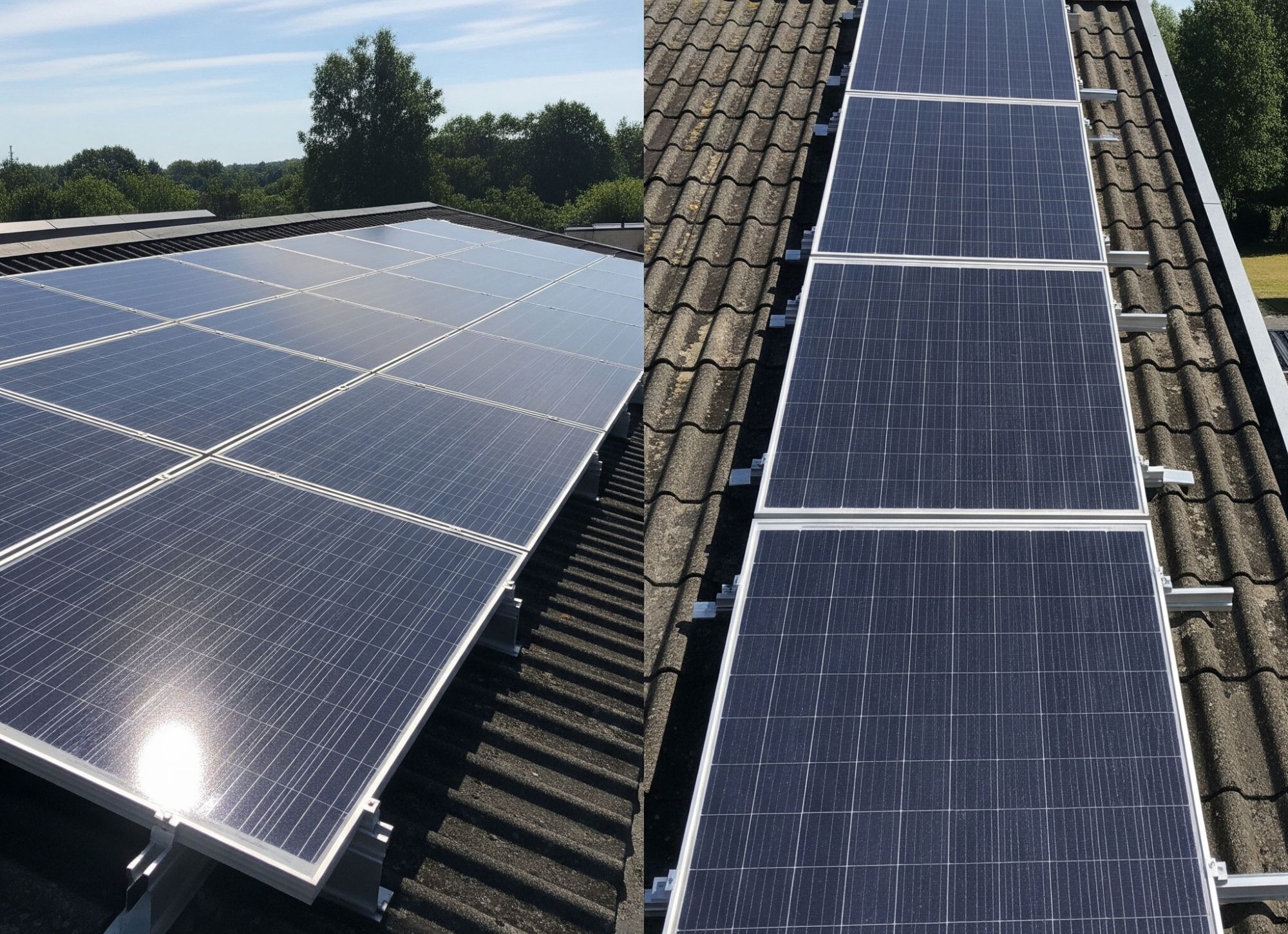
Horizontal Vs Vertical Solar Panel Installation: Benefits & Costs 2025
As the UK continues to accelerate its transition to clean energy, homeowners, landlords, and commercial property owners are increasingly investing in solar panel systems.
One crucial consideration in this investment is the orientation of the panels, should you opt for a horizontal or vertical solar panel installation?
In this guide, we explore everything you need to know about, helping you make an informed decision tailored to your property’s needs and location.
Horizontal Vs Vertical Solar Panels: A Quick Overview
When deciding between horizontal and vertical solar panel installations, several factors come into play, from performance and installation requirements to aesthetics and long-term maintenance. The comparison table below provides a helpful overview to get you started:
| Feature | Horizontal Panels | Vertical Panels |
|---|---|---|
| Energy Efficiency | Higher (optimal tilt for UK sun) | Lower (less exposure to peak sunlight) |
| Performance in UK Climate | Performs better year-round | Better for snow/rain runoff, but lower output |
| Installation Costs | Generally lower | Higher due to additional mounting systems |
| Installation Requirements | Needs south-facing or angled roof | Can be mounted on vertical surfaces/walls |
| Lifespan | 25-30 years | 25-30 years |
| Best Suited Properties | Pitched roofs, larger rooftops | Limited roof space, flat roofs, facades |
| Maintenance & Cleaning | Easier due to tilt and runoff | Requires more manual cleaning |
| Servicing Accessibility | Easily accessible | Can be harder to access if wall-mounted |
| Aesthetics | More conventional appearance | Modern, architectural integration |
Horizontal Solar Panel Systems
Horizontal solar panels are typically installed flush with pitched or flat rooftops, facing south in the Northern Hemisphere to maximise exposure to direct sunlight throughout the day.
In the UK, an angle of 30 to 40 degrees is considered optimal, as it aligns closely with the sun’s arc during all four seasons, ensuring balanced energy generation across both summer and winter months.
This tilt allows the panels to harness solar irradiance efficiently, converting sunlight into electricity using photovoltaic (PV) cells.
When mounted on a pitched roof, horizontal panels generally require minimal racking or structural adjustment, making installation faster and more cost-effective compared to complex configurations.
For flat roofs, mounting systems such as ballasted frames or tilted brackets are often used to achieve the optimal pitch angle without penetrating the roof membrane, a common practice in commercial and larger-scale domestic installations.
Horizontal systems are also better suited for string inverters or microinverters, as they typically receive uniform sunlight across the array. This setup minimises issues like shading and mismatch losses, leading to more consistent performance.
According to the Energy Saving Trust, panels tilted between 30° and 40° facing true south can generate between 850–950 kWh of electricity per kW installed annually in the UK, making horizontal configurations the gold standard for residential solar installations.
In snowy conditions, the tilted design promotes self-shedding of debris and precipitation, reducing manual cleaning needs and maintaining consistent efficiency.
Additionally, the airflow beneath horizontally mounted panels helps with passive cooling, reducing the risk of overheating, which can degrade panel performance over time.
| Pros | Cons |
|---|---|
| Better sun exposure throughout the year | Requires adequate roof space |
| Lower installation costs | Not suitable for all property types (e.g., shaded roofs) |
| Easier to clean and maintain | May not align with modern aesthetics |
| Proven efficiency in UK conditions |
Vertical Solar Panel Systems
Vertical solar panel systems are installed at a 90-degree angle on upright surfaces such as exterior walls, building facades, fencing, balcony railings, or even bespoke ground-mounted structures.
Rather than being tilted toward the sun, vertical panels face directly outward, often oriented towards the south, east, or west depending on the available surface and property layout.
In the UK’s northern climate, vertical panels are especially effective during the winter months.
During this time, the sun’s lower position in the sky casts solar rays at a shallower angle, allowing vertical systems to capture more sunlight than traditional sloped panels might in low-light conditions.
This makes them particularly valuable for urban buildings, north-south terraced homes, or multi-storey blocks where the roof may not receive sufficient exposure, or space is constrained.
Unlike traditional horizontal arrays, vertical solar systems often double as building-integrated photovoltaics (BIPV). These are integrated into the architecture itself, replacing façade cladding, railings, or external shading devices.
This dual-purpose approach enhances both energy efficiency and design aesthetics, while also contributing to thermal insulation benefits by reducing solar heat gain on building envelopes.
However, vertical systems do come with inherent limitations in annual output. In the UK, vertically oriented PV panels typically produce 20–30% less energy annually than optimally tilted horizontal systems.
The efficiency loss stems from reduced sunlight exposure during the high summer months when the sun is overhead.
To mitigate performance drops, many vertical systems employ bifacial solar panels, which can capture reflected light from surrounding surfaces like pavements, snow, or adjacent structures, especially in open, urban courtyards or south-facing facades.
These panels are particularly effective in high-albedo environments, where more light is reflected onto the rear surface of the module.
Vertical installations may also benefit from microinverter technology, which allows each panel to operate independently, a useful feature when panels receive uneven solar exposure due to shadows cast by neighbouring buildings, trees, or architectural protrusions.
Lastly, vertical installations often have higher visual impact, which can be a positive design feature on modern or eco-conscious developments.
However, in conservation areas or listed properties, vertical panels may require planning permission or architectural approvals due to visibility from the street.
| Pros | Cons |
|---|---|
| Ideal for properties with limited roof space | Lower overall efficiency in UK climate |
| Better snow and rain runoff | Higher installation complexity and cost |
| Aesthetic integration with modern architecture | Harder to clean and service |
| Potential for bifacial panels to collect reflected light |
Horizontal Vs Vertical Solar Panel Systems: Key Differences
To decide which orientation is right for your property, it’s essential to delve deeper into the differences.
Energy Efficiency
Horizontal solar panels have a distinct edge in energy efficiency due to their optimal tilt angle, which allows them to capture maximum solar irradiance throughout the year.
In the UK, where the average solar irradiance is approximately 950–1,200 kWh/m² annually, a tilt of 30–40 degrees, facing true south, allows panels to align with the sun’s path, ensuring consistent energy generation across seasons.
By contrast, vertical panels, though effective in capturing low-angle winter sunlight, receive significantly less direct exposure during the peak summer months when the sun is high overhead.
As a result, they typically produce 20–30% less electricity annually compared to optimally tilted horizontal systems.
Additionally, horizontal arrays are less affected by diffuse light limitations and offer better irradiance capture across longer daily sun hours, particularly in spring and summer when generation potential is at its highest.
This makes horizontal installations more suitable for homeowners aiming to maximise self-consumption and reduce reliance on grid electricity.
However, it’s worth noting that vertical bifacial panels, which can absorb light from both the front and rear surfaces may partially offset some efficiency losses by harvesting reflected sunlight from walls, pavements, or snow.
Still, this performance gain is highly location-dependent and typically doesn’t compensate fully for the loss of direct irradiance.
Winner: Horizontal Panels
Energy Efficiency Output Table (per kWp Installed)
| Orientation | Average Annual Output (UK) |
|---|---|
| Horizontal (30° tilt) | 850-1,050 kWh/kWp |
| Vertical | 650-750 kWh/kWp |
Performance in UK Climate
Horizontal solar panel systems, particularly those tilted between 30–40 degrees and facing south, are best suited to capture both direct and diffuse sunlight across all four seasons.
Their orientation ensures greater sun exposure during midday and summer months, which are responsible for the bulk of annual solar yield.
Even under cloud cover, modern photovoltaic (PV) panels can still convert diffused light into electricity and the broad exposure surface of a horizontal system maximises this potential.
The lower angle of the sun during winter in the UK, often as low as 15° above the horizon does reduce horizontal panel output somewhat.
However, due to the longer summer days and higher sun angle from May to August, horizontal systems still maintain superior year-round consistency in energy production.
On the other hand, vertical solar panels may experience a relative performance advantage during winter, particularly on south-facing walls.
Their upright angle makes them more effective at capturing low-angle sunlight, which strikes vertical surfaces more directly in winter.
This can make vertical systems a viable complementary option for properties looking to boost cold-season energy production, such as in hybrid or east-west installations.
However, in the UK, winter accounts for only around 15–20% of total annual solar generation.
So while vertical systems may outperform horizontal panels on select winter days, the net annual performance remains lower overall due to poorer capture during long, high-sun summer days.
In terms of temperature performance, both systems benefit from the UK’s relatively mild climate.
PV panels lose efficiency as temperature increases, but average UK temperatures (around 9–12°C) support stable operation without significant overheating losses, giving horizontal panels a further edge by maintaining efficient output in warmer months.
According to Solar Energy UK, a well-positioned horizontal system in the south of England can produce 900–1,000 kWh per kW annually, compared to 650–800 kWh from a vertical system, a 20–30% output gap.
Winner: Horizontal Panels
Installation Costs
Horizontal solar panel systems are typically more cost-effective to install, particularly on pitched roofs or large flat commercial roofs.
These installations benefit from standardised components such as pre-fabricated mounting rails, roof anchors, and pre-approved racking systems. Labour time is also shorter due to the ease of access and the routine nature of the installation process.
For example:
- A 4kW horizontal system on a pitched roof may cost around £6,000–£7,500, fully installed.
- Installation time is typically 1–2 days, depending on roof access and weather conditions.
In contrast, vertical solar panel installations often incur higher upfront costs. This is due to the need for custom mounting solutions, particularly when panels are integrated into building façades, balcony railings, or bespoke structures like fences and external shading devices.
In some cases, panels must be embedded into architectural designs, which may require engineered frameworks, additional weatherproofing, or structural reinforcements.
Furthermore, vertical installations often involve:
- Additional design and structural assessments
- Potential planning permission (especially on visible façades or listed buildings)
- Increased labour time and scaffolding costs
- Higher specialist contractor rates due to the non-standard setup
Vertical systems on commercial properties or multi-storey blocks can be particularly expensive to install due to height restrictions, safety considerations, and the need for custom access equipment such as MEWPs (Mobile Elevated Work Platforms).
Estimated Installation Cost Table (Incl. VAT)
| System Size | Orientation | Avg. Cost (Incl. VAT) | Notes |
|---|---|---|---|
| 3kW System | Horizontal | £4,500 – £6,000 | Standard rooftop installation; most economical |
| Vertical | £6,000 – £7,800 | Façade-mounted or custom structures; higher design and labour costs | |
| 4kW System | Horizontal | £6,000 – £8,000 | Most common system size for UK homes |
| Vertical | £8,000 – £11,200 | Customised installs on walls, balconies, or non-standard surfaces | |
| 6kW System | Horizontal | £8,500 – £10,500 | Suitable for larger homes or homes with EVs and battery storage |
| Vertical | £11,500 – £14,000 | Often used in commercial or high-demand residential applications |
The average residential solar PV system in the UK is typically 3–4kW, according to Ofgem and the Energy Saving Trust. This size generally provides enough electricity to cover 50–70% of an average household’s annual consumption.
Winner: Horizontal Panels
EE Renewables provides expert commercial and residential solar installations across Southern England. Request a free, no-obligation quote today tailored to your property and region.
Installation Requirements
The installation requirements for solar panels can significantly influence system performance, cost, and feasibility, especially when considering differences between horizontal and vertical orientations.
These requirements depend on property layout, available space, local planning constraints, and structural considerations.
Horizontal solar panel installations are most effective on pitched roofs that are oriented towards the south, with minimal shading from chimneys, trees, or nearby buildings.
These installations typically require:
- A south, southeast, or southwest-facing roof
- At least 10–20m² of clear, unshaded roof space
- A roof in good structural condition, ideally with minimal obstructions
- Suitable access for mounting brackets and inverter placement (typically in loft or garage)
On flat roofs, horizontal panels are installed using tilted mounting systems, which may require additional ballast to prevent wind uplift.
However, flat roof installations are common for commercial buildings, bungalows, or modern residential extensions, and can be customised for optimal orientation.
Vertical solar panel systems, on the other hand, provide a flexible alternative for properties that lack traditional roof space or have complex roof geometries. These panels are mounted on vertical surfaces like:
- Building facades
- External walls or cladding systems
- Balcony railings or fencing structures
- Purpose-built vertical frames on the ground
Because of this flexibility, vertical panels are ideal for:
- Urban or high-rise properties where roof access is limited
- North–south terraced homes with limited south-facing roof availability
- Architecturally sensitive properties, where integration into the façade is preferred
However, vertical systems may come with additional requirements:
- Custom mounting hardware (e.g. rails, brackets, integrated BIPV systems)
- Scaffolding or specialist access equipment for installation
- Wind loading assessments and building envelope evaluations, particularly for taller properties or coastal regions
While horizontal systems are the default for most standard UK homes, vertical installations open opportunities for retrofits, urban buildings, and design-led renewable energy solutions, especially where horizontal installations aren’t feasible.
Winner: Tie
Both systems have distinct installation criteria. Horizontal systems are more straightforward and standardised, but vertical panels provide a creative solution for properties with non-traditional or restricted roof space.
Expert tip: Because of the technical expertise and safety precautions required, it’s best to hire a professional installer to set up a horizontal or vertical solar system instead of attempting to install solar panels yourself.
Lifespan
When it comes to longevity, horizontal and vertical solar panel systems generally share the same lifespan, typically between 25 to 30 years, depending on the quality of components, the installation standard, and ongoing maintenance.
This is because both orientations use the same core photovoltaic (PV) technology, materials, and manufacturing standards.
Most solar panels installed in the UK are made from monocrystalline or polycrystalline silicon, and are certified to perform under UK and EU standards.
As long as the panels are installed by an MCS-accredited installer, both horizontal and vertical arrays will be subject to similar performance warranties, often guaranteeing 80–85% of original efficiency after 25 years.
However, the actual lifespan of a solar PV system isn’t determined solely by the panels. It also depends on:
- Inverter lifespan (typically 10–15 years before needing replacement)
- Mounting hardware and its resistance to corrosion, weather, and wind uplift
- Site-specific conditions such as salt exposure (in coastal areas), pollution, and shade
In terms of wear and tear:
- Horizontal systems may be more exposed to debris buildup, particularly on flat roofs, but benefit from rain-driven self-cleaning and better airflow that helps with cooling.
- Vertical systems are less prone to debris accumulation on the surface but may suffer from greater wind load impacts depending on building height and façade orientation, especially in exposed or coastal locations.
Importantly, vertical panels, particularly those installed as building-integrated photovoltaics (BIPV) may require longer servicing intervals if integrated within cladding or facade systems, as accessing them may be more challenging than roof-mounted systems.
Well-maintained PV systems in the UK can last beyond 30 years with only gradual efficiency loss, making solar a reliable long-term investment regardless of panel orientation.
“The efficiency of solar panels typically degrades at a rate of around 0.5% per year, meaning after 25 years, your system could still be performing at around 87.5% of its original capacity.” – Energy Saving Trust
Winner: Tie
Both horizontal and vertical systems are designed for long-term durability when installed and maintained properly. The choice of orientation does not inherently affect system lifespan, quality of components and ongoing servicing are the most critical factors.
Best Suited Properties
Horizontal Solar Panels are the ideal choice for:
- Traditional detached and semi-detached homes with ample pitched or flat roof space facing south, southeast, or southwest.
- Properties with large, unobstructed rooftops that allow panels to be installed at the optimal tilt angle (typically 30–40° in the UK).
- Homes in suburban and rural areas where roof shading from trees or nearby buildings is minimal.
- Commercial properties and industrial units with expansive flat roofs that can accommodate larger solar arrays using ballasted mounting systems.
The benefits of horizontal panels here include maximised year-round energy generation, simpler installation, and ease of maintenance. These systems offer the best balance of efficiency and cost-effectiveness for typical UK houses.
Vertical Solar Panels are better suited to:
- Flats, apartments, and high-rise buildings where roof space is limited, inaccessible, or heavily shaded.
- Modern or urban homes with small or flat roofs that are not ideal for solar panel installation.
- Commercial buildings with architectural features such as glass façades, curtain walls, or areas where façade-mounted BIPV systems can be incorporated.
- Properties located in densely populated urban areas where rooftop installations face planning restrictions or where aesthetic considerations are paramount.
Vertical panels can be mounted on south-facing walls, balcony railings, or other upright surfaces, making them a versatile option for buildings that cannot accommodate horizontal arrays.
While vertical panels may have slightly lower energy output compared to horizontal arrays, they provide an opportunity to still harness solar energy in space-constrained environments.
In addition, vertical installations may contribute to the modern architectural appeal of new developments or eco-friendly retrofits, potentially increasing property value and attracting sustainability-conscious tenants or buyers.
Winner: Depends on Property Type
Choosing between horizontal and vertical solar panels is less about which technology is better overall, and more about which solution fits your property’s unique layout, planning environment, and energy needs.
A thorough site assessment by a qualified installer, such as EE Renewables is essential to determine the most effective system for your property.
Maintenance and Cleaning
While both horizontal and vertical systems are designed to be durable and weather-resistant, their orientation significantly impacts cleaning needs, accessibility, and ongoing servicing requirements.
Horizontal Solar Panels benefit greatly from their angled positioning. These panels naturally allow rainwater to wash away dust, debris, pollen, and light dirt. This is an effective and eco-friendly self-cleaning mechanism.
The natural rinsing reduces the need for frequent manual cleaning in most UK environments, especially in rural and suburban areas where pollution levels tend to be lower.
In addition, horizontal panels installed on pitched roofs are generally easier to access for routine inspections and maintenance, particularly if mounted on residential properties with safe roof access.
Cleaning is usually only necessary if panels become visibly dirty or after extreme weather events, such as heavy snowfall or storms.
According to the Energy Saving Trust, regular annual checks to inspect for damage, loose wiring, or shading issues are recommended, but intensive cleaning is rarely required.
Vertical Solar Panels, by contrast, often face increased maintenance challenges due to their upright positioning:
- Vertical panels do not benefit from rainwater runoff in the same way, meaning that pollutants, dust, and grime can accumulate more readily on their surface.
- This issue is particularly acute in urban and industrial areas of the UK, such as London, Bristol, or Cardiff, where air pollution, soot, and particulates from traffic and industry can rapidly degrade panel performance if not cleaned regularly.
- Panels mounted on façades or balconies may also collect bird droppings, pollen, and leaves, necessitating more frequent manual cleaning to maintain optimal output.
On top of that, accessibility for cleaning vertical panels can be more challenging, especially on multi-storey buildings or in tightly packed urban environments.
Cleaning may require specialist services, scaffolding, or the use of extendable tools, which can add to maintenance costs.
Maintenance and Servicing Comparison
| Maintenance Aspect | Horizontal Panels | Vertical Panels |
|---|---|---|
| Natural Rainwater Cleaning | Yes, effective due to tilt angle | No, minimal runoff; manual cleaning required |
| Frequency of Cleaning | Low (annual or bi-annual checks) | Higher (quarterly to bi-annual recommended in polluted areas) |
| Accessibility | Generally easier (roof access) | Can be difficult, may need scaffolding or specialist cleaners |
| Typical Annual Servicing Cost (UK) | £120 – £180 | £150 – £250 |
| Common Maintenance Tasks | Visual inspection, inverter check, debris removal | Panel cleaning, bird-proofing, inspection of mounting integrity |
Winner: Horizontal Panels
Aesthetics
Vertical Solar Panels excel in aesthetic flexibility, particularly in modern architecture and urban environments.
Because they can be seamlessly integrated into building facades, curtain walls, balconies, and shading devices, vertical panels offer a sleek, minimalist look that complements contemporary design trends.
In new builds and retrofits, vertical solar panels can be designed to:
- Match colour schemes and materials for a cohesive façade appearance
- Serve as architectural features, such as solar screens or pergolas
- Minimise the bulkiness and disruption often associated with rooftop arrays
For urban flats, apartments, and commercial developments in areas like London, Bristol, and Cardiff, vertical panels can be a practical way to generate solar power while adhering to strict planning regulations and conservation area restrictions.
The ability to mount panels flush with walls reduces visibility from street level, helping to maintain the character of heritage areas.
On the other hand, horizontal solar panels, while highly effective, are typically mounted on pitched roofs or flat rooftops, where they are more conspicuous.
On traditional homes, especially those with older or listed architecture, visible rooftop panels may be considered intrusive, leading to planning challenges or aesthetic objections from neighbours or local authorities.
However, horizontal panels do maintain a low profile on pitched roofs, blending into the roofline when installed correctly with slim frames and flush mounts.
They are also less likely to disrupt the architectural integrity of the façade, which may be an important consideration in historic districts.
Winner: Vertical Panels
Thanks to their versatility in design integration and lower visual impact on façades, vertical solar panels are often the preferred choice where aesthetics are a priority, particularly in modern developments, urban flats, and conservation-sensitive areas.
For homeowners and developers seeking to combine renewable energy with architectural style, vertical systems offer a compelling solution.
Winner: Vertical Panels
Horizontal Vs Vertical Solar Panel Systems: Which is Best for Your Property?
Choosing between horizontal and vertical solar panel systems is a pivotal decision that depends on a variety of property-specific factors.
Making the right choice ensures you maximise energy generation, achieve the best financial returns, and future-proof your renewable energy investment.
Key Factors to Consider:
1. Roof Space and Orientation
South-facing, unobstructed roofs with a tilt angle of 30–40 degrees offer the best conditions for horizontal solar panels in the UK.
This orientation aligns well with the sun’s path throughout the year, maximising exposure to solar irradiance and enabling consistent, high-volume energy production.
If your property has ample south-facing roof space, common in detached or semi-detached houses, horizontal systems are generally the most efficient and cost-effective choice.
The Impact of Proper Orientation on Savings
Well-positioned solar panels can reduce a household’s electricity bills by up to 70%.
Achieving such significant savings depends largely on system size, location, and crucially, the orientation and tilt of your panels. Poorly oriented panels, such as vertical arrays on unsuitable surfaces, may lead to diminished returns despite the same investment.
For most UK homes, horizontal panels facing south provide the ideal balance of cost, performance, and reliability. However, for urban flats or properties with limited roof options, vertical panels offer an important opportunity to participate in the green energy transition.
2. Architectural Constraints and Property Type
For properties such as flats, urban apartments, or buildings with complex roof shapes or limited roof space, vertical solar panels provide a valuable alternative.
Installed on walls, balconies, or façades, vertical systems can bypass the limitations imposed by lack of roof area or shading obstacles.
In conservation areas or listed buildings, vertical panels may also better meet planning requirements by reducing rooftop visibility and preserving historic aesthetics. Always check with your local planning authority via the Planning Portal to understand restrictions.
3. Energy Needs and Long-Term Goals
Horizontal panels typically produce 20–30% more energy annually compared to vertical systems due to better solar alignment and year-round efficiency.
This makes them the preferred option for homeowners and landlords aiming to maximise electricity generation, reduce grid reliance, and improve carbon footprint.
However, vertical panels can still significantly contribute to energy needs, especially when integrated creatively across a building’s façade or combined with other renewable technologies like battery storage.
4. Budget and Installation Costs
Horizontal systems generally have lower installation costs because of standardised mounting hardware, quicker installation times, and fewer custom components.
Vertical systems often require specialised mounting solutions, additional planning, and sometimes bespoke structural work, factors that raise upfront costs.
Despite this, the long-term financial benefits of solar energy often outweigh initial expenses, with government-backed schemes and incentives sometimes available to support installation.
Need expert guidance for your unique property? Contact EE Renewables for a tailored solar panel quote today. We cover London, Brighton, Cardiff, Bristol and surrounding areas.
FAQs
1. Can vertical solar panels qualify for UK government incentives?
Yes, both vertical and horizontal installations may qualify under schemes like the Smart Export Guarantee (SEG) and ECO4 depending on your installation and installer.
3. Do vertical panels work well in winter?
Yes, vertical panels can perform better than horizontal ones in winter due to the lower sun angle and improved snow shedding.
5. Can I combine both orientations?
Yes, hybrid systems can be installed where some panels are mounted horizontally and others vertically to maximise space and output.
Our Verdict
Choosing between horizontal and vertical solar panel installations ultimately depends on your property type, energy goals, and aesthetic preferences.
Horizontal systems remain the most efficient and cost-effective option for most UK homes, but vertical panels offer a compelling alternative for properties with space constraints or architectural considerations. Take the next step toward greener energy. Request your free quote from EE Renewables and get expert solar advice tailored to your home or commercial property across Southern England and Wales.
