


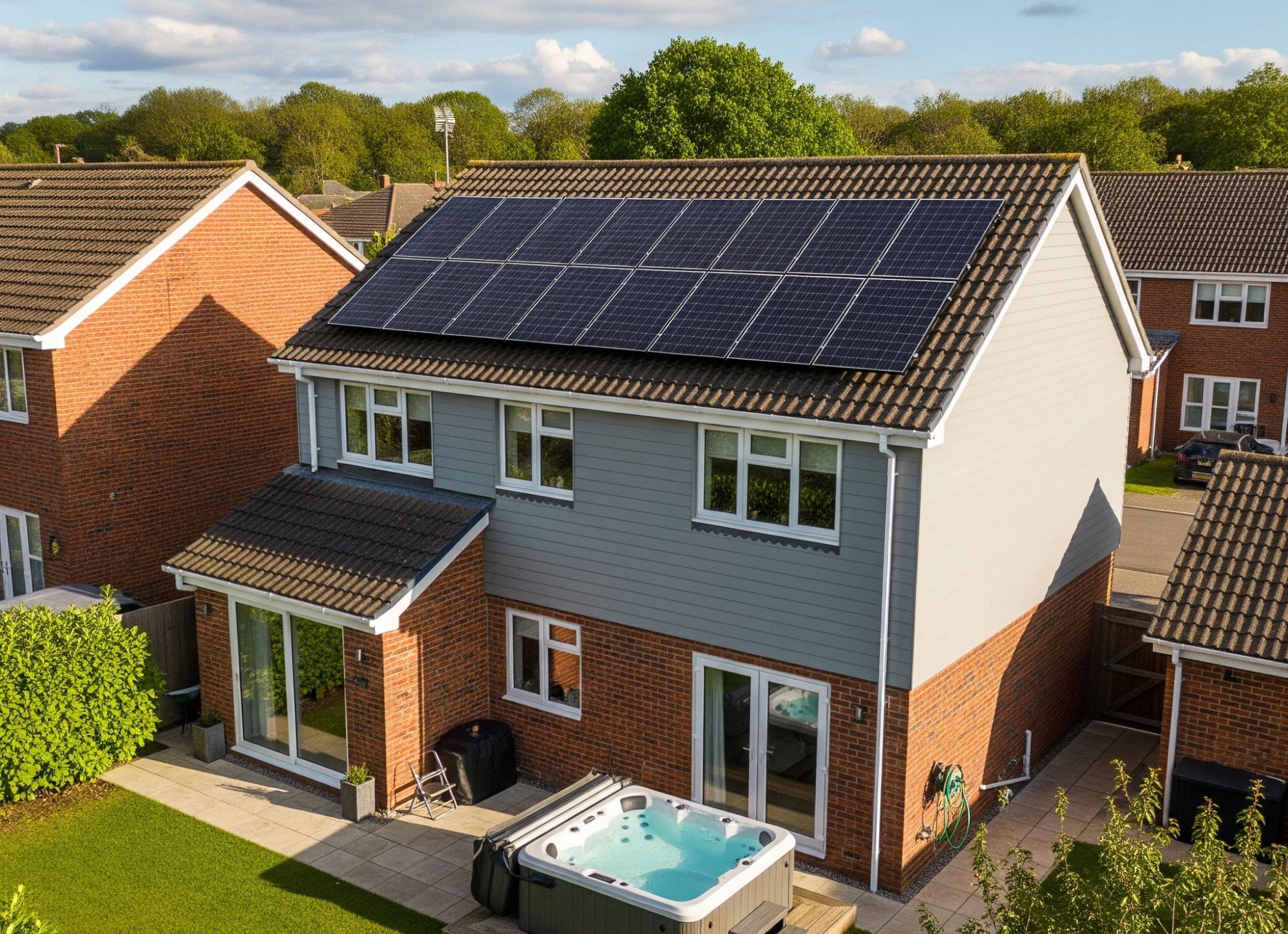
How Many Solar Panels Needed To Run A Hot Tub?
Most homeowners need somewhere between 4 and 11 solar panels to run a domestic hot tub, while commercial businesses such as spas and hotels typically need 20 to 120 or more solar panels, depending on how many tubs they run and how often guests use them.
In this guide, we will walk through exactly how many panels a typical residential hot tub needs, how many a commercial spa, hotel, or leisure business might need, and the specific factors that push that number up or down.
We will also look at whether solar can realistically power a hot tub all year round, how battery storage and payback periods differ between homes and businesses, and the actual formulas installers use, so you can work out your own numbers or come prepared with the right questions when you speak to a solar installer.
How Many Solar Panels Are Needed To Run A Hot Tub At Home?
Residential hot tubs typically need between 4 and 11 solar panels to run on solar power, depending on the size of the tub, how often it is used, and how well it retains heat. A standard 400W solar panel produces roughly 1.2 kWh of electricity per day when averaged across the year in Southern England, so the number of panels you need comes down to how many kilowatt hours your specific hot tub uses.
Most residential hot tubs use somewhere between 4 kWh and 13 kWh per day once they are up to temperature. Smaller, well-insulated two to four person tubs sit at the lower end, while larger six to eight person tubs and swim spas sit much higher, particularly if they are used daily and left uncovered for long periods.
Solar Panels Needed For Residential Hot Tubs By Size
| Hot tub size | Typical daily electricity use | Solar panels needed (400W panels) |
|---|---|---|
| Small 2 to 4 person (inflatable or hard-shell) | 4 kWh per day | 4 panels |
| Mid-size 4 to 6 person hard-shell | 6 kWh per day | 6 panels |
| Large 6 to 8 person hard-shell | 9 kWh per day | 8 panels |
| Swim spa or large luxury hot tub | 13 kWh per day | 11 panels |
These figures assume a well-sited 400W solar panel producing around 1.2 kWh a day on average across the year in Southern England, Greater London, South West England, and South Wales. Homes in Brighton, Southampton, and Bristol tend to sit toward the higher end of UK solar yield, while properties with more shading or a less favourable roof angle may need one or two extra panels to comfortably cover the same hot tub.
The Calculation Homeowners Can Use
Working out your own number is straightforward once you know your hot tub’s daily energy use. Use this formula:
Number of solar panels = Hot tub’s daily energy use (kWh) ÷ Average daily output per panel (kWh)
So if your hot tub uses 8 kWh a day, and each panel produces around 1.2 kWh a day on average, you would divide 8 by 1.2, giving you approximately 6.7, which rounds up to 7 panels. It is always sensible to round up rather than down, since cloudy days, winter months, and the fact your hot tub will not always run at exactly its average consumption all eat into the maths.
Many installers also add a small buffer of one or two extra panels to account for household appliances competing for the same solar generation during the day.
What Factors Affect The Number Of Solar Panels Needed To Run A Hot Tub At Home?
Several variables affect the number of solar panels needed to run a hot tub at home, and understanding them will help you avoid under-sizing or over-spending on your system. The main factors are the size and type of hot tub, how insulated it is, how often you use it, your location and roof orientation, and whether you pair your panels with a battery.
Hot Tub Size And Capacity
Bigger hot tubs hold more water, and heating and maintaining a larger volume of water takes noticeably more energy than a compact two-person model. A six to eight person tub will generally need close to double the solar panels of a small two to four person tub, purely because there is more water to bring up to temperature and more surface area losing heat.
Insulation Quality And Tub Age
Older or budget hot tubs, along with many inflatable models, tend to have thinner insulation, which means the heater kicks in more often to compensate for heat loss. A well-insulated hard-shell tub with a full foam base and a tight-fitting, properly sealed cover can use noticeably less electricity than an older or poorly sealed unit of the same size, which directly reduces the number of panels required.
Frequency And Duration Of Use
A hot tub that is used for twenty minutes twice a week draws far less power overall than one that is used daily, has the jets running for long sessions, or is regularly left uncovered while family and guests get in and out. Higher usage patterns push up daily kWh consumption, which in turn increases the solar panel count needed to offset that use.
Water Temperature Settings
Keeping water at 40 degrees Celsius uses considerably more electricity than maintaining it at 36 to 37 degrees, since the heater has to work harder and more frequently to counter heat loss to the surrounding air, especially in cooler months. Households that prefer very hot water, or who lower the temperature between uses and reheat it each time, will typically need extra panels compared with those running a steady, moderate temperature.
Property Location And Roof Orientation
Solar generation is not uniform across the country, and homes in Southern England, Greater London, South West England, and South Wales generally enjoy stronger and more consistent solar yield than properties further north. A south-facing roof with minimal shading in Oxford or Cardiff will generate meaningfully more electricity per panel than a north or east-facing roof with overhanging trees, which affects how many panels are needed to hit the same daily output.
Battery Storage Availability
Hot tubs are often used in the evening, after the sun has gone down and solar panels have stopped generating for the day. Without a battery, that evening electricity has to be drawn from the grid, so pairing your solar panel system with a solar battery storage system allows you to store daytime generation and release it when your hot tub actually needs it, which can reduce the panel count needed to achieve the same level of self-sufficiency.
How Many Solar Panels Are Needed To Run Hot Tubs In Commercial Businesses?
Commercial businesses such as spas, hotels, and leisure centres typically need between 20 and 120 or more solar panels, depending on the number of hot tubs on site, how many guests use them daily, and how long the tubs operate for.
Commercial hot tubs run far more intensively than domestic ones, often operating from early morning until late evening with almost constant filtration, so their combined energy demand is considerably higher.
A single commercial hot tub can use around 10 to 15 kWh per day, largely because commercial units tend to be larger, run their pumps and filtration systems for longer hours to meet health and safety standards, and are refilled and reheated more frequently due to continuous guest turnover.
When a business operates multiple tubs across a spa floor or wellness suite, those daily kWh figures multiply quickly.
Solar Panels Needed For Commercial Hot Tubs By Business Size
| Business type | Number of hot tubs | Typical daily electricity use | Solar panels needed (400W panels) |
|---|---|---|---|
| Boutique B&B or small guesthouse | 1 to 2 tubs | 24 kWh per day | 20 panels |
| Small spa or leisure club | 3 to 4 tubs | 42 kWh per day | 35 panels |
| Hotel spa or wellness centre | 5 to 8 tubs | 78 kWh per day | 65 panels |
| Large resort spa or holiday park | 10 or more tubs | 144 kWh per day or more | 120 panels or more |
These estimates assume roughly 12 kWh of daily use per commercial hot tub and a 400W panel generating around 1.2 kWh a day on average across Southern England, Greater London, South West England, and South Wales.
A busy hotel spa in Bristol or a wellness retreat near Cardiff running eight tubs from breakfast through to late evening will sit toward the top of that range, while a smaller countryside guesthouse with one or two tubs used mainly by overnight guests will sit closer to the bottom.
The Calculation Commercial Managers Can Use
Spa managers, hotel operations teams, and leisure centre owners can use the same core formula as homeowners, simply scaled up for multiple units:
Number of solar panels = (Number of hot tubs x Average daily energy use per tub in kWh) ÷ Average daily output per panel (kWh)
For example, a hotel with six hot tubs, each using an average of 12 kWh per day, would first multiply 6 by 12 to get 72 kWh of total daily demand. Dividing 72 by an average panel output of 1.2 kWh gives 60 panels.
Larger commercial sites should also factor in other electricity demands across the building, such as pool heating, lighting, and communal areas, since a well-designed commercial solar array is usually sized to offset the whole site’s consumption rather than the hot tubs in isolation.
What Factors Affect The Number Of Solar Panels Needed To Run Hot Tubs In A Commercial Setting?
Commercial hot tub installations are shaped by a different set of pressures than domestic ones, and getting the sizing right matters far more when there are guests, staff rotas, and revenue involved.
The key factors are guest volume and operating hours, the number and size of tubs on site, filtration and health and safety requirements, seasonal demand, and the building’s wider energy profile.
Guest Volume And Operating Hours
A hotel spa open from 7am to 10pm will draw on its hot tubs for far longer each day than a small guesthouse where tubs are mainly used by evening guests. Longer operating hours mean the heaters and pumps cycle more frequently to maintain temperature between uses, which increases total daily electricity consumption and therefore the panel count required.
Number And Size Of Hot Tubs On Site
Some spas run a single large communal hot tub, while others run several smaller tubs across different treatment areas or outdoor terraces. Every additional tub adds its own heating and pump load, so businesses with multiple tubs need a solar array sized for the combined total, not just the largest individual unit.
Filtration And Health And Safety Standards
Commercial hot tubs in the UK must meet strict water hygiene standards, which typically means filtration pumps run for longer hours, sometimes close to continuously, compared with a domestic tub that might only filter for a few hours a day. This constant circulation adds a steady background electricity draw that needs to be factored into the solar sizing, separate from the heating load itself.
Seasonal And Occupancy Variation
Hotels and spas often see higher hot tub usage in winter, when guests specifically seek out warm water experiences, yet this is also when UK solar generation is at its lowest.
Businesses that experience strong seasonal swings in occupancy, such as coastal hotels in Brighton or holiday parks in South Wales, need to think carefully about how solar output in December compares with peak winter demand, and whether battery storage or a grid connection buffer is needed to bridge that gap.
Integration With Wider Site Energy Use
A hot tub rarely operates in isolation on a commercial site. Pool heating, laundry, kitchens, lighting, and guest room energy use all draw from the same electricity supply, so the actual number of panels a business needs is usually calculated against total site consumption rather than the hot tubs alone.
A commercial solar survey will typically look at the property’s full annual energy usage from utility bills to size an array that delivers the best return across the whole building, not just around the hot tub area.
Can Solar Panels Power A Hot Tub All Year Round?
Yes, solar panels can power a hot tub all year round, but output swings considerably between seasons, with UK panels typically generating around 65 to 75 percent of their annual total between April and September, and only 25 to 35 percent across the darker autumn and winter months.
In practical terms, a system that comfortably covers your hot tub in June might only cover a third or a quarter of the same usage in December, so most homeowners rely on a mix of solar generation and grid top-up during winter rather than expecting full solar coverage every single day of the year.
To put real numbers on it, a typical UK solar panel produces around three to four times more electricity in June than it does in December, and on the shortest, greyest days of winter, output can fall to somewhere between 15 and 30 percent of a bright summer day’s generation.
This does not mean panels stop working. Solar panels still generate electricity on cloudy days and throughout winter, just at a reduced rate, because they respond to daylight rather than direct heat or sunshine specifically. A heavily overcast December day might see a system producing only 10 to 25 percent of its rated output, while a bright, crisp winter day with clear skies can still reach 40 to 60 percent of peak summer performance.
For hot tub owners, the practical takeaway is that a system sized to comfortably cover 80 to 100 percent of your hot tub’s energy needs across spring, summer, and early autumn will likely only offset a smaller portion of your winter usage, perhaps 20 to 40 percent, unless the system is deliberately oversized or paired with battery storage to make the most of every unit generated.
Many homeowners choose to size their system around a sensible annual average rather than trying to fully cover the depths of winter, since oversizing purely for three or four dark months rarely makes financial sense.
Running your hot tub during daylight hours whenever practical, particularly late morning through mid-afternoon when generation peaks, is one of the simplest ways to maximise the proportion of solar-powered running costs across the whole year, including winter.
What Is The Realistic Payback Period For Solar Panels Used To Run A Hot Tub?
The realistic payback period for solar panels used to run a hot tub ranges from around six to twelve years for a typical home, and slightly longer for larger commercial installations, depending on usage patterns, tariffs, and how much of the generated electricity is used directly rather than exported.
Since hot tubs are one of the highest single electricity loads on both domestic and commercial properties, adding one to a site often shortens the overall payback period compared with a property that has lighter daytime electricity use, simply because there is more valuable, high-cost grid electricity being displaced.
Payback Period For Residential Solar And Hot Tubs
Residential solar systems used to run a hot tub typically pay for themselves in six to twelve years, with the exact figure depending on your usage pattern, your existing electricity tariff, and how much of your generation you use directly rather than export.
Running a hot tub typically costs UK households somewhere in the region of £500 to £1,500 a year in electricity, and homeowners who shift as much of that usage as possible onto solar generation, particularly by running the heater and jets during daylight hours, commonly see running costs fall by roughly half to two thirds.
Adding battery storage extends the initial investment but usually improves the long-term savings further, since it allows evening hot tub sessions, by far the most common usage pattern, to be powered by stored solar electricity rather than electricity bought back from the grid at full price.
It is worth remembering that 0 percent VAT currently applies to the installation of solar panels and battery storage on residential properties in Great Britain, which meaningfully reduces the upfront cost and therefore shortens the payback period compared with a few years ago.
Payback Period For Commercial Solar And Hot Tubs
Commercial solar installations used to run hot tubs across a spa, hotel, or leisure site generally take somewhat longer to pay back than domestic systems, often in the region of eight to fifteen years, largely because the upfront investment is considerably higher even though the annual savings are also much larger in absolute terms.
Businesses running multiple hot tubs alongside pool heating, laundry, and communal lighting tend to see stronger returns than a site with just one or two tubs, since the solar array offsets a much larger and more constant baseline electricity demand throughout the working day.
Commercial payback timelines are also shaped by how the business is taxed and financed, since equipment such as solar panels and battery storage can often be written down against profits through capital allowances, which improves the effective return in the earlier years of ownership.
Businesses considering solar for hot tub operations should ask any installer for a site-specific payback projection based on actual half-hourly or daily electricity data rather than a generic estimate, since guest volume, operating hours, and existing tariff structure all have a significant effect on how quickly the investment is recovered.
How Does Solar Battery Storage Work With A Hot Tub?
Solar battery storage works with a hot tub by capturing surplus electricity your panels generate during the day and holding it in reserve so it can be used in the evening or overnight, which is when most households and businesses actually use their hot tub.
Without a battery, any solar electricity you do not use immediately is exported back to the grid, often at a lower rate than you would pay to buy electricity back later that same evening, so a battery closes that gap and lets you use far more of your own generation.
Battery storage does not increase the number of solar panels you need to generate enough electricity overall, but it does change how effectively that electricity gets used, and the practical benefit looks quite different depending on whether you are running one domestic tub or a bank of tubs on a commercial site.
Battery Storage For Residential Hot Tubs
For a typical domestic hot tub, a battery in the 5 kWh to 10 kWh range is usually enough to cover an evening soak plus general household evening use, while larger homes running a hot tub alongside an electric vehicle or a heat pump may look at batteries in the 10 kWh to 20 kWh range.
As a rule of thumb, your battery should be sized to store somewhere between 50 and 70 percent of your typical daily electricity usage, which for most hot tub owners means the battery captures the afternoon surplus and releases it precisely when the tub is switched on after dinner.
A well-matched battery can turn a solar and hot tub setup from covering perhaps half of your running costs to covering seventy percent or more, simply by making sure fewer of your kilowatt hours go to waste during the hours your tub is not switched on.
Battery Storage For Commercial Hot Tub Operations
For commercial sites running several tubs alongside pool plant and wider building loads, battery systems run considerably larger, often into the tens of kilowatt hours, specifically to capture the late afternoon and early evening load that would otherwise draw straight from the grid at peak commercial rates.
For a full-service hotel or spa where the pool and hot tub plant runs well into the evening, a well-sized commercial battery can capture a meaningful share of that early evening load that would otherwise be bought from the grid at commercial peak rates.
Commercial battery systems for sites of this size are a bigger investment than domestic batteries, and the payback period is generally longer, often adding a couple of years compared with a solar-only installation.
However, the economics tend to improve considerably from around year five onwards, once the initial capital cost has been absorbed and the business continues to benefit from reduced peak-rate grid consumption year after year.
For hotels and spas weighing up whether battery storage is worthwhile, the honest answer depends heavily on operating hours, guest volume, and how much of the current electricity bill falls into expensive peak-rate bands, which is exactly the kind of detail a proper commercial energy survey is designed to uncover.
What Should Homeowners And Business Owners Check Before Investing In Solar For A Hot Tub?
Homeowners and business owners should check a handful of practical details before investing in solar for a hot tub, since getting these right upfront avoids costly resizing or disappointing performance later.
The most important things to check are your current electricity usage, your roof or ground space, your existing electrical setup, and whether your supplier and tariff are set up to make the most of solar generation.
- Twelve months of actual electricity bills or smart meter data. Do not rely on manufacturer estimates for your hot tub, since real-world usage is often higher than the headline figures suggest once jets, lighting, and cover-lifter motors are all accounted for.
- Usable roof or ground space and orientation. Check how much space you have available, which direction it faces, and whether there is any significant shading from chimneys, trees, or neighbouring buildings, as this affects both how many panels will physically fit and how much each one will actually generate.
- Consumer unit and existing wiring. Have your electrical setup checked by a qualified installer, since older properties sometimes need an upgrade to safely accommodate a new solar and battery system alongside a hot tub’s own dedicated circuit.
- Smart Export Guarantee tariff. Check what export rate your energy supplier currently offers for any surplus electricity you send back to the grid, as rates vary considerably between suppliers.
- Time-of-use electricity tariffs. Find out whether a time-of-use tariff would let you charge a battery cheaply overnight during the darker months, when solar generation alone will not be enough to fully cover your hot tub.
Ready For A Free Solar Panel Quote From EE Renewables?
EE Renewables provides commercial and residential solar panel installation and solar battery storage solutions across Southern England, Greater London, South West England, and South Wales, including London, Brighton, Oxford, Southampton, Bristol, and Cardiff.
Whether you are a homeowner looking to power a hot tub more affordably, a landlord considering solar for a rental property, or a spa or hotel manager exploring commercial solar for multiple tubs and wider site energy use, our team can design a system sized correctly for your actual energy needs, not just a generic estimate.
Get in touch today for a free quote tailored to your location, whether you are in London, Brighton, Oxford, Southampton, Bristol, Cardiff, or anywhere else across Southern England, Greater London, South West England, and South Wales.
Getting the panel count right the first time matters. Undersize your system and you will still be topping up from the grid every evening, particularly during the colder months when your hot tub works hardest. Oversize it without proper planning and you may be paying for capacity you rarely use.
Our team surveys your property, reviews your electricity usage, and factors in your hot tub alongside the rest of your household or business consumption to recommend a system that pays for itself as efficiently as possible, with the option to add solar battery storage so you can use your own solar power in the evening, exactly when your hot tub needs it most.
Frequently Asked Questions
Can a hot tub run entirely off-grid on solar power alone?
Running a hot tub completely off-grid is possible but usually requires a larger solar array paired with substantial battery storage, since hot tubs often draw power in the evening and overnight when panels are not generating. Most UK homeowners instead use a grid-connected solar and battery system that significantly offsets hot tub running costs rather than removing the grid connection entirely, which tends to be far more cost-effective for typical domestic use.
Does a hot tub need a dedicated solar inverter or can it share the main house system?
A hot tub does not need its own dedicated inverter and can run from the same solar and battery system that powers the rest of the home, provided the system has been sized to cover the additional load. Sharing one system is generally more efficient and cost-effective than installing a separate setup, since it allows surplus solar generation to be used flexibly across whichever appliance needs it at any given time.
Will running a hot tub on solar power affect my Smart Export Guarantee payments?
Using more of your own solar generation to run a hot tub means less surplus electricity is exported to the grid, which can reduce the income you receive through the Smart Export Guarantee. However, most households still come out ahead financially, since the money saved by not buying that electricity from a supplier at full retail rate is typically higher than the export payment you would have earned for sending it back to the grid.
Is planning permission needed for a solar array sized to run a hot tub?
Most domestic solar panel installations in the UK fall under permitted development rights and do not require planning permission, provided panels do not protrude significantly above the roofline and the total capacity stays within standard residential limits. Listed buildings, properties in conservation areas, and some larger commercial installations may need specific approval, so it is worth checking with your installer or local planning authority before proceeding, particularly for larger commercial hot tub setups.
How long does it typically take for solar panels to pay for the hot tub’s running costs?
The payback period depends on your hot tub’s usage pattern, your existing electricity tariff, and how much of the solar generation you use directly versus export, but many UK households see meaningful reductions in their hot tub running costs within the first year of installation. Pairing solar panels with battery storage generally shortens the practical payback further, since it allows evening hot tub use, the most common usage time, to be powered by stored daytime solar generation rather than grid electricity.
