


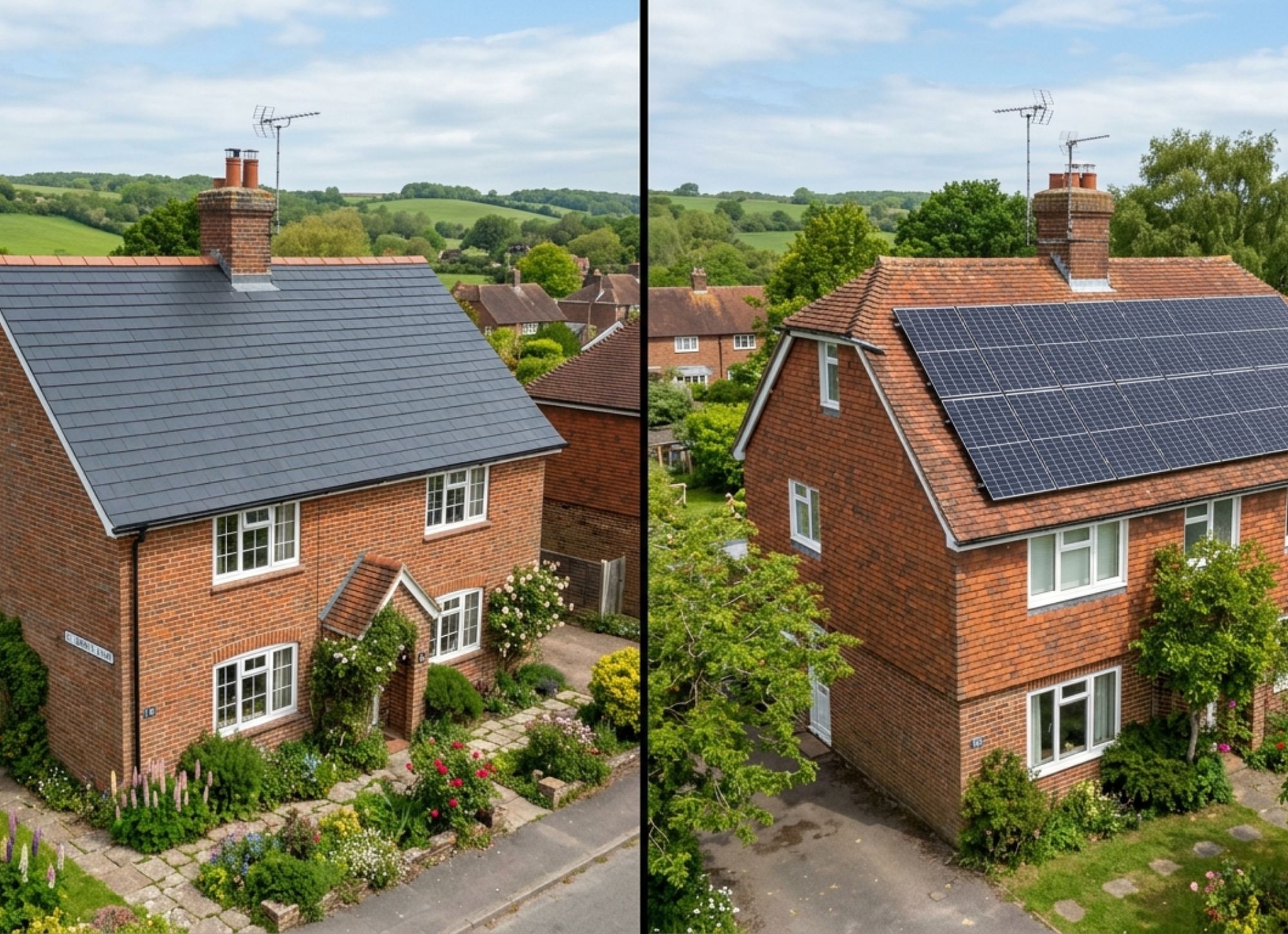
Solar Shingles vs Solar Panels: Costs, Pros and Cons
Solar panels generally offer the stronger financial return, while solar shingles suit homeowners prioritising kerb appeal or facing planning restrictions. In this solar shingles vs solar panels guide breaks down exactly how they compare so you can decide which suits your property across Southern England, Greater London, the South West, or South Wales.
Solar Shingles vs Solar Panels: A Quick Overview
Solar shingles and solar panels both generate clean electricity from sunlight, but they differ significantly in how they’re built, installed, and priced, which affects which one suits different types of properties. The table below gives you a quick side by side comparison before we look at each option in more detail.
| Factor | Solar shingles | Solar panels |
|---|---|---|
| Cell efficiency | Around 17-21% | Around 15-23% depending on type |
| Installed cost (4kW) | £12,000-£16,200 | £6,400-£8,000 |
| Installation requirements | Roof covering replacement, specialist fitting | Standard mounting on existing roof |
| Lifespan | 25-30 years | 25-30 years |
| Best suited properties | New builds, re-roofing projects, conservation areas | Most standard UK roofs |
| Maintenance and cleaning | Similar to panels, plus flashing checks | Occasional cleaning, minimal upkeep |
| Servicing | Combined with roof inspection | Standard annual solar check |
| Aesthetics | Low profile, blends into roofline | Visible, mounted on top of roof |
| Typical payback period | 12-18 years | 7-11 years |
How Do Solar Shingles Work?
Solar shingles work by replacing a section of your existing roof covering with thin, overlapping photovoltaic units designed to mimic the look of traditional asphalt or slate shingles while generating electricity. Unlike standard panels, which sit on top of the roof using mounting brackets, solar shingles form part of the actual weatherproof layer, giving a flatter, more discreet appearance that many homeowners find more attractive.
Pros and Cons of Solar Shingles
Pros
- Sleek, low profile appearance that blends seamlessly into the roofline
- Often easier to gain planning approval in conservation areas
- Doubles as a functional roof covering, useful for new builds and re-roofing projects
- Can add strong kerb appeal for design conscious buyers
Cons
- Considerably more expensive than standard solar panels
- Slightly lower cell efficiency compared with the best standard panels
- Longer payback period given the higher upfront cost
- Fewer UK installers have genuine experience fitting solar shingles
Should You Choose Solar Shingles?
Choose solar shingles if…
- You’re planning a full re-roofing project or building a new home
- You live in a conservation area or listed building with strict planning rules
- Appearance and property aesthetics matter more to you than the lowest cost
- You want the roof covering and solar generation combined into one investment
Do not choose solar shingles if…
- Your existing roof is in good condition with no re-roofing plans
- You want the fastest possible payback period
- Budget is your main priority
- You want the widest choice of installers and technology available
How Do Solar Panels Work?
Solar panels work by mounting photovoltaic modules on top of your existing roof using brackets and rails, converting sunlight into electricity without needing to replace any of the roof covering underneath. This remains the standard, most widely fitted solar technology across the UK, offering strong efficiency, lower cost, and a much wider pool of experienced installers compared with solar shingles.
Pros and Cons of Solar Panels
Pros
- Considerably cheaper than solar shingles for the same system capacity
- Wide choice of panel types, including monocrystalline, PERC, and bifacial options
- Faster payback period thanks to lower upfront installation costs
- Straightforward installation without needing to replace roof covering
Cons
- More visible on the roof, which some homeowners consider less attractive
- May face more scrutiny in conservation areas or on listed buildings
- Requires mounting hardware fixed into the roof structure
Should You Choose Solar Panels?
Choose solar panels if…
- You want the strongest financial return and fastest payback period
- Your existing roof is in good condition with no re-roofing plans
- You want the widest choice of installers and panel technology
- Budget is a key consideration in your decision
Do not choose solar panels if…
- You’re in a conservation area where visible panels may face planning issues
- You’re already re-roofing and want to combine that cost with solar generation
- A discreet, low profile appearance is your absolute priority
Solar Shingles vs Solar Panels: Head to Head Comparison
Now that you’ve seen the overview, let’s dig deeper into how solar shingles and solar panels actually compare across the factors that matter most to UK homeowners and landlords.
Efficiency
Solar shingles typically achieve cell efficiency of around 17% to 21%, while solar panels range more widely from around 15% for basic polycrystalline panels up to 23% for premium monocrystalline or PERC options. Because solar shingles use smaller individual units to cover the roof, total output per square metre can be marginally lower than an equivalent panel array covering the same area, even when cell efficiency figures are similar.
| Technology | Typical efficiency range |
|---|---|
| Solar shingles | 17-21% |
| Standard polycrystalline panels | 15-18% |
| Standard monocrystalline panels | 20-23% |
| PERC panels | 21-23% |
Winner: Solar panels, thanks to the wider availability of higher efficiency options like monocrystalline and PERC technology.
Cost
Solar shingles cost considerably more than solar panels for an equivalent system size, mainly because they replace the entire roof covering rather than simply mounting on top of it. A typical 4kW solar shingle installation costs between £12,000 and £16,200, compared with £6,400 to £8,000 for a similarly sized standard solar panel system.
| System size | Solar shingles cost | Solar panels cost |
|---|---|---|
| 1kW | £5,500-£8,050 | £2,000-£2,900 |
| 2kW | £7,000-£9,900 | £3,600-£4,800 |
| 3kW | £10,000-£13,000 | £4,800-£6,400 |
| 4kW | £12,000-£16,200 | £6,400-£8,000 |
Winner: Solar panels, by a clear margin on upfront cost and payback period.
Installation Requirements
Solar shingles require a much more involved installation process, since fitting them means removing sections of the existing roof covering and replacing it entirely with the shingle system, essentially combining roofing work with solar installation. Solar panels, by contrast, use a standard mounting system fixed onto the existing roof structure, which is quicker to install and doesn’t require touching the roof covering itself.
Winner: Solar panels, for a simpler, faster, and less disruptive installation process.
Lifespan
Both solar shingles and solar panels are generally designed to last between 25 and 30 years, backed by performance warranties guaranteeing around 80% to 87% of original output by the end of that period. Neither technology has a clear advantage here, since both are built to comparable industry standards for longevity.
Winner: Tie, with both technologies offering similar expected lifespans.
Properties Best Suited To Each Option
Solar shingles best suit new build homes, properties undergoing a full re-roofing project, and homes in conservation areas or with listed building status where a discreet appearance matters for planning approval. Solar panels suit the vast majority of standard UK homes with roofs in good condition, offering better value without needing any roofing work beyond the mounting installation itself.
Winner: Solar panels, given their suitability for a much broader range of typical UK properties.
Maintenance and Cleaning
Both solar shingles and solar panels require broadly similar maintenance, mainly occasional cleaning to remove dirt and debris, though solar shingles need extra attention paid to the flashing and seals around the units given their role in keeping the roof weatherproof.
| Task | Solar shingles | Solar panels |
|---|---|---|
| Cleaning | £70-£150 annually | £60-£120 annually |
| Flashing/seal check | £80-£150 | Not applicable |
| Annual inspection | £100-£180 | £80-£150 |
Winner: Solar panels, for slightly lower ongoing maintenance costs and simpler upkeep.
Servicing
Servicing for solar shingles is often best combined with a wider roof inspection, since any issues can potentially affect the property’s weatherproofing as well as solar performance. Solar panels can be serviced independently of the roof itself, typically through a standard annual solar health check covering the panels, inverter, and wiring.
Winner: Solar panels, for more straightforward, standalone servicing.
Aesthetics
Solar shingles offer a genuinely sleeker, more discreet appearance, sitting flush with the roofline rather than visibly mounted on top like standard panels. This makes them a clear favourite for homeowners prioritising kerb appeal or trying to satisfy stricter planning requirements in conservation areas.
Winner: Solar shingles, for a more seamless, low profile finish.
Get a Free Solar Quote From EE Renewables
EE Renewables provides expert solar panel installation and battery storage installation across Southern England, Greater London, South West England, and South Wales, covering London, Brighton, Oxford, Southampton, Bristol, and Cardiff. Our team will assess your roof, budget, and priorities honestly to recommend the option that delivers genuine long term value.
Get in touch today for a free quote tailored to your location, and find out whether solar shingles or solar panels are the right choice for your home.
Frequently Asked Questions
Can solar shingles be repaired individually, or does the whole roof section need replacing?
Solar shingles can generally be repaired or replaced individually, similar to how a damaged roof tile might be swapped out, provided the installer has matching stock and experience with the specific product used. This is one reason choosing a well established solar shingle brand with good long term availability matters.
Do solar shingles increase home insurance premiums compared with solar panels?
Solar shingles don’t typically increase home insurance premiums any more than standard solar panels, though you should always declare either installation to your insurer to ensure the roof covering and electrical components are properly covered. Checking with your specific insurer confirms exact terms for your policy.
Can you mix solar shingles and standard solar panels on the same roof?
Mixing solar shingles and standard solar panels on the same roof is technically possible but uncommon, usually done when one roof section is being replaced while another remains in good condition. Most installers would recommend keeping the system as one consistent technology type for simpler wiring and monitoring.
Are solar shingles heavier than solar panels for the same roof area?
Solar shingles are generally not significantly heavier than solar panels, since both are designed to work within standard UK roof structural limits, though solar shingles do add weight as part of replacing the roof covering itself rather than sitting on top of an already weight-bearing structure. A structural check during the site survey confirms suitability either way.
Do solar shingles work as well as solar panels in shaded areas?
Solar shingles generally perform similarly to standard solar panels in shaded conditions, since both rely on comparable underlying photovoltaic cell technology, though neither performs particularly well under heavy, consistent shade regardless of the format chosen. Positioning and orientation matter more than the specific technology when dealing with shading concerns.
