


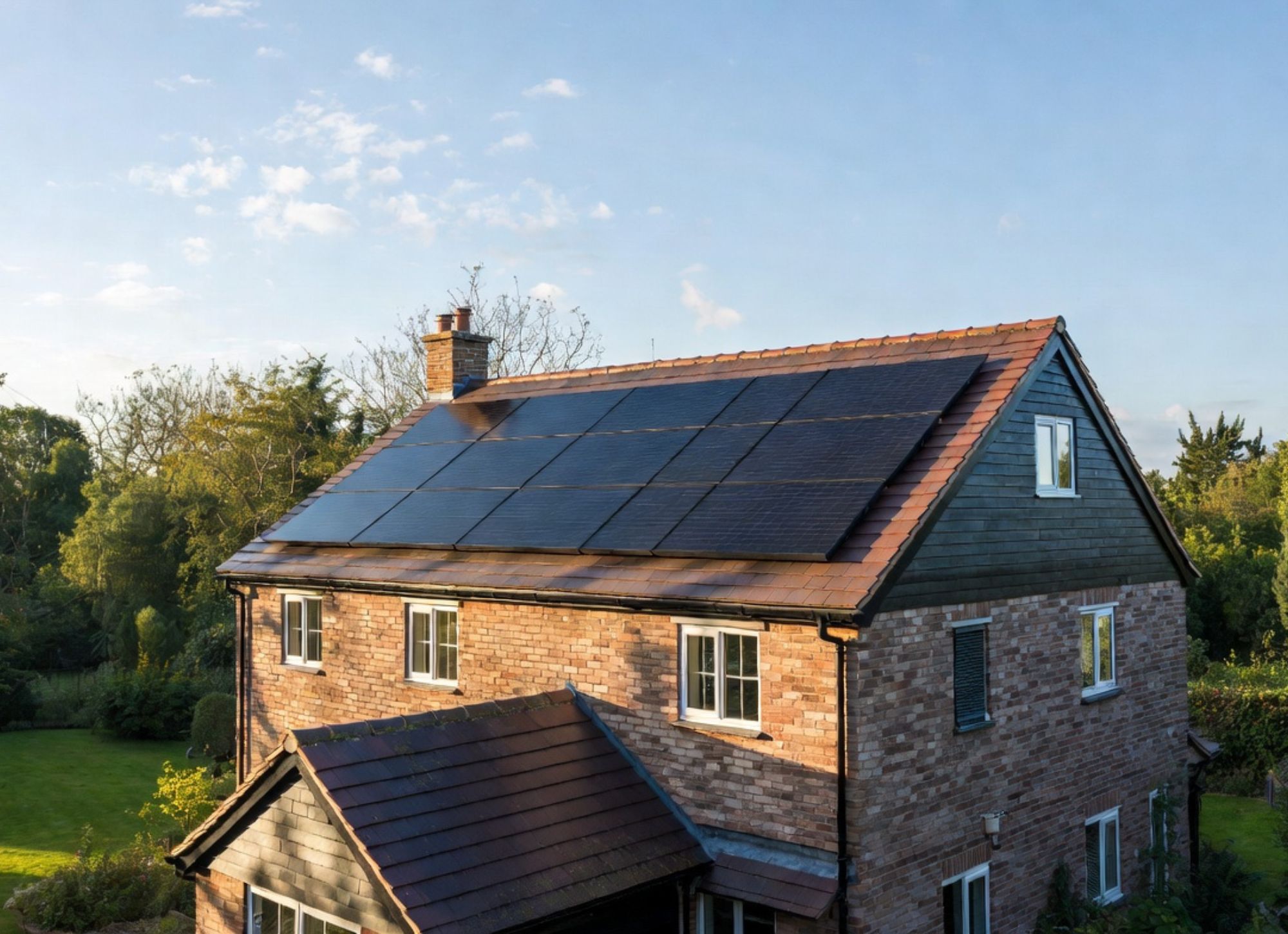
Can You Install Solar Panels on a North Facing Roof?
Yes, you can install solar panels on a north facing roof, but it is generally not recommended as a primary installation location for UK homeowners. A north facing roof receives significantly less direct sunlight throughout the day compared to south, east, or west facing alternatives, which means the panels will generate considerably less electricity and deliver a weaker financial return.
That said, it is not always a dead end. Depending on your roof layout, your energy goals, and whether alternative surfaces are available, installing solar panels on a north facing roof can still make sense in certain situations.
This guide walks you through everything you need to know before making a decision.
Can You Put Solar Panels on a North Facing Roof?
Yes, you can put solar panels on a north facing roof, but for most homeowners and landlords in the UK it is not the most productive or cost-effective choice. In the northern hemisphere, the sun travels across the southern sky throughout the day.
A north facing roof therefore faces away from the sun’s path for the majority of daylight hours, meaning panels mounted on it receive only indirect, diffuse light rather than direct solar irradiance. This directly reduces the amount of electricity the panels generate.
Estimates vary slightly depending on location and roof pitch, but a north facing solar installation in the UK typically generates around 30% to 50% less electricity per year than an equivalent south facing system. For a homeowner in London, Brighton, Southampton, or Cardiff, this reduced output has a direct impact on both bill savings and the time it takes to recoup the installation investment.
That said, there are nuances worth understanding. A shallow-pitch north facing roof performs better than a steep one, because a near-flat surface still receives reasonable diffuse light. Properties with no other viable roof surface may find that a north facing installation is better than no solar at all.
And in some cases, splitting an installation across both north and south facing roof slopes can actually improve the spread of generation across the day, reducing morning and evening peaks in grid import.
Pros and Cons of Solar Panels on a North Facing Roof
Here is an honest and balanced summary of what a north facing roof means for a solar installation:
Pros:
- Solar panels can still generate electricity from diffuse and indirect light, even on a north facing roof
- A shallow-pitch north facing roof performs better than a steep one, as the panel angle is closer to horizontal
- A split installation across north and south slopes can broaden daily generation and reduce peak grid imports
- In some cases, a north facing installation is the only available option and still provides meaningful savings compared to no solar at all
- Modern high-efficiency solar panels perform better in low-light conditions than older panel technology, improving the viability of north facing installations
- Adding battery storage alongside a north facing system can help maximise the value of whatever electricity is generated
Cons:
- A north facing roof receives significantly less direct sunlight than south, east, or west facing alternatives
- Annual electricity generation can be 30% to 50% lower than an equivalent south facing system
- The financial payback period is considerably longer, often exceeding 15 years, compared to 6 to 10 years for a south facing system
- Most MCS-accredited installers will advise against a purely north facing installation unless no better alternative exists
- The Smart Export Guarantee income from surplus export will be lower due to reduced overall generation
- A north facing installation on a steep-pitch roof is rarely cost-effective and may not be recommended by a reputable installer
What Factors to Consider Before Installing Solar Panels on a North Facing Roof?
Before deciding whether to proceed with a north facing roof solar installation, there are several important factors that both you and your installer need to assess carefully. These considerations will help you make an informed decision and set realistic expectations for what the system will deliver.
Roof Pitch and Angle
The pitch of your north facing roof plays a significant role in determining how much electricity the panels will generate. A steeply pitched north facing roof, say 45 degrees or more, will point the panels almost directly away from the sun, resulting in the lowest possible output and making the installation very difficult to justify financially.
A shallower pitch of 10 to 20 degrees brings the panels closer to a horizontal position, which receives more diffuse sky radiation and performs noticeably better. If you have a low-pitch or nearly flat north facing roof, the case for going solar becomes considerably stronger, as the panels can still capture a reasonable amount of ambient light throughout the day.
Whether Alternative Roof Surfaces Are Available
Before committing to a north facing installation, your installer should assess every available surface on and around your property. Many homes with a north facing primary roof slope also have an east or west facing rear slope, a flat-roofed extension, a south facing garage roof, or suitable garden space for a ground-mounted system.
Any of these alternatives will almost always deliver better financial performance than a north facing roof installation. A thorough survey of all available options is a standard part of a professional pre-installation assessment, and a reputable installer will present you with a clear comparison before recommending a course of action.
Shading from Neighbouring Buildings and Trees
Shading is always a concern with solar panels, but it is a particularly important factor for north facing roofs. Because a north facing installation relies on diffuse and indirect light rather than direct sun, any additional shading from nearby trees, neighbouring buildings, or chimneys reduces output even further.
A shading analysis, which good installers carry out using specialist software, will identify whether shading losses are likely to be significant and help determine whether the installation is viable in your specific location.
Energy Consumption Patterns
Your household’s electricity consumption pattern matters when assessing a north facing solar installation. North facing panels generate their electricity during daylight hours, just like any other solar installation, but the lower output means self-consumption is more limited.
If your household uses a large proportion of its electricity during the day, such as if someone works from home or the property runs daytime appliances heavily, then even a lower-output north facing system can offset a useful amount of grid consumption. Combined with battery storage, the value of each unit generated is maximised regardless of the orientation.
System Payback Period and Financial Expectations
One of the most important honest conversations to have before proceeding with a north facing solar installation is around financial expectations. A south facing system on a typical three-bedroom home in Southern England might pay back within 6 to 9 years.
A north-facing equivalent on the same property with 40% lower output might take 12 to 18 years or more to pay back, which is still within the system’s operational lifespan but leaves a considerably thinner margin.
Understanding these figures clearly before installation helps avoid disappointment later, and a good installer will provide realistic generation estimates and payback projections as part of the quotation process.
Modern Panel Technology and Efficiency
Not all solar panels perform equally in low-light conditions, and this matters particularly for north facing installations. Higher efficiency panels using monocrystalline PERC or TOPCon cell technology perform better in diffuse light conditions compared to older or lower-specification panels.
If you are considering a north facing installation, specifying a higher-efficiency panel technology gives you the best possible output from a challenging orientation. Your installer should recommend panel specifications that are appropriate for your specific roof situation rather than simply offering a standard product.
How Are Solar Panels Installed on a North Facing Roof?
Solar panels are installed on a north facing roof using the same professional process as any other pitched roof installation. The mounting method depends on your specific roof material, which is most commonly tiles, slate, or metal sheeting. Here is what the process looks like from start to finish.
Step 1: Pre-Installation Survey and Orientation Assessment
The process begins with a full site survey. The installer assesses the roof pitch, surface condition, tile or slate type, and structural integrity, and crucially, records the precise compass orientation of the roof using a compass or GPS tool.
Solar modelling software is used to calculate the expected annual generation for the north facing orientation and pitch, and this is compared against alternative surfaces on the property. The installer presents the results and recommendations before any commitment is made to proceed.
Step 2: System Design and Panel Layout
If a north facing installation is agreed to be the best available option, the installer designs the system to maximise output within the constraints of the orientation.
This may involve specifying higher-efficiency panels, recommending a panel optimiser system to ensure each panel performs independently rather than being limited by the weakest panel in the string, and sizing the system slightly larger to compensate for the reduced output per panel compared to a south facing system.
Step 3: Scaffolding Erection
Scaffolding is erected around the relevant section of the roof to provide a safe working platform in accordance with the Work at Height Regulations 2005. For most standard domestic properties, scaffolding is in place for two to four days covering the installation period from start to finish.
Step 4: Roof Hook or Bracket Installation
For a tiled or slate north facing roof, the installer carefully lifts individual tiles at the pre-planned fixing locations and fits stainless steel roof hooks beneath the tiles, securing each hook to the roof battens below. Tiles are replaced neatly around the hooks.
For metal roof profiles, appropriate seam clamps or through-fix brackets are used as described for those roof types. The fixing locations are determined by the panel layout design and ensure the mounting rails will be correctly spaced and aligned.
Step 5: Mounting Rail Installation
Aluminium mounting rails are attached horizontally across the roof hook positions. These rails are levelled and aligned carefully to ensure the finished array is straight and the panels sit at the correct angle. Rail expansion joints are incorporated where appropriate to allow for thermal movement over the system’s lifetime.
Step 6: Solar Panel Fitting and DC Cabling
The solar panels are placed onto the rails and secured with end and mid clamps. For a north facing installation, the use of individual panel optimisers or microinverters is worth considering at this stage, as these devices allow each panel to operate at its own maximum output independently, which can partially mitigate the impact of low-light conditions and any uneven shading across the array.
DC cables are connected and routed back to the building entry point using UV-resistant cable management.
Step 7: Inverter Installation and Electrical Connection
Inside the property, the DC cables connect to the inverter, which converts the solar electricity into AC power for use in the home. The inverter is connected to the consumer unit by a qualified electrician, and a generation meter is installed. For north facing installations where battery storage is being added at the same time, the battery system is also installed and integrated at this stage.
Step 8: Commissioning, Testing, and MCS Registration
The system is tested in full and registered with the MCS database. The homeowner receives the MCS installation certificate, product warranties, and electrical installation certificate. MCS registration makes the system eligible for Smart Export Guarantee payments, which, while lower than for a south facing system due to reduced surplus generation, still contribute to the overall financial return.
How Much Does It Cost to Install Solar Panels on a North Facing Roof?
Installing solar panels on a north facing roof in the UK costs broadly the same as an equivalent installation on any other pitched roof, typically between £5,000 and £9,500 for a standard domestic system. The hardware, labour, scaffolding, and certification costs do not change based on roof orientation.
What changes is the financial return, because lower generation means longer payback and reduced savings compared to a south or east facing installation.
| Option | No. of Panels | Output | Typical Cost | Annual Generation |
|---|---|---|---|---|
| Standard System | 10–14 panels | 4kWp–5.6kWp | £6,500–£8,500 | 2,000–3,200 kWh |
| With Optimisers / High-Efficiency Panels | — | — | +£300–£800 | Improved vs. standard |
| With Battery Storage | — | — | +£2,500–£5,000 | — |
Standard System (10 to 14 Panels, 4kWp to 5.6kWp)
A standard domestic system on a north facing tiled roof typically costs between £6,500 and £8,500 including panels, inverter, mounting, cabling, scaffolding, and MCS certification.
Annual generation on a moderate-pitch north facing roof in Southern England is likely to be in the range of 2,000 to 3,200 kWh, compared to 3,500 to 4,900 kWh for the same system on a south facing roof.
Uplifting for Higher-Efficiency Panels or Optimisers
For a north facing installation, specifying higher-efficiency panels or adding individual panel optimisers is often worthwhile to maximise output from the challenging orientation. This may add £300 to £800 to the overall system cost but can improve annual generation by a meaningful percentage compared to a standard panel specification on the same roof.
Adding Battery Storage
Battery storage is particularly valuable alongside a north-facing solar installation because it allows every unit of generated electricity to be used within the home rather than exported at a lower rate. A battery storage system adds between £2,500 and £5,000 to the project cost depending on capacity and significantly increases the self-consumption rate of the generated electricity.
How Much Less Electricity Does a North Facing Solar Panel Generate?
A north facing solar panel generates substantially less electricity than an equivalent south facing panel, and the exact difference depends on the roof pitch and the specific location in the UK.
As a general guide for UK properties:
- A south facing roof at 35 degrees pitch is the benchmark, generating 100% of the optimum output
- A south-east or south-west facing roof generates approximately 95% of optimum
- An east or west facing roof generates approximately 80% to 85% of optimum
- A north-east or north-west facing roof generates approximately 60% to 70% of optimum
- A north facing roof generates approximately 50% to 70% of optimum depending on pitch, with lower pitches performing better
For a typical 4kWp system in Southern England that would generate around 3,800 kWh per year on a south facing roof, the same system on a north facing roof at a 35-degree pitch might generate 1,900 to 2,400 kWh annually. This represents a real and significant reduction in bill savings and export income that should be clearly understood before any installation decision is made.
Is a North Facing Solar Installation Ever Worth It?
A north facing solar installation can be worth it in certain specific circumstances, and dismissing it entirely without considering the full picture would be unfair to many homeowners who genuinely have limited options.
The situations where a north facing installation is most likely to be worthwhile include:
- Properties where the only available roof surface faces north and there is no viable alternative such as a garage roof, flat roof extension, or space for a ground-mounted array
- Properties where the north facing roof has a very shallow pitch of 15 degrees or less, bringing the generation figures significantly closer to a horizontal installation
- Homeowners who plan to combine north facing panels with a battery storage system to maximise the value of every unit generated
- Properties where a split array across both north and south facing slopes is possible, spreading generation more evenly across the morning, afternoon, and evening
- Landlords or homeowners who are primarily motivated by reducing carbon emissions and improving their property’s EPC rating, rather than maximising financial return
What a north facing installation is rarely worth is as a standalone investment on a steep-pitch roof where the output figures make a financially meaningful return extremely difficult to achieve within the system’s service life. A reputable installer will always tell you this honestly rather than simply proceeding with a sale.
What Are the Alternatives to a North Facing Solar Installation?
Before settling on a north facing installation, it is always worth exploring the alternatives carefully.
An east or west facing roof slope is a considerably better option than north facing. East facing panels generate strongly in the morning, and west facing panels generate strongly in the afternoon.
A split east-west installation across both rear slopes of a semi-detached or terraced property in London, Brighton, Oxford, or Bristol can be a very effective way to spread generation across the day and match household consumption patterns well.
A flat roofed extension, garage, or outbuilding offers the opportunity to mount panels on angled ballast frames facing in any direction, turning what might otherwise be a challenging roof orientation into an optimal one.
Ground-mounted solar arrays on suitable garden or land areas are another strong alternative for properties with outdoor space, and they are not subject to the same orientation constraints as roof-mounted systems.
If your property is a terraced house in a London street where the main roof faces north and a rear extension faces south, the answer is often simply to place the panels on the rear extension roof. An experienced installer will identify this kind of solution during the survey stage.
Get a Free Solar Panel Installation Quote From EE Renewables
If you have a north facing roof and you are wondering whether solar is still an option for your home, EE Renewables is here to give you a straight, honest assessment and explore every available option with you.
We provide expert solar panel installation and solar battery storage solutions across Southern England, Greater London, South West England, and South Wales, including London, Brighton, Oxford, Southampton, Bristol, Cardiff, and all surrounding areas.
Get your free, no-obligation solar installation quote from EE Renewables today and find out what is genuinely possible for your home.
Our experienced team surveys every available surface at your property and designs a system that gives you the best possible return for your specific situation, whether that is a south facing roof, a rear extension, a garage, a ground mount, or even a carefully considered north facing installation where it genuinely makes sense.
We will never recommend an installation that does not serve your interests, and we will always provide clear, realistic generation estimates and payback projections before you commit to anything.
Frequently Asked Questions
Can I use microinverters to improve the output of north facing solar panels?
Yes, microinverters can help improve the effective output of a north facing solar installation by allowing each panel to operate independently at its own maximum power point, rather than being limited by the performance of the weakest panel in a series string.
On a north-facing roof where light levels are lower and potentially uneven across the array, this independent operation can recover a useful percentage of generation that would otherwise be lost. Microinverters also offer the added benefit of panel-level monitoring, which makes it easier to identify any underperforming panels over time.
The additional cost compared to a standard string inverter is typically £300 to £600 for a domestic system, and on a north facing installation this investment can be worthwhile.
Will a north facing solar installation affect my home insurance?
Like any solar installation, a north facing system should be declared to your home insurer before it is installed. The panels increase the rebuild value of the property and represent a change to the building structure, and most insurers will simply update your sum insured to reflect this.
The orientation of the panels does not affect the insurance position in any meaningful way. Failing to notify your insurer could leave you underinsured in the event of a claim, so always make that call before installation day.
Can I get Smart Export Guarantee payments from a north facing solar installation?
Yes, you can receive Smart Export Guarantee payments from a north facing solar installation, provided the system is MCS-certified and installed by an accredited installer. The SEG scheme pays you for every unit of surplus electricity you export to the national grid, regardless of your roof orientation.
Because a north facing system generates less electricity overall, the volume of surplus available for export will be lower than from a south facing system, so the annual SEG income will be more modest. However, combining a north facing system with battery storage can help retain more of the generated electricity for self-consumption, which is generally more financially valuable per unit than exporting it.
Do north facing solar panels degrade faster than south facing panels?
No, solar panel degradation is driven by factors such as material quality, UV exposure, thermal cycling, and manufacturing standards, not by roof orientation. A north facing panel actually receives less intense direct solar radiation than a south facing panel, which means it experiences slightly less thermal stress over time.
In theory this could marginally slow degradation, though in practice the difference is negligible and manufacturers apply the same performance warranty to panels regardless of how they are installed. Panel degradation rates are typically around 0.5% to 1% per year for a quality product, and this applies equally to north and south facing installations.
Is planning permission required for solar panels on a north facing roof?
Planning permission is not usually required for solar panels on a north facing roof in England and Wales, as most residential solar installations fall within permitted development rights.
The key permitted development conditions relate to the panels not projecting more than 200mm beyond the roof plane, not being installed on a wall or roof slope that fronts a highway, and not exceeding the highest point of the existing roof.
If your property is a listed building or is within a designated conservation area, additional restrictions may apply regardless of roof orientation. Your installer will advise on the planning position for your specific property as part of the pre-installation survey.
