


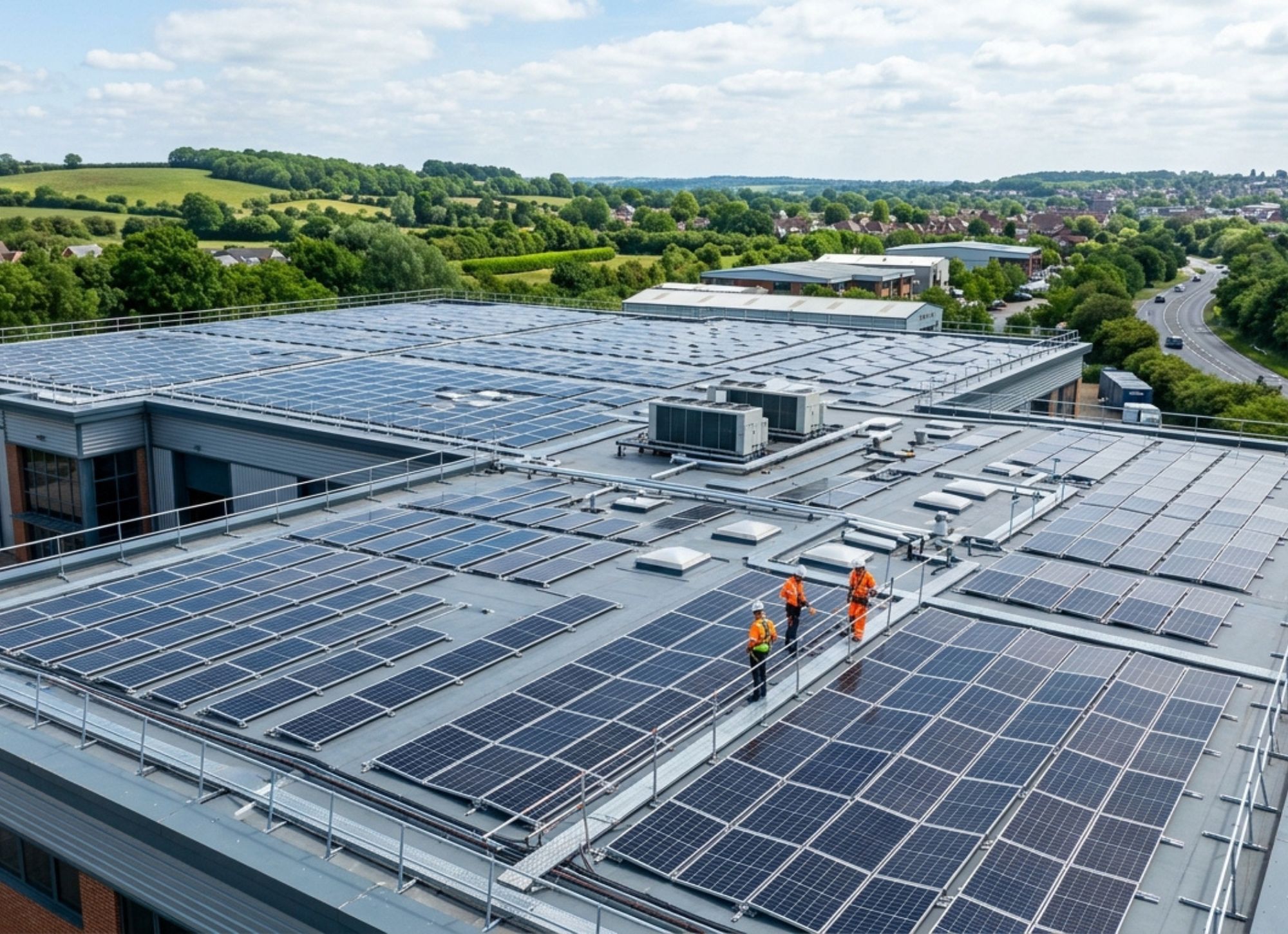
Best Commercial Solar Panels: Brands & Models Reviewed By Our Experts
The best commercial solar panels are the AIKO Comet 2N, the JA Solar DeepBlue 4.0 Pro and the AIKO Neostar 3S. The AIKO Comet 2N is the best all-rounder for large commercial roofs, the JA Solar DeepBlue 4.0 Pro offers the best value for big roofs and ground-mounted arrays, and the AIKO Neostar 3S is best for smaller commercial roofs such as offices and shops.
Choosing the best commercial solar panels for your site can make a real difference to how quickly the system pays for itself.
We design and install commercial systems of every size across London, Brighton, Oxford, Southampton, Bristol and Cardiff. In this guide, we compare our top three panels on efficiency, price, performance, lifespan and the types of commercial property each one suits.
3 best commercial solar panels: At a Glance
The 3 best commercial solar panels at a glance are the AIKO Comet 2N, JA Solar DeepBlue 4.0 Pro and AIKO Neostar 3S. Here’s how they compare for business use.
| Rank | Solar panel | Best for | Power output | Efficiency | Est. installed cost (excl. VAT) |
|---|---|---|---|---|---|
| 1 | AIKO Comet 2N | Best overall for large commercial roofs | Around 600W to 650W | Up to around 24% | £800 to £1,100 per kW |
| 2 | JA Solar DeepBlue 4.0 Pro (72-cell) | Best value, large roofs and ground mounts | Around 560W to 600W | Up to around 23% | £700 to £950 per kW |
| 3 | AIKO Neostar 3S | Smaller commercial roofs, offices and shops | 440W to 515W | 22.4% to 23.5% | £1,000 to £1,400 per kW |
Specs vary slightly between versions, so we always confirm the exact model on your proposal. Commercial installations carry 20% VAT, which VAT-registered businesses can usually reclaim. Larger systems cost less per kW because fixed costs are spread over more panels.
Want to know what solar could save your business? EE Renewables provides expert commercial solar panel installation and solar battery storage installation across Southern England, Greater London, South West England, and South Wales, including areas like London, Brighton, Oxford, Southampton, Bristol, and Cardiff. Book your free site survey today.
3 best commercial solar panels: Ranked By Our Experts
The 3 best commercial solar panels ranked by our experts are set out below, starting with our top pick. For each, we cover the key specs, efficiency, pricing, the commercial properties it suits, reliability, lifespan and maintenance, so you can match the right panel to your site.
1. AIKO Comet 2N: Best commercial solar panel overall for large roofs
The AIKO Comet 2N is our top commercial pick because it packs very high efficiency into a large-format panel built for business roofs. It’s part of AIKO’s commercial range and uses the company’s back-contact cell technology, which moves the wiring behind the cells so more of the surface can capture light.
On a warehouse, factory or school roof, that means more electricity from the same area, fewer panels to fit and lower installation costs per kW.
Key specs at a glance
| Specification | Detail |
|---|---|
| Power output | Around 600W to 650W |
| Efficiency | Up to around 24% |
| Cell technology | Back-contact |
| Panel format | Large commercial format, around 2.3m x 1.1m |
| Product warranty | Typically 15 to 25 years, depending on version |
| Performance warranty | Typically 30 years |
| Temperature coefficient | Around -0.26%/°C |
| Expected lifespan | 30 years or more |
| Estimated panel cost | £130 to £170 per panel |
| Estimated installed cost (excl. VAT) | £800 to £1,100 per kW, around £40,000 to £55,000 for 50kW |
| Best suited to | Warehouses, factories, distribution centres, schools and large offices |
AIKO Comet 2N: Efficiency
With efficiency of up to around 24%, the Comet 2N is among the most efficient commercial panels available. On a large roof, that extra efficiency adds up quickly. A 50kW system needs roughly 80 panels rather than 90 or more, which saves on mounting, labour and roof space.
AIKO Comet 2N: Pricing
Expect to pay around £800 to £1,100 per kW installed, excluding VAT. A 50kW system typically costs £40,000 to £55,000, while larger 150kW to 250kW systems often come in at the lower end per kW. With strong daytime use, many businesses see payback in around 4 to 7 years.
AIKO Comet 2N: Commercial properties it’s best suited to
The Comet 2N is ideal for large, unshaded roofs, such as steel-clad warehouses, logistics units, factories, supermarkets, schools and leisure centres. Its high output per panel helps on roofs where load limits or rooflights restrict the usable area.
AIKO Comet 2N: Powering your site or offsetting bills
Most commercial sites use electricity during the day, so a well-sized Comet 2N system can cover a large share of daytime demand, often 60% to 90% of the solar being used on site. It’s designed to cut bills while staying connected to the grid, with any surplus exported. A battery can extend savings into early mornings and evenings for sites with longer operating hours.
AIKO Comet 2N: Reliability and performance
Back-contact cells handle partial shade from roof plant, parapets and rooflights better than many standard panels. A low temperature coefficient means output holds up on hot summer days, which matters on dark metal roofs that get very warm. AIKO has become one of the leading makers of back-contact panels, giving confidence in long-term performance.
AIKO Comet 2N: Lifespan
With a typical 30-year performance warranty and slow yearly degradation, the Comet 2N should keep producing strongly for 30 years or more. That’s well beyond the typical commercial payback period, leaving decades of low-cost electricity.
AIKO Comet 2N: Maintenance
Commercial arrays benefit from a planned maintenance schedule. We recommend an annual inspection covering panels, fixings, cables and inverters, plus periodic cleaning on low-pitched roofs where dust and bird droppings build up. Remote monitoring flags any drop in output quickly.
AIKO Comet 2N: Pros and cons
The AIKO Comet 2N is a premium performer for large commercial roofs. Here’s how its strengths and drawbacks compare.
| Pros | Cons |
|---|---|
| Very high efficiency for a large-format commercial panel | Higher cost per panel than standard TOPCon alternatives |
| Strong performance in partial shade from roof plant and rooflights | Large, heavy format needs careful roof load checks |
| Excellent hot-weather output on metal roofs | Exact warranty terms vary by version, so need checking |
| Fewer panels needed, cutting mounting and labour costs | Less suited to small or fragmented roofs |
| Long performance warranty with slow degradation |
Is the AIKO Comet 2N best for you?
Choose the AIKO Comet 2N if:
- You have a large commercial roof and want maximum output from it
- Your roof has rooflights, plant or parapets that cast some shade
- Your site uses most of its electricity during the working day
- You’re focused on long-term return rather than the lowest upfront cost
Do not choose the AIKO Comet 2N if:
- You have plenty of roof or land and want the lowest cost per kW
- Your roof has tight load limits that can’t take large-format panels
- Your roof is small, where a standard-size panel will fit better
2. JA Solar DeepBlue 4.0 Pro (72-cell): Best value commercial solar panel for large roofs and ground mounts
The JA Solar DeepBlue 4.0 Pro in its large 72-cell format is our pick for businesses that want strong performance at the lowest cost per kW. JA Solar is one of the world’s biggest panel manufacturers, and the DeepBlue 4.0 Pro range uses modern N-type cells that cope well with the UK’s cloudy days.
It’s a workhorse panel, widely used on large rooftops, solar carports and ground-mounted arrays across the country.
Key specs at a glance
| Specification | Detail |
|---|---|
| Power output | Around 560W to 600W |
| Efficiency | Up to around 23% |
| Cell technology | N-type |
| Bifacial option | Yes, on glass-glass versions |
| Product warranty | 12 to 25 years, depending on version |
| Performance warranty | Up to 30 years, depending on version |
| Temperature coefficient | Around -0.29%/°C |
| Expected lifespan | 30 years or more |
| Estimated panel cost | £80 to £110 per panel |
| Estimated installed cost (excl. VAT) | £700 to £950 per kW, around £35,000 to £48,000 for 50kW |
| Best suited to | Large roofs on a budget, ground-mounted arrays, farms and carports |
JA Solar DeepBlue 4.0 Pro (72-cell): Efficiency
With efficiency of up to around 23%, the DeepBlue 4.0 Pro isn’t far behind premium back-contact panels. On large roofs and land where space isn’t the main constraint, that small difference matters far less than the lower price.
JA Solar DeepBlue 4.0 Pro (72-cell): Pricing
This is where JA Solar shines. Installed costs typically run at £700 to £950 per kW, excluding VAT, so a 50kW system costs around £35,000 to £48,000. Ground-mounted and larger projects often fall at the lower end per kW. For sites with strong daytime demand, payback of around 4 to 6 years is common.
JA Solar DeepBlue 4.0 Pro (72-cell): Commercial properties it’s best suited to
The DeepBlue 4.0 Pro suits large industrial and agricultural roofs, distribution warehouses, and businesses with spare land for a ground-mounted array. The glass-glass bifacial versions are especially good for ground mounts and carports, where light reflects up onto the back of the panels.
JA Solar DeepBlue 4.0 Pro (72-cell): Powering your site or offsetting bills
Because it’s cheaper per kW, the DeepBlue 4.0 Pro makes it easier to fill a big roof or field and cover more of your site’s electricity use. It’s designed to cut bills while staying grid-connected, and on sites with high demand, such as cold stores, manufacturing and farms, a large array can cover a big share of daytime consumption. Surplus can be exported, stored in a battery or used to charge electric vehicles.
JA Solar DeepBlue 4.0 Pro (72-cell): Reliability and performance
JA Solar’s N-type cells perform well in low light and degrade more slowly than older panel types. The glass-glass versions are particularly tough, with better resistance to moisture and weather on exposed sites. JA Solar’s global scale and long track record make it one of the most widely trusted names in commercial solar.
JA Solar DeepBlue 4.0 Pro (72-cell): Lifespan
Depending on the version, the DeepBlue 4.0 Pro carries a performance warranty of up to 30 years. Product warranties vary more, from 12 to 25 years, so we always check the exact terms. Expect 30 years or more of useful output.
JA Solar DeepBlue 4.0 Pro (72-cell): Maintenance
Large arrays benefit from an annual inspection and remote monitoring. Ground-mounted systems also need vegetation kept under control so grass and weeds don’t shade the lower edge of the panels. Periodic cleaning helps on dusty agricultural and industrial sites.
JA Solar DeepBlue 4.0 Pro (72-cell): Pros and cons
The JA Solar DeepBlue 4.0 Pro trades a little efficiency for excellent value at scale. Here’s a quick comparison.
| Pros | Cons |
|---|---|
| Excellent value per kW for large projects | Slightly lower efficiency than back-contact panels |
| Modern N-type cells that perform well in low light | Product warranty can be shorter on some versions |
| Tough glass-glass bifacial versions for ground mounts | Needs more roof space than premium panels for the same output |
| Made by one of the world’s largest panel manufacturers | Glass-glass versions are heavier, which matters on weaker roofs |
| Widely available through UK distributors | Specs vary between versions, so the datasheet needs checking |
Is the JA Solar DeepBlue 4.0 Pro best for you?
Choose the JA Solar DeepBlue 4.0 Pro if:
- You have a large roof or spare land and want the lowest cost per kW
- You’re planning a ground-mounted array, solar farm or carport
- Your business wants the fastest possible payback
- You’re rolling out solar across several sites on a set budget
Do not choose the JA Solar DeepBlue 4.0 Pro if:
- Your roof space is limited and you need maximum output per panel
- Your roof has strict weight limits and a glass-glass version is proposed
- A long product warranty is essential and your chosen version has a shorter one
3. AIKO Neostar 3S: Best commercial solar panel for smaller roofs, offices and shops
The AIKO Neostar 3S is our pick for smaller commercial buildings, where roof space is limited and every panel needs to work hard. It’s a standard-size panel rather than a large commercial format, which makes it easier to fit on pitched office roofs, shopfronts, surgeries and small business units.
With very high efficiency and excellent shade performance, it gets the most out of tight or awkward roofs.
Key specs at a glance
| Specification | Detail |
|---|---|
| Power output | 440W to 515W |
| Efficiency | 22.4% to 23.5% |
| Cell technology | Back-contact |
| Product warranty | 25 years |
| Performance warranty | 90.3% after 25 years |
| Temperature coefficient | -0.22%/°C |
| Weight | 20.6kg |
| Expected lifespan | 25 to 30 years or more |
| Estimated panel cost | £100 to £130 per panel |
| Estimated installed cost (excl. VAT) | £1,000 to £1,400 per kW, around £20,000 to £28,000 for 20kW |
| Best suited to | Offices, shops, cafés, surgeries, small units and pitched commercial roofs |
AIKO Neostar 3S: Efficiency
With efficiency of up to 23.5%, the Neostar 3S is one of the most efficient standard-size panels available in the UK. On a small office or retail roof, that means a bigger system in the same space, and more of your daytime electricity covered.
AIKO Neostar 3S: Pricing
Smaller commercial systems cost more per kW because survey, scaffolding and design costs are shared across fewer panels. Expect around £1,000 to £1,400 per kW installed, excluding VAT, so a 20kW system typically costs £20,000 to £28,000. For businesses open during the day, payback of around 5 to 8 years is realistic.
AIKO Neostar 3S: Commercial properties it’s best suited to
The Neostar 3S is ideal for offices, high street shops, cafés, dental and GP surgeries, small workshops and business units. It also suits mixed-use buildings and converted period properties in cities like London, Brighton and Bath, where roofs are smaller, more broken up or partly shaded.
AIKO Neostar 3S: Powering your site or offsetting bills
For a small business, a Neostar 3S system can cover a large share of daytime electricity use, particularly for lighting, IT and air conditioning. It’s designed to cut bills while staying connected to the grid. A small battery can help cover early morning and evening use in shops and cafés with longer opening hours.
AIKO Neostar 3S: Reliability and performance
Back-contact cells handle shade from nearby buildings, chimneys and roof plant better than many standard panels. The -0.22%/°C temperature coefficient is one of the best available, so output stays strong on hot days, when air conditioning demand is highest. The 90.3% output guarantee after 25 years points to slow, steady ageing.
AIKO Neostar 3S: Lifespan
With a 25-year product warranty and a 25-year performance warranty, the Neostar 3S is built to last. Expect 25 to 30 years or more of useful output, well beyond the payback period.
AIKO Neostar 3S: Maintenance
Maintenance is light. An inspection every year or two, remote monitoring and occasional cleaning in dusty urban areas are usually all that’s needed. Bird mesh is a sensible extra on city-centre buildings.
AIKO Neostar 3S: Pros and cons
The AIKO Neostar 3S is a top performer for smaller commercial roofs. Here’s how it compares.
| Pros | Cons |
|---|---|
| One of the highest efficiency ratings of any standard-size panel in the UK | Costs more per kW than large-format commercial panels |
| Excellent shade performance thanks to back-contact cell design | Less cost-effective on very large roofs |
| Best-in-class temperature coefficient for hot weather output | Some higher-wattage versions use a white backsheet rather than all-black |
| 25-year product warranty with strong degradation profile | Higher-output versions are physically larger, which can affect layouts |
| Lightweight relative to its power output |
Is the AIKO Neostar 3S best for you?
Choose the AIKO Neostar 3S if:
- You run an office, shop, surgery or small business unit
- Your roof is small, pitched, awkwardly shaped or partly shaded
- You want as much output as possible from limited space
- Your building uses more electricity on warm, sunny days
Do not choose the AIKO Neostar 3S if:
- You have a large warehouse or factory roof, where large-format panels are cheaper per kW
- You’re planning a ground-mounted array or solar farm
- Keeping the upfront cost per kW as low as possible is your main priority
How We Chose the Best Commercial Solar Panels
We chose the best commercial solar panels using our hands-on experience designing, installing and maintaining systems for offices, warehouses, schools, farms and industrial sites across Southern England, Greater London, South West England and South Wales. We only recommend panels we’re confident will perform for decades, and we judged each one against the same criteria:
- Real-world UK performance: how each panel performs in our cloudy, changeable climate and on typical UK commercial roofs.
- Output per square metre: how much power each panel delivers from limited roof space, especially where rooflights and plant take up room.
- Cost per kW and return on investment: the full installed cost against expected savings and payback for a business.
- Shade and heat performance: how each panel copes with shade from parapets and roof plant, and with heat on dark metal roofs.
- Warranties and degradation: the length and terms of product and performance warranties, and how much output is guaranteed over 25 to 30 years.
- Manufacturer strength: the scale, financial stability and track record of the company standing behind the warranty.
- Build quality and certification: resistance to wind, snow, hail and salt air, plus suitability for fire-safe installation on commercial roofs.
- Roof and structural fit: panel size and weight, and how well each suits steel-profile, membrane and pitched commercial roofs.
- Availability and after-sales support: reliable supply through UK distributors and access to replacement panels for multi-year projects.
Our recommendations are independent. Every site is different, so after surveying your premises we’ll recommend the panel that genuinely fits your roof, energy use and budget, and explain why.
Ready to book a free commercial solar site survey with EE Renewables?
Booking a free commercial solar site survey with EE Renewables is the first step to cutting your business’s energy costs. Following a chat with one of our experts, we’ll come and assess your site, free of charge. It’s essential for our team to discuss your energy costs, energy usage, and survey the space available for solar panels to understand how we can best meet your requirements and design a bespoke solution.
We can deliver projects of any size, from small scale office systems to large-scale industrial projects. We’ll advise if the roof of your premises is unsuitable for solar or ground mounted solar panels are a better fit for your land. Whatever our recommendation, you can expect honesty. There are no surprise costs or hidden fees.
EE Renewables provides expert commercial solar panel installation across Southern England, Greater London, South West England, and South Wales, including areas like London, Brighton, Oxford, Southampton, Bristol, and Cardiff. Get in touch today to book your free site survey.
Frequently Asked Questions
Can businesses claim tax relief on commercial solar panels?
Yes, most businesses can claim tax relief on commercial solar panels through capital allowances. The Annual Investment Allowance lets businesses deduct up to £1 million of qualifying spending, which can include solar panels, from taxable profits in the year of purchase. Speak to your accountant to confirm how it applies to your business.
Do commercial solar panels increase business rates?
In England, eligible onsite solar panels and batteries are currently exempt from business rates, under a relief that runs until 2035. That means adding solar shouldn’t normally increase your rates bill. Rules in Wales can differ, so it’s worth checking with your local council or rating adviser.
Can commercial systems over 50kW earn export payments?
Yes, commercial systems over 50kW can still earn export payments, but they need a different route to qualify. MCS certification only covers systems up to 50kW, so larger systems usually need to be registered through Ofgem’s process for bigger installations. Your installer should guide you through this as part of the project.
Can you put solar panels on an asbestos roof?
Solar panels generally shouldn’t be fixed directly to an asbestos cement roof, as drilling or walking on it can release harmful fibres and damage fragile sheets. The usual options are to over-clad the roof, replace it, or install a ground-mounted array instead. An asbestos survey is the first step for older industrial buildings.
Can you get commercial solar panels with no upfront cost?
Yes, some businesses get commercial solar panels with no upfront cost through a power purchase agreement or leasing. A funder pays for the system, and you buy the electricity it produces at an agreed rate, usually below grid prices. It suits businesses that prefer to keep capital free, although buying outright usually gives the biggest long-term savings.
