


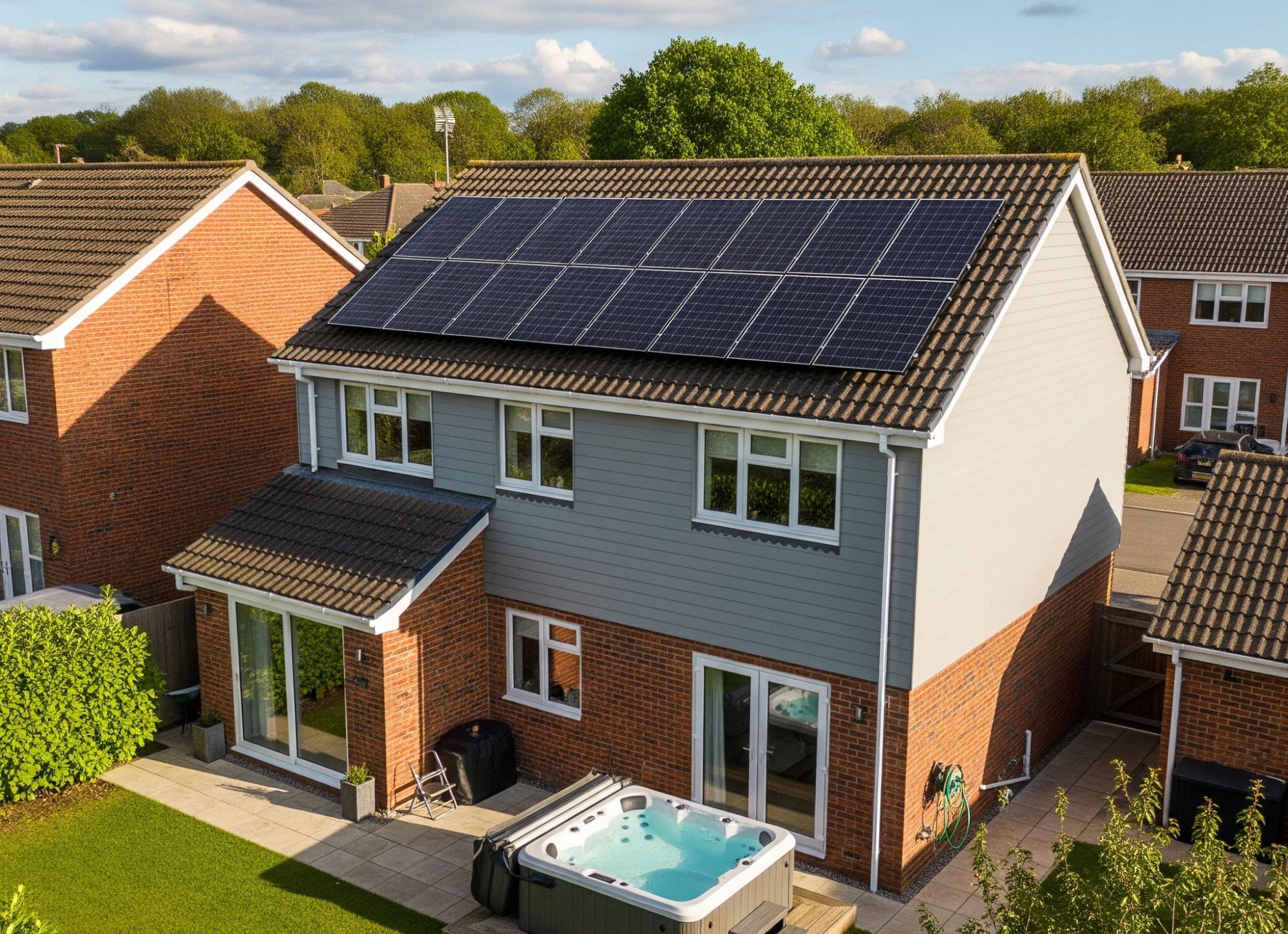
How Many Solar Panels Needed To Run A Hot Tub?
Hot tubs are a luxurious and energy-intensive addition to UK homes and commercial properties alike. Whether you’re a homeowner seeking lower energy bills or a business like a spa or hotel looking to cut operational costs, many people are now exploring the feasibility of running a hot tub on solar power.
But how many solar panels do you actually need to rub a hot tub?
This guide breaks down the power demands of different-sized hot tubs and aligns those needs with solar panel system capacities. We’ll also explore seasonal variations, energy storage considerations, and costs.
By the end, you’ll know exactly what’s required and whether it’s a smart investment for your property.
How Many Solar Panels Do You Need to Run a Hot Tub?
An average residential hot tub in the UK typically uses around 4 kWh of electricity per day. To generate this much energy, you would need approximately 3 standard 400W solar panels, assuming an average of 3.5 peak sun hours per day in the UK.
The exact number of solar panels required depends on the size of the hot tub, its usage patterns, your location in the UK, and the efficiency of your solar panel system.
Solar Panel Requirements by Hot Tub Size
| Hot Tub Size | Avg. Daily Power Consumption | Solar Panel Output (Per Panel/Day) | Panels Required | Typical Panel Wattage | Avg. Cost per Panel (Installed) |
|---|---|---|---|---|---|
| 2–3 person (Small) | 1.5 – 2.5 kWh | ~1.1 kWh | 2 – 3 | 400W | £400 – £500 |
| 4–5 person (Medium) | 3.5 – 5 kWh | ~1.1 kWh | 4 – 5 | 400W | £400 – £500 |
| 6+ person (Large) | 6 – 7.5 kWh | ~1.1 kWh | 6 – 7 | 400W | £400 – £500 |
Estimates based on UK irradiance levels and standard 400W panels. Solar output varies seasonally.
According to Ofgem, solar panels in the UK typically produce around 3.4 to 4.5 kWh per day during peak summer months, but this output can fall to as low as 0.9 to 1.5 kWh per day in winter due to reduced sunlight and weather conditions.
Looking to power your hot tub with solar? EE Renewables provides expert residential solar solutions across Southern England, Greater London, the South West, and South Wales. Request a free quote tailored to your location.
How Many Solar Panels are Needed for Commercial Hot Tubs?
For commercial properties like spas, hotels, or leisure centres, it’s common to operate 3 to 5 hot tubs daily, with each consuming around 10 kWh depending on their size and usage.
This means commercial setups can require anywhere from 22 to 36 solar panels to fully power their hot tubs via solar energy.
Commercial setups typically operate multiple hot tubs or hydrotherapy units throughout the day.
Solar Panel Requirements for Commercial Properties Running Hot Tubs
| Property Type | No. of Hot Tubs | Daily Energy Usage (kWh) | Panel Output (Daily) | Panels Required | Typical Panel Wattage | Avg. Cost per Panel (Installed) |
|---|---|---|---|---|---|---|
| Small Spa | 2 | ~10 kWh | ~1.1 kWh | 9 – 10 | 400W – 450W | £450 – £600 |
| Hotel (Medium) | 3 – 4 | ~15 – 20 kWh | ~1.1 kWh | 14 – 18 | 400W – 450W | £450 – £600 |
| Wellness Resort | 5 – 6 | ~25 – 35 kWh | ~1.1 kWh | 23 – 32 | 450W (Recommended) | £500 – £650 |
Commercial buildings also benefit from:
- Lower cost-per-watt for bulk installations.
- Opportunities for government-backed financing or grants.
- VAT relief for eligible energy efficiency upgrades.
EE Renewables provides professional solar panel installation for commercial properties across Southern England and Wales.
Whether you’re running a boutique spa or a full-scale wellness resort, our team can help you design and install a tailored system to meet your hot tub energy demands. Request a free solar quote today.
How to Calculate the Number of Solar Panels Needed to Power a Hot Tub
To calculate the number of solar panels required to power a hot tub, you need to know three key things:
- Daily energy consumption of your hot tub (kWh)
- Average daily output of one solar panel (kWh/day)
- Location-based sunlight hours (peak sun hours)
Step-by-Step Calculation:
- Determine your hot tub’s average daily energy usage.
- Small (2–3 person): ~2 kWh/day
- Medium (4–5 person): ~4 kWh/day
- Large (6+ person): ~6–7.5 kWh/day
- Commercial (per tub): ~10–15 kWh/day
- Small (2–3 person): ~2 kWh/day
- Find your region’s average peak sun hours.
- Southern England: 3.5 – 4.5 hours/day
- Midlands: 3 – 4 hours/day
- Northern UK: 2.5 – 3.5 hours/day
(Source: Solar Energy UK)
- Southern England: 3.5 – 4.5 hours/day
- Estimate the daily output per panel.
- A 400W panel in the UK typically generates ~1.1 kWh/day
- A 400W panel in the UK typically generates ~1.1 kWh/day
- Apply the formula:
Daily hot tub usage (kWh) ÷ Panel output (kWh/day) = Number of panels needed
Example Calculation (Medium 4–5 Person Hot Tub in Southern England)
- Daily Usage: 4 kWh
- Panel Output: 1.1 kWh/day
- 4 ÷ 1.1 = 3.63 panels
You’ll need approximately 4 x 400W solar panels to power a medium-sized hot tub.
Commercial Example (Hotel with 3 Hot Tubs)
- Daily Usage: 3 hot tubs × 12 kWh = 36 kWh/day
- Panel Output: 1.1 kWh/day per panel
- 36 ÷ 1.1 = ~33 panels
A commercial property with 3 actively used hot tubs would require around 33 high-efficiency panels, especially if operating year-round.
Calculating accurately ensures your solar system is efficient, cost-effective, and tailored to your property’s real energy needs. If you’re unsure about your tub’s actual energy use, your installer can help by reviewing your current electricity bills or checking appliance specs.
For personalised calculations and system design, request for a free, location-specific solar quote from EE Renewables.
What Factors Affect the Number of Solar Panels You Need to Power a Hot?
Several key factors can influence your actual solar panel requirements:
1. Hot Tub Usage
The frequency of use and water temperature settings play a major role in how much electricity your hot tub consumes.
A tub that’s used daily, or kept at a consistently high temperature (e.g. 39–40°C), will require significantly more energy than one used occasionally or kept at a moderate heat.
- Residential setups: Typically used in the evenings and weekends. Insulation and energy-efficient covers can reduce heat loss and power consumption.
- Commercial properties like spas, hotels, and wellness retreats often operate hot tubs for 10–12+ hours per day, leading to higher consumption. Larger volumes of water and frequent guest use increase heating and filtration needs.
For commercial sites, backup heating may also be used to meet demand during peak hours, and energy usage must be carefully assessed before sizing a solar system.
2. Location in the UK
Your property’s geographical location significantly impacts solar panel efficiency. Solar irradiance (sunlight energy) is stronger in the south than in northern parts of the UK. For example:
- Southern England (e.g. London, Brighton, Southampton): ~4.0 – 4.5 peak sun hours/day
- Midlands & South Wales (e.g. Cardiff, Birmingham): ~3.5 – 4.0 hours/day
- Northern England & Scotland (e.g. Leeds, Glasgow): ~2.5 – 3.5 hours/day
These differences can affect how many panels you need to meet your hot tub’s energy demands. You can view regional solar irradiance data using Ofgem’s regional maps and tools, which provide reliable data for system planning.
3. Seasonal Variation
Solar panel performance in the UK is highly seasonal. During summer months (May to August), systems can generate up to 70–90% of total annual output.
However, in winter (November to January), generation may drop by as much as 80% due to reduced daylight and cloud cover.
To address seasonal variability:
- Consider installing a solar battery (e.g. GivEnergy or Tesla Powerwall) to store summer excess for later use
- Use an energy-efficient hot tub cover and set the temperature lower during periods of low use
- Understand that off-grid performance may be unrealistic in winter without grid support or backup heating
Even with a large system, most UK homes will still need some grid input during the darkest months unless energy use is carefully managed.
4. Panel Efficiency
Not all solar panels are created equal. Panel efficiency refers to the percentage of sunlight that a panel can convert into usable electricity.
- Standard efficiency panels (18–20%) are widely used for residential properties
- High-efficiency panels (up to 22–23%) from brands like SunPower or REC offer better output, especially in limited space scenarios
Investing in premium panels means:
- Fewer panels needed for the same energy output
- Better performance in low light conditions, which is especially helpful in the UK climate
- Higher upfront cost, but potentially faster ROI, particularly for those with space limitations or higher energy usage
5. Roof Space or Ground Mount Options
Available installation space is one of the biggest practical factors in solar planning:
- Residential properties often rely on south-facing roofs, which may only accommodate 6–12 panels (depending on pitch and obstructions like chimneys).
- Commercial sites often have the luxury of flat roofs or surrounding land, making them ideal for ground-mounted solar systems, which can be tilted and oriented for maximum efficiency.
Ground-mounted systems:
- Are easier to clean and maintain
- Offer superior airflow, improving panel performance
- Can be installed with adjustable tilt mechanisms for seasonal optimisation
If space is tight, a smaller number of high-efficiency panels and a solar battery can still make a meaningful impact.
Can Solar Panels Fully Power a Hot Tub?
Yes, solar panels can fully power a hot tub, particularly during the spring and summer months in the UK when solar generation is at its peak.
However, powering a hot tub year-round using only solar energy is more complex and typically not feasible without a solar battery or some grid support.
This is especially important for high-demand months (October–February) when reduced daylight hours and poor weather can reduce your system’s output by up to 80%.
Ensuring Year-Round Reliability
To maintain uninterrupted operation of your hot tub:
- Install a slightly oversized solar system – Aim for 20–25% more capacity than your estimated daily usage to compensate for seasonal fluctuations and system losses.
- Use a high-performance solar battery – This stores excess energy generated during the day for evening use or backup during cloudy periods.
- Keep your hot tub well insulated – A good quality thermal cover and energy-efficient pump/heater can reduce energy demand significantly.
According to Solar Energy UK, adding battery storage can boost on-site solar consumption by up to 70%, reducing reliance on the grid and improving return on investment. This makes battery pairing especially valuable for energy-intensive equipment like hot tubs.
Battery Size Needed For Residential Hot Tubs:
| Hot Tub Size | Daily Energy Use | Recommended Battery Size | Typical Battery Cost (Installed) |
|---|---|---|---|
| Small (2–3 person) | 2 – 3 kWh | 5 kWh | £3,500 – £5,000 |
| Medium (4–5 person) | 4 – 5 kWh | 7 – 10 kWh | £5,500 – £8,000 |
| Large (6+ person) | 6 – 7.5 kWh | 10 – 12 kWh | £7,000 – £10,000 |
Popular UK brands like GivEnergy, Tesla Powerwall, and Pylontech offer scalable battery solutions, compatible with most home solar systems.
Battery Size Needed For Commercial Properties with Hot Tubs:
| Commercial Use Case | Est. Daily Use | Recommended Battery Size | Est. Installed Cost |
|---|---|---|---|
| Small Spa (2 tubs) | 10 – 12 kWh | 15 – 20 kWh | £12,000 – £18,000 |
| Hotel (3–4 tubs) | 15 – 20 kWh | 25 – 30 kWh | £18,000 – £25,000 |
| Wellness Resort (5+ tubs) | 30 – 45+ kWh | 40 – 60+ kWh | £30,000 – £50,000+ |
Commercial batteries are often modular and scalable, meaning systems can be expanded as energy needs grow. Larger commercial installations may also benefit from tax incentives, VAT exemptions, and potential SEG (Smart Export Guarantee) payments for surplus energy exported to the grid.
Hybrid Systems: The Best of Both Worlds
For most UK households and businesses, a hybrid solar system, one that uses solar panels, a battery, and limited grid input offers the best balance of cost, reliability, and sustainability.
- In summer, your system may power the hot tub entirely off-grid.
- In winter, it can draw minimal supplemental energy from the grid.
- With smart monitoring, you can track generation, storage, and consumption to optimise use.
Insights: If you’re also considering heating your pool with solar energy, our guide on using solar panels to heat a swimming pool provides an in-depth look at system sizing, installation tips, and seasonal performance.
Is it Financially Worth it to Power a Hot Tub with Solar?
Yes, powering a hot tub with solar energy can be financially beneficial, especially over the long term.
While the initial investment in solar panels and battery storage can be substantial, the ongoing savings on electricity bills and increased energy independence make it a worthwhile option for both homeowners and commercial operators.
Annual Savings for Homeowners
Running a hot tub on mains electricity in the UK can cost £350–£700+ per year, depending on size, insulation, usage, and tariff.
According to the Energy Saving Trust, households using solar panels can save up to £650 annually on electricity costs, meaning that for many hot tub owners, solar could completely offset operational costs.
Additional benefits include:
- Reduced exposure to energy price volatility
- Faster return on investment (ROI) when hot tub usage is high
- Potential to sell excess electricity back to the grid via the Smart Export Guarantee (SEG)
Commercial ROI: Even More Compelling
For commercial properties like spas, hotels, leisure centres, and wellness retreats, the savings scale quickly. A hotel with four hot tubs might spend £3,000–£5,000 per year on electricity just for water heating and pump operation.
Offsetting even 50–70% of that with solar can lead to thousands of pounds saved annually, and significantly improve the business’s sustainability credentials.
- Solar enhances brand image among eco-conscious consumers
- Reduced operational costs free up capital for reinvestment
- Systems can be claimed as capital expenditure, with tax advantages available
Payback Period and Long-Term Value
The payback period for a residential solar system powering a hot tub is typically between 6 and 10 years, depending on system size, sunlight availability, and electricity usage. With commercial systems, ROI can be achieved even faster due to higher baseline energy consumption.
Beyond financial savings, investing in solar:
- Future-proofs your property against rising energy costs
- Increases property value and EPC ratings
- Enhances energy security during grid outages or price spikes
Government Grants and Financial Incentives for Solar Panels
The UK government has made efforts to incentivise renewable energy adoption:
- 0% VAT on domestic solar installations (since April 2022): This reduces installation costs by up to 20% for homeowners.
- ECO4 scheme: While mainly targeted at low-income households and insulation measures, this scheme may indirectly support solar installs as part of a broader energy-efficiency package.
- Smart Export Guarantee (SEG): Earn money for any unused electricity exported to the grid. Rates vary by supplier.
FAQs
Can I use solar panels just for my hot tub and not the rest of my home?
Yes, but it’s usually more cost-effective to power multiple appliances. A dedicated system for a hot tub is possible but may lead to underutilised capacity during low-use periods.
Do inflatable hot tubs use less power and therefore need fewer panels?
While they use slightly less energy initially, they lack proper insulation and tend to lose heat faster. Over time, they may consume just as much or more electricity.
Can I claim any grants for solar panels to power my hot tub?
You may qualify for grants under schemes like ECO4 if you combine solar with other energy efficiency measures. Always check with your local authority or EE Renewables.
Will I need planning permission to install solar panels?
Most residential solar panel installations are considered permitted development. However, commercial installations or listed properties may require consent.
How does weather impact solar performance for hot tubs?
Cloudy days reduce energy generation, particularly in winter. Solar batteries and hybrid setups can help balance out energy usage during periods of low sunlight.
Our Verdict
Running your hot tub with solar panels is entirely possible in the UK, both for residential and commercial use.
With the right number of panels, efficient battery storage, and a well-designed system, you can enjoy the relaxing benefits of a hot tub while lowering your carbon footprint and electricity bills.
Whether you’re a homeowner or a business owner, it pays to invest wisely. Reach out to EE Renewables today to get a tailored solar quote and see how much you could save. Serving Southern England, Greater London, the South West, and South Wales, we’re your trusted local solar experts.
