


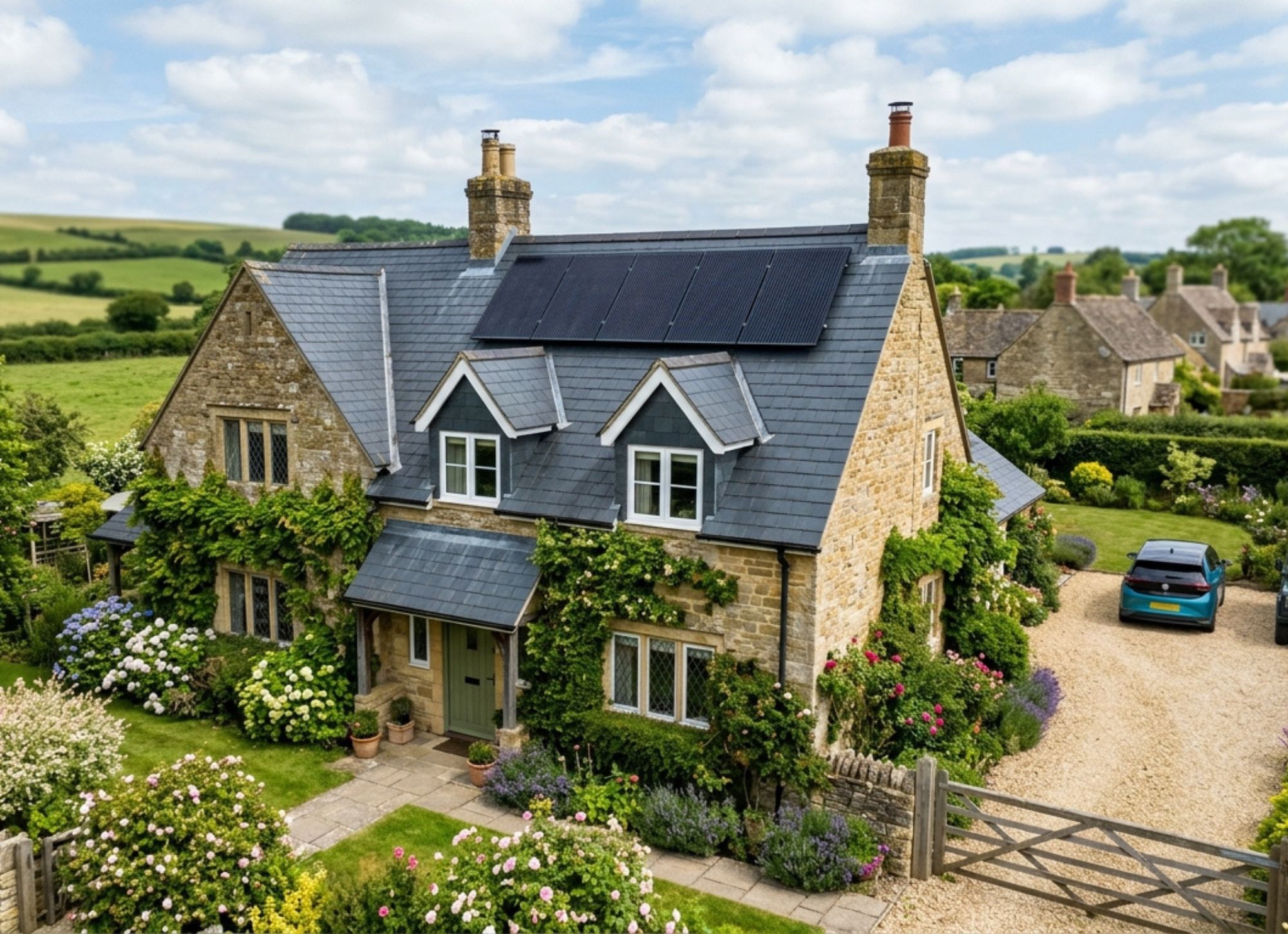
5kW Solar Panel Systems In The UK: Costs, Output, Pros and Cons
A 5kW solar panel system costs around £6,500 to £8,500 in the UK, fully installed with 0% VAT, and most homes pay £7,000 to £8,000. It uses 11 to 13 panels and, across Southern England and South Wales, typically produces 4,400 to 5,500 kWh of electricity a year. That can save roughly £550 to £950 a year, or £1,000 to £1,250 with a battery.
5kW solar panel systems have become the go-to size for many UK families. Panels are cheaper and more powerful than they were a few years ago, so for not much more than a 4kW system you get a noticeably bigger slice of free electricity. That matters if you’re running an electric car, working from home or thinking about a heat pump.
There’s one catch many guides skip over: at 5kW, you’ll need to decide between a smaller inverter with quick grid sign-off, or a full-size inverter that needs approval first. In this guide we’ll explain that choice, along with honest costs, real output figures for our part of the country, realistic savings, and the pros and cons, for homeowners and landlords across Southern England, Greater London, South West England and South Wales.
What can you expect from a 5kW solar panel system in the UK?
From a 5kW solar panel system in the UK, you can expect 11 to 13 panels producing around 4,400 to 5,500 kWh a year in our region, for an installed cost of £6,500 to £8,500. It suits three to five bedroom homes with average to high electricity use.
| What you need to know | A typical 5kW system |
|---|---|
| Installed cost (0% VAT) | £6,500 to £8,500 |
| Cost with a 10 kWh battery | £10,000 to £13,500 |
| Number of panels | 11 to 13 |
| Roof space | About 26 to 32 m² of usable roof |
| Yearly output (South and South Wales) | 4,400 to 5,500 kWh |
| Average daily output | About 13 kWh (around 21 kWh in June, 4 to 5 kWh in December) |
| Typical yearly savings | £550 to £950 without a battery |
| Typical payback | 8 to 14 years |
| Grid approval | G98 with a 3.6 kW inverter, or G99 with a 5 kW inverter |
| Panel lifespan | 25 to 30 years or more |
| Carbon saved | Roughly 0.7 to 1 tonne of CO2 a year |
What “5kW” means
The 5kW rating, sometimes written as 5kWp, is the system’s peak power, the most it can produce at any one moment in ideal test conditions. It doesn’t tell you how much electricity you’ll get over a year. That depends on your location, roof direction, pitch and shading, which is why the same system produces more in Brighton than in Manchester.
The average new home solar system in the UK is now close to 5kW, so this is very much the mainstream choice today.
Wondering what a 5kW system could produce on your roof? EE Renewables provides expert solar panel installation across Southern England, Greater London, South West England, and South Wales, including areas like London, Brighton, Oxford, Southampton, Bristol, and Cardiff. Use our online tool to get your free solar panel installation quote.
How much does a 5kW solar panel system cost?
A 5kW solar panel system costs around £6,500 to £8,500 to buy and install in the UK in 2026, with most homes paying £7,000 to £8,000. Adding a 10 kWh battery at the same time typically brings the total to £10,000 to £13,500.
| System | Typical installed price (0% VAT) |
| 5kW solar panels only | £6,500 to £8,500 |
| 5kW solar plus a 5 kWh battery | £9,500 to £11,500 |
| 5kW solar plus a 10 kWh battery | £10,000 to £13,500 |
| 5kW solar plus a Tesla Powerwall 3 | £13,000 to £17,000 |
These are approximate prices based on typical quotes in our region. We’ll confirm your exact price after a survey.
Where your money goes when investing in a 5kW solar panel system
| Part of the job | Rough cost |
|---|---|
| Solar panels (11 to 13) | £2,200 to £3,000 |
| Inverter | £800 to £1,500 |
| Roof mounting and fixings | £450 to £700 |
| Electrical work, cabling and generation meter | £600 to £900 |
| Scaffolding | £400 to £1,000 |
| Design, labour, MCS registration and grid paperwork | £1,100 to £1,700 |
Why 5kW is often better value than 4kW
Scaffolding, labour and paperwork cost much the same whether you fit 9 panels or 12. That means the extra three or so panels on a 5kW system usually add only £700 to £1,000 to the price, for roughly 25% more electricity. If your roof has the space, going from 4kW to 5kW is often one of the best value upgrades you can make.
What pushes the price up on 5kW solar panel systems
Slate roofs, tall or hard-to-reach houses, London scaffolding licences, pigeon mesh, premium all-black panels, optimisers for shaded roofs and an older fuse board can all add to your quote. A good installer will list each item separately.
Be wary of very cheap quotes
A quote well below these ranges usually means lower wattage panels, a budget inverter or missing extras such as scaffolding. Compare quotes line by line and make sure each includes MCS certification and grid paperwork.
How much electricity does a 5kW solar panel system produce?
A 5kW solar panel system produces around 4,400 to 5,500 kWh of electricity a year across Southern England and South Wales. The UK-wide average is closer to 4,250 kWh, because northern areas get less sun.
Approximate yearly output from a south-facing 5kW system with no shading:
| Area | Approximate yearly output (5kW system) |
|---|---|
| Greater London | 4,500 to 5,000 kWh |
| Brighton, Southampton and the South Coast | 4,900 to 5,400 kWh |
| Oxford and the Thames Valley | 4,500 to 5,000 kWh |
| Bristol, Somerset, Devon and Cornwall | 4,750 to 5,500 kWh |
| Cardiff and South Wales | 4,400 to 5,000 kWh |
Your installer must give you an MCS output estimate. It’s deliberately cautious, so many homes beat it.
5kW solar panel system output month by month
Here’s roughly what a south-facing 5kW system in the South of England produces through the year:
| Month | Approximate monthly output | Average per day |
|---|---|---|
| January | 165 kWh | 5 kWh |
| February | 240 kWh | 9 kWh |
| March | 400 kWh | 13 kWh |
| April | 540 kWh | 18 kWh |
| May | 625 kWh | 20 kWh |
| June | 640 kWh | 21 kWh |
| July | 640 kWh | 21 kWh |
| August | 550 kWh | 18 kWh |
| September | 425 kWh | 14 kWh |
| October | 300 kWh | 10 kWh |
| November | 190 kWh | 6 kWh |
| December | 140 kWh | 4.5 kWh |
| Year | About 4,855 kWh | About 13 kWh |
On a clear summer day, a 5kW system can produce 25 kWh or more, while a dull December day might give you just 2 or 3 kWh. Around 70% of the year’s output arrives between April and September.
How roof direction affects the output of a 5kW solar panel system
| Roof direction | Share of best possible output | Approximate yearly output (5kW) |
|---|---|---|
| South | 100% | 4,850 kWh |
| South-east or south-west | About 95% | 4,600 kWh |
| East or west | About 80 to 85% | 3,900 to 4,100 kWh |
| North-east or north-west | About 65 to 70% | 3,150 to 3,400 kWh |
On an east-west roof, splitting panels across both sides is common for 5kW systems, because one side alone often isn’t big enough. It spreads your generation across the morning and evening, which suits many working households.
Shading and pitch
A pitch of around 30° to 40° is ideal, though most UK roofs are close enough. Shade matters more: a chimney or tree shading even part of the array can drag down output. Optimisers or microinverters help panels work independently, so one shaded panel doesn’t hold back the rest.
How many panels and how much roof space does a 5kW system need?
A 5kW system needs 11 to 13 modern solar panels, which cover roughly 21 to 25 m² of roof. Allowing for the gaps installers leave around the edges, you’ll want about 26 to 32 m² of usable, unshaded roof.
| Panel size | Panels needed | System size | Panel area |
|---|---|---|---|
| 400W | 13 | 5.2 kW | About 25 m² |
| 430W | 12 | 5.16 kW | About 23 m² |
| 450W | 11 | 4.95 kW | About 21 m² |
| 500W | 10 | 5.0 kW | About 20 to 22 m² |
Most panels we fit today are monocrystalline, rated around 430W to 470W with efficiencies of about 21% to 23%.
Why roof space figures online vary
You’ll see anything from 20 m² to nearly 40 m² quoted. Lower figures count just the panels, while higher ones add generous margins. Installers keep panels back from roof edges and ridges for wind safety, so the usable roof you need is always a bit bigger than the panels.
Weight
Each panel weighs around 20 to 25 kg, so a 5kW array adds roughly 220 to 300 kg spread across the whole roof. Most UK roofs cope with this easily. Your surveyor will check the roof and timbers, and if your roof needs replacing soon, it’s worth doing that first.
Smaller and awkward roofs
On terraced houses in London, Brighton and Bristol, a single roof slope often won’t take 12 panels. We may split the array between front and back, use higher wattage panels, or suggest a 4kW system instead. Flat roofs need extra space, because panels on tilted frames have to be spaced out so they don’t shade each other.
What size inverter does a 5kW solar panel system need?
A 5kW solar panel system usually needs either a 3.6 kW inverter or a 5 kW inverter. The smaller one keeps you under the limit for quick grid sign-off, while the larger one captures a little more electricity but needs approval from your network operator before installation.
| 3.6 kW inverter | 5 kW inverter | |
|---|---|---|
| Grid process | G98: fit first, notify within 28 days | G99: apply and get approval first |
| Typical wait | None | Several weeks, sometimes two to three months |
| Electricity lost on sunny peaks | Typically a few percent a year | Very little |
| Best for | Most homes wanting a quick, simple install | Homes planning a battery, EV or future expansion |
Why a smaller inverter still works well
In UK conditions, panels rarely produce their full rated power. A 3.6 kW inverter on 5kW of panels only “clips” output on the brightest summer middays. The rest of the time, all 5kW of panels feed the inverter, so you still get far more electricity over a year than a smaller array would give. For many homes, the small loss is worth avoiding the wait.
When G99 makes sense
If you’re adding a battery, the total inverter capacity in your home usually counts towards the limit, so a G99 application is often needed anyway. In that case, a 5 kW hybrid inverter that runs both panels and battery is usually the neatest option. Most G99 applications are approved, sometimes with a limit on how much you can export at once.
Your local network operator
Which network operator handles your application depends on where you live:
- UK Power Networks: London, Brighton and much of the South East
- SSEN: Oxford, Southampton and central Southern England
- National Grid Electricity Distribution: Bristol, the South West, Cardiff and South Wales
We handle the paperwork for you, whichever route your system needs.
What can a 5kW solar panel system run?
A 5kW solar panel system can run almost everything in a typical family home on a sunny day, producing around 13 kWh on an average day and 20 kWh or more in summer. Over a year it generates well above the roughly 2,700 kWh a typical UK home uses, leaving plenty over for an EV or to export.
A sunny summer day’s use
Here’s what 20 kWh of solar could cover on a bright day:
| Appliance | Typical use | Approximate electricity used |
|---|---|---|
| Washing machine | Two 40°C washes | 1.6 kWh |
| Dishwasher | One eco cycle | 1 kWh |
| Tumble dryer | One load | 2.5 kWh |
| Electric oven | One hour | 1.5 kWh |
| Electric shower | Two 8-minute showers | 2.5 kWh |
| Fridge freezer | Running all day | 0.8 kWh |
| Home office (laptop, monitor, broadband) | Eight hours | 1 kWh |
| TV, lighting and kettle | Through the day | 1.5 kWh |
| EV charging | About 25 miles of driving | 7 kWh |
| Total | About 19.4 kWh |
The key is timing. Your panels produce most between about 10am and 4pm, so running appliances and charging the car during the day gets the most out of them.
Electric cars
A typical EV covering around 7,500 miles a year uses roughly 2,000 to 2,500 kWh. A 5kW system can cover a good share of that from spring to autumn if the car is at home in the day. A solar-aware charger, such as a myenergi zappi, automatically tops up the car with spare solar instead of exporting it at a lower rate.
Heat pumps
A heat pump in a typical home uses around 3,000 to 4,500 kWh a year, mostly in winter when solar output is lowest. A 5kW system helps, particularly with hot water in summer, but won’t cover much of your winter heating. Pairing panels with a battery and a cheap overnight tariff is usually the best way to cut heat pump running costs.
How much can a 5kW solar panel system save you?
A 5kW solar panel system can save you around £550 to £950 a year without a battery, combining bill savings and export payments. With a battery and a smart tariff, that typically rises to £1,000 to £1,250, and higher still if you charge an electric car.
A realistic example
Take a south-facing 5kW system in the South producing 4,850 kWh a year, in a home using 3,500 kWh:
- Solar used at home: about 1,700 kWh (35%), saving roughly £440 at around 26p per kWh.
- Solar exported: about 3,150 kWh. At 12p per kWh that’s about £380, or around £160 at a basic 5p rate.
- Total: roughly £600 to £820 a year.
If someone’s home during the day, you’ll use more solar directly and save more. With a battery, self-use typically climbs to 60% to 80%.
Export payments
Because a 5kW system produces more than most homes use in summer, your export tariff matters. Under the Smart Export Guarantee, larger suppliers must offer you a rate, ranging from a few pence to around 15p per kWh on fixed tariffs, with time-of-use tariffs paying more at peak times. You can pick an export tariff from a different supplier to the one you buy from.
Payback period for a 5kW solar panel system
| Scenario | Typical cost | Yearly savings | Rough payback |
|---|---|---|---|
| Solar only, little daytime use, basic export rate | £7,500 | £550 to £650 | 11 to 14 years |
| Solar only, home in the day, good export rate | £7,500 | £800 to £950 | 8 to 9 years |
| Solar plus a 10 kWh battery on a smart tariff | £11,500 | £1,000 to £1,250 | 9 to 12 years |
| Solar, battery and an EV on a smart tariff | £11,500 | £1,300 to £1,700 | 7 to 9 years |
Over 25 years, a 5kW system could save you roughly £12,000 to £22,000 at today’s prices, even after allowing for a replacement inverter.
What size battery should you pair with a 5kW solar panel system?
The battery you should pair with a 5kW solar panel system is usually around 5 to 10 kWh for most homes, rising to 13 kWh or more if you have an electric car or high evening use. Size it to how much electricity you use after dark, not just to your panels.
| Household | Battery size to consider | Why |
|---|---|---|
| Smaller home, modest evening use | 5 to 7 kWh | Covers evening basics at a lower cost |
| Three to four bed family home | About 10 kWh | The most common pairing for 5kW |
| EV owner or high evening use | 13 to 16 kWh | Stores enough for the car and the house |
| Planning to grow | Modular, starting around 10 kWh | Add more storage later without starting again |
kW or kWh: the difference that trips people up
People often search for a “5kW battery”, but batteries are compared by kWh, not kW. The kWh figure is how much energy a battery stores, like the size of a fuel tank. The kW figure is how fast it can charge or discharge, which decides how many appliances it can run at once. Also check the usable capacity, which is usually 90% to 95% of the total.
What it costs
Fitted at the same time as your panels, a battery typically adds £3,000 to £5,500 for 5 to 10 kWh. That’s cheaper than adding one later, because a single hybrid inverter can run both, and you only pay for one installation. Brands we fit include Fox ESS and the Tesla Powerwall 3.
Why a battery works harder in winter
A modern battery doesn’t just store solar. On a smart tariff it can charge overnight at around 7p to 9p per kWh and power your home through the expensive evening. That keeps it earning its keep in winter, when your panels produce far less.
Is 5kW the right solar panel system size for your home?
A 5kW system is the right size for your home if you use roughly 3,000 to 5,000 kWh of electricity a year, or expect your usage to rise, and have room for 11 to 13 panels. That covers many three to five bedroom homes, especially those with an EV, a home office or plans for a heat pump.
| System size | Panels | Yearly output (South and South Wales) | Typical installed cost | Usually suits |
|---|---|---|---|---|
| 4kW | 8 to 10 | 3,500 to 4,400 kWh | £5,500 to £7,500 | Two to three bed homes, average usage |
| 5kW | 11 to 13 | 4,400 to 5,500 kWh | £6,500 to £8,500 | Three to five bed homes, higher usage |
| 6kW | 13 to 15 | 5,300 to 6,600 kWh | £7,500 to £9,500 | Larger homes, EVs and heat pumps |
| 8kW | 18 to 20 | 7,000 to 8,800 kWh | £9,500 to £12,500 | Big homes and all-electric households |
5kW vs 4kW
If your roof fits 12 panels and you use more than about 3,000 kWh a year, 5kW usually wins, because the extra panels cost relatively little. If you use less than 2,500 kWh a year and are out all day, a 4kW system may give a better return, since more of a 5kW system’s output would be exported at lower rates.
5kW vs 6kW
If you already have an EV and a heat pump, or run a business from home, a 6kW or 10kW system may suit you better. Just remember that anything above 5kW almost always needs G99 approval and more roof space.
Check your usage first
Your yearly electricity use in kWh is on your annual statement or supplier app. It’s the single most useful number to bring to a survey.
What are the pros and cons of a 5kW solar panel system?
The pros and cons of a 5kW solar panel system weigh strong output, better value per panel and room for an EV or battery against a higher upfront cost, more roof space and the extra step of grid approval with a full-size inverter.
| Pros | Cons |
|---|---|
| Produces around 4,400 to 5,500 kWh a year in the South | Upfront cost of £6,500 to £8,500 |
| Better value per panel than a 4kW system | Needs 26 to 32 m² of usable roof, too much for some terraces |
| Saves around £550 to £950 a year, or more with a battery | A 5 kW inverter needs G99 approval, which can take weeks |
| Enough surplus to help charge an EV | Output drops to 4 to 5 kWh a day in midwinter |
| Earns more in export payments than smaller systems | Without a battery, much of your solar is exported at lower rates |
| Panels last 25 to 30 years or more with little maintenance | The inverter usually needs replacing once in the system’s life |
| Cuts your carbon footprint by roughly 0.7 to 1 tonne a year | Planning consent may be needed on listed buildings and in some conservation areas |
| Pairs well with a 5 to 10 kWh battery | May be more than low-use homes need |
For most three to five bedroom homes with a decent roof, the pros comfortably outweigh the cons.
Are there any grants or schemes for a 5kW solar panel system?
There are no universal grants for a 5kW solar panel system, but 0% VAT, the Smart Export Guarantee and the Warm Homes Plan can all reduce what you pay or increase what you earn.
0% VAT until March 2027
Solar panels and batteries installed on homes in Great Britain currently carry 0% VAT. The relief is due to run until 31 March 2027, after which it’s set to rise to 5%. On a £7,500 system, that would add about £375.
The Smart Export Guarantee
The Smart Export Guarantee (SEG) pays you for electricity you send to the grid. Suppliers with at least 150,000 domestic customers must offer a tariff. It covers systems up to 5 MW, so any home system qualifies, despite what some websites say. You’ll need an MCS certificate and a smart meter that records exports. The older Feed-in Tariff closed to new applicants in 2019.
The Warm Homes Plan
The government’s Warm Homes Plan is rolling out support for home energy upgrades, including solar panels. It combines grants for lower income households with low or zero interest loans for others. The ECO4 scheme closed in March 2026, and in Wales the Warm Homes Nest scheme supports eligible lower income households, mainly with heating and insulation. Eligibility can change, so ask us what applies to you.
Council group buying schemes
Some councils across London and the South East run group buying schemes such as Solar Together, which can offer competitive prices. Check your council’s website, as offers open and close through the year.
Do you need planning permission for a 5kW solar panel system?
You don’t usually need planning permission for a 5kW solar panel system on a house, because roof-mounted solar is normally permitted development. The main exceptions are listed buildings, some conservation areas, flats and ground-mounted systems.
When permission may be needed
- Listed buildings: listed building consent is almost always required.
- Conservation areas: panels visible from the road face stricter rules, and some areas have extra controls. This is common in parts of Bath, Brighton, Oxford and central London.
- Flats: you’ll usually need the freeholder’s permission, and sometimes planning consent.
- Ground-mounted systems: these have their own size and position limits.
Rules in Wales are broadly similar to England but not identical, so we check the local position for every job.
Panels must not stick out too far
Under permitted development, roof panels shouldn’t project more than 20cm from the roof surface and shouldn’t sit higher than the highest part of the roof. Standard on-roof installations meet these limits comfortably.
In-roof panels
In-roof, or integrated, panels sit flush with the roof and replace some of the tiles. They look neater, which can help on sensitive properties, and make sense if you’re re-roofing or building an extension. They usually cost more than standard on-roof panels and are best planned alongside roof work.
Read our guide on in-roof vs on-roof solar panels.
How long does a 5kW solar panel system last?
A 5kW solar panel system lasts 25 to 30 years or more, with the inverter usually needing replacement once in that time. Panels gradually lose a little output each year rather than stopping suddenly.
Performance and product warranties
There are two different panel warranties, and it’s worth knowing which is which. A performance warranty, usually 25 to 30 years, guarantees the panels will still produce around 85% to 90% of their original output by the end.
A product warranty, usually 12 to 25 years, covers manufacturing faults. Most quality panels lose about 0.4% to 0.5% of their output a year.
Read our guide on the best solar panels on the market.
Inverter replacement
Inverters typically last 10 to 15 years, with warranties of around 5 to 12 years. Budget roughly £800 to £1,500 for a replacement. Hybrid inverters that also run a battery sit at the higher end.
Maintenance
UK rain keeps most panels clean enough. Homes near main roads, farmland or the coast may benefit from an occasional professional clean. Check your monitoring app every so often, so you can spot any unexpected drop in output early.
Is a 5kW solar panel system worth it?
A 5kW solar panel system is worth it for most UK homes with average to high electricity use and enough unshaded roof. In the South of England and South Wales, it typically pays for itself in 8 to 14 years and keeps producing for decades after.
It’s a great fit if you:
- Use around 3,000 to 5,000 kWh of electricity a year
- Have space for 11 to 13 panels on a south, east or west-facing roof
- Have, or are planning, an EV, a home office or a battery
- Plan to stay in your home for at least eight to ten years
Think carefully if you:
- Use under 2,500 kWh a year and are out all day, as a 4kW system may suit you better
- Have a small, shaded or north-facing roof
- Expect to move within a few years
Is a 5kW solar panel system worth it for landlords?
A 5kW solar panel system can be well worth it for landlords of larger family homes and HMOs, where electricity use is high and an EPC boost matters. Tenants usually get the bill savings, but you get a more attractive, future-ready property.
EPC ratings
Under government plans, privately rented homes in England will need to reach EPC band C by 2030. Solar panels are one of the most effective single upgrades for lifting an EPC score, and a 5kW system gives a bigger boost than a smaller one. Rules in Wales can differ, so check the latest position for Welsh properties.
Why 5kW suits HMOs and larger lets
Shared houses and larger family lets often use more electricity during the day, which means more of the solar gets used on site. That makes the savings more noticeable to tenants and strengthens your case for a modest rent premium.
Practical points
- Export payments: agree in writing who registers for and receives Smart Export Guarantee payments.
- Bills included: if you pay the bills in an HMO, you keep the savings directly, which can make payback much quicker.
- Flats and leasehold: check freeholder consent and planning rules before committing.
- Insurance and paperwork: tell your landlord insurer, and keep the MCS certificate with your property records.
Ready to get a free solar panel installation survey from EE Renewables?
EE Renewables provides expert solar panel installation across Southern England, Greater London, South West England, and South Wales, including areas like London, Brighton, Oxford, Southampton, Bristol, and Cardiff. Our online tool makes it easy to get a solar panel installation quote for your property within minutes.
Frequently Asked Questions
Can a 5kW solar panel system take a home off-grid?
A 5kW solar panel system can’t realistically take a typical UK home fully off-grid. Output in December is often a fifth of June’s, so you’d need a very large battery, a backup generator or another power source, and careful winter use. For most homes, staying connected with a battery and smart tariff gives far better value.
Do you need a three-phase supply for a 5kW solar panel system?
No, you don’t need a three-phase supply for a 5kW solar panel system. Almost all UK homes have a single-phase supply, which works perfectly well. The only difference is the grid process: an inverter above 3.68 kW on a single phase needs G99 approval before installation.
Can you add more panels to a 5kW system later?
Yes, you can add more panels to a 5kW system later, but it’s usually cheaper to fit them all at once. Extra panels may need a larger inverter, fresh scaffolding and an updated grid application. If you think your usage will grow, it’s often worth sizing up at the start.
What happens to a 5kW solar panel system if you sell your home?
If you sell your home, a 5kW solar panel system normally stays with the property and passes to the new owner. Give the buyer your MCS certificate, warranties and inverter details, and remind them to register for export payments. Owning the panels outright makes the sale much simpler than a roof lease arrangement.
Can a portable solar generator replace a 5kW rooftop system?
A portable solar generator can’t replace a 5kW rooftop system. Portable units are designed for camping, outdoor work and short power cuts, and typically store just 1 to 3 kWh. A 5kW rooftop system produces thousands of kWh a year, connects to your home’s wiring and earns export payments.
